You're looking at a blank card, a folder of family photos, and a deadline that's getting closer. Should you choose a funny message, write a long letter, print a favorite picture, or turn the card into a keepsake Grandma will save? The best birthday card ideas for Grandma don't start with a design trend. They start with the feeling you want her to have when she opens the envelope.
A photo collage can celebrate shared history. A letter can say what everyday calls leave unsaid. Custom artwork can represent a hobby or memory when the right photograph doesn't exist. Other designs can honor a milestone, preserve a family tradition, invite a deeper conversation, make her laugh, or support a cause she values.
Mail This can help turn approved wording and supplied photos or artwork into a physical card. Its preview-and-approval flow lets you review the final design, recipient, and total before purchase. The stated $9.99 price includes domestic postage, with applicable tax shown upfront. The important part is still yours: choose the memory, tone, and detail that sound like your family.
Table of Contents
- 1. Photo Collage Memory Card With AI Layout Design
- 2. Handwritten Letter-Style Card With AI Message Enhancement
- 3. Illustration-Based Card With Custom AI Artwork Generation
- 4. Milestone Achievement Celebration Card
- 5. Recipe or Family Tradition Card With Printed Card Back
- 6. Humor and Playful Roast Card With Witty AI Copy
- 7. Guided Gratitude and Reflection Card With Journaling Prompts
- 8. Cause-Based Donation Card With Charity Matching
- 8-Point Comparison of Birthday Card Ideas for Grandma
- Choose the Idea That Sounds Like Her
1. Photo Collage Memory Card With AI Layout Design
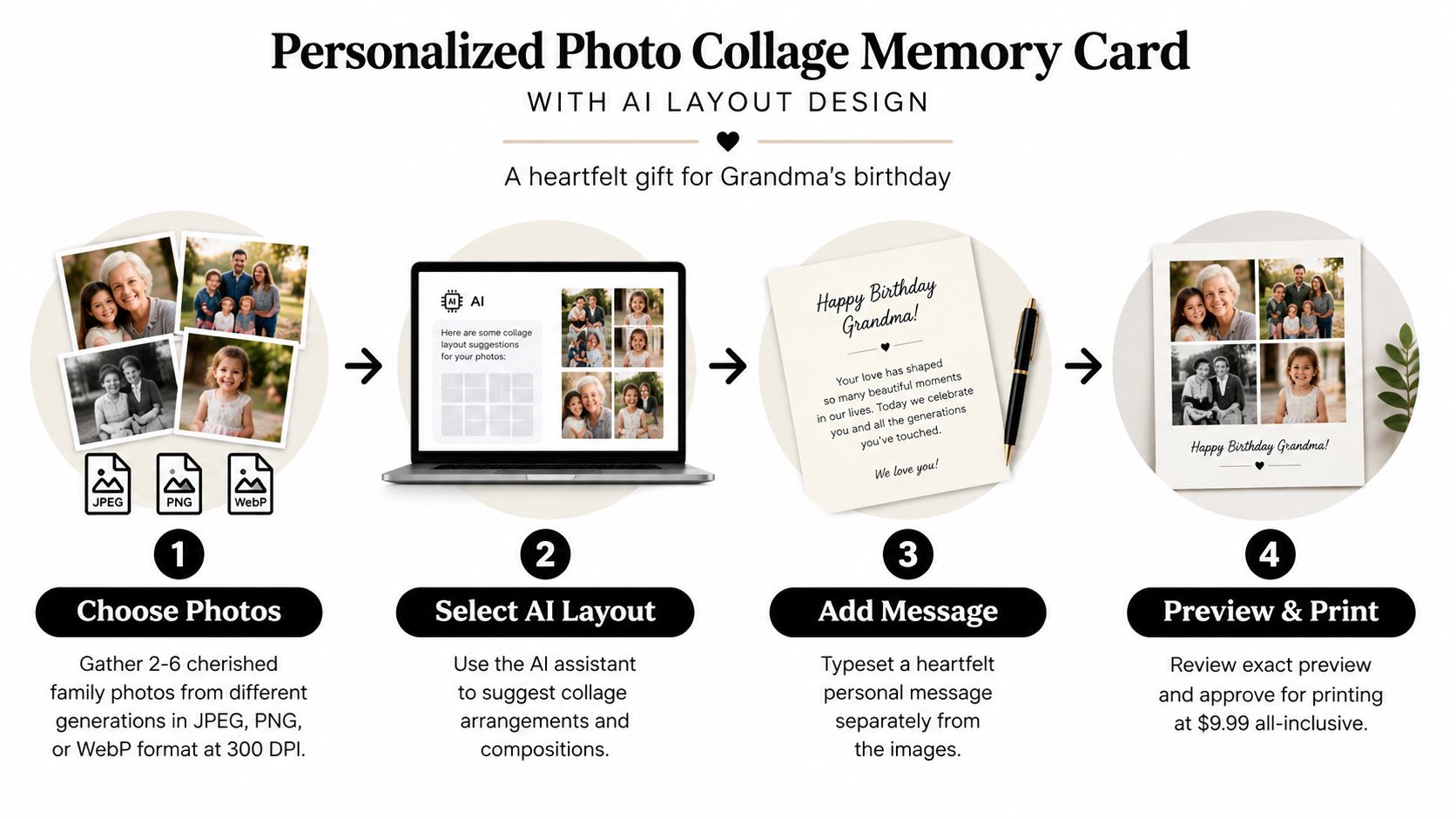
A photo collage works best for a grandmother who experiences love through family moments. Instead of asking one image to carry the whole message, combine photographs that show the people, places, and occasions she holds close. A grandchild's graduation, a family meal, a holiday gathering, or a quiet candid moment can create a visual story without requiring a long paragraph.
Choose images with a shared thread. You might show several generations, follow one family tradition through time, or gather recent moments from different grandchildren. A collage can also pair a childhood photograph of Grandma with a current family picture, creating a sense of continuity without making the card feel like a formal biography.
See the birthday camera card option if you want a starting point for a photo-led design. Mail This supports user-supplied JPEG, PNG, and WebP images, and its AI assistant can help suggest arrangements before you approve the final typesetting.
Make the pictures tell one story
Avoid treating the front of the card like a crowded album page. Select the photographs that carry the strongest emotional meaning, then use the message to explain why they belong together.
- Choose variety: Mix posed family portraits with natural moments, such as cooking, gardening, laughing, or sitting together.
- Add context: Write one sentence about what connects the images, such as a family trip, a shared celebration, or a tradition Grandma helped create.
- Check image quality: Use clear photographs with good lighting, and inspect faces and important details in the preview.
- Keep the cover calm: Let the images do most of the visual work, then place the personal message inside.
Practical rule: A smaller group of meaningful photographs usually says more than a crowded collection of loosely related images.
Try a message such as, “These moments all remind me how much warmth you bring to our family. Thank you for making every gathering feel special. Happy birthday, Grandma.” Before mailing, confirm that every person is identified correctly and that the final crop doesn't remove the detail that makes a photograph meaningful.
2. Handwritten Letter-Style Card With AI Message Enhancement
A grandmother who saves letters, rereads notes, or values thoughtful conversation may appreciate a card that feels like a short personal letter. It gives you space to express gratitude, recall a meaningful moment, and name something you learned from her. The format also suits relationships built through regular calls or messages. A physical note gives one carefully chosen thought a lasting place instead of letting it vanish into an ordinary conversation.
In a 2014 Pew Research Center survey, 64% of U.S. adults with at least one living grandparent said they were in touch at least monthly. Among those with regular contact, 92% used the telephone, while others used text messages, social media, email, or letters, as reported in Pew Research Center's survey of grandparent communication. The card can complement those conversations by preserving a feeling or memory you might not express during a quick call.
Begin with a detail only your family would recognize. It could be learning a family dish at her kitchen table, sitting with her during a difficult period, or hearing the same advice at different stages of your life. That detail is the thread holding the message together. Mail This's assistant can help arrange your ideas, but you should decide whether each sentence sounds like something you would naturally say.
A useful letter has four movements. Open with appreciation by naming what you value about Grandma now. Add one memory, choosing a specific scene, habit, phrase, or lesson rather than listing several examples. Connect it to the present by explaining how that moment still shapes your choices or understanding. Close with a wish for her birthday or the year ahead. This structure works like a path through a familiar house. It guides the reader from recognition to memory, then back to the relationship you share today.
A University of Waterloo study linked in research on grandparent and grandchild communication supports birthdays as an opportunity for personal written connection. You might write: “I still remember how you made room for me at the kitchen table and listened to every small story. You taught me that care often looks like patience and attention. I hope your birthday brings you the same comfort you've given our family.”
Read the draft aloud before approving it. Select a warm serif or script style only when every letter remains clear. Check the final preview for the exact wording, name, and signature, then use these birthday card writing ideas if you need help refining the message.
3. Illustration-Based Card With Custom AI Artwork Generation
A custom illustration gives you a way to represent Grandma without relying on a perfect photograph. It suits an artistic grandmother, someone with a strong hobby, or a family whose most meaningful memory is a place or activity rather than a single image. A garden, knitting basket, favorite reading chair, quilt pattern, or familiar holiday setting can all become visual symbols.
Describe the scene as if you're briefing an illustrator. Include the setting, mood, colors, objects, and style you want. “A grandmother in a garden” is a starting point. “A gentle watercolor scene of a woman with glasses sitting on a garden bench, surrounded by colorful flowers and greenery, with a basket of knitting beside her” gives the artwork more direction.
Mail This can use AI-generated artwork through its custom card flow. Explore custom card creation with Mail This when you want to describe an idea rather than begin with a supplied photograph.
Connect the illustration to a real memory
The artwork becomes more personal when the inside message explains its meaning. For example, a drawing of flowers might accompany, “Your garden taught me to notice small things and give them time to grow.” A whimsical illustration of Grandma as a superhero could say, “You've rescued us with snacks, advice, and perfectly timed phone calls for as long as I can remember.”
Generate an initial concept, then inspect the image for details that feel accurate and respectful. If the artwork includes a person, don't assume that a generic likeness will resemble Grandma. Symbolic art may be a better choice, especially when you want to celebrate her interests without making an artificial portrait the center of the card.
The preview matters here because generated artwork and approved wording serve different purposes. Mail This describes its process as separating message typesetting from generated image text, which helps keep the personal greeting clear and exact. Review the spelling of her name, the emotional tone, and whether the illustration supports the message rather than distracting from it.
A short message can work well with a detailed illustration. Try, “This little garden scene made me think of the patience, creativity, and joy you bring to everything you do. Happy birthday to our one-of-a-kind Grandma.”
4. Milestone Achievement Celebration Card
“Your years of caring for this family have given all of us a place to belong.” That message honors an achievement through its effect, not merely through an age or anniversary. A milestone card can recognize Grandma's career, marriage, creative work, home, family support, or role as a grandparent. Choose the chapter that best reflects what your relationship has experienced.
Grandparenthood is a widely shared family milestone in the United States. Two-thirds of adults aged 65 and older were grandparents in 2024, and the share rose from 27% among adults in their 50s to 74% among people aged 80 to 90, according to Pew Research Center's facts about grandparents. The figures belong in your planning, not necessarily on the card. They suggest why a personal message about Grandma's particular place in the family will feel more thoughtful than generic age-related wording.
Start with one verified detail. Confirm dates, job titles, anniversaries, and family timelines with relatives before printing. A mistaken year can distract from a loving message. Also ask whether Grandma enjoys public recognition. Someone who dislikes attention may prefer a quiet note about the difference she has made, rather than a grand announcement.
Build the message around its effect
Organize the wording like a short family story. Name the chapter she built, describe how her persistence or care shaped your life, then offer a wish for the next chapter. This structure works like a bridge between history and affection: the achievement provides the setting, while your experience gives it meaning.
For example: “Your years of caring for this family have given all of us a place to belong. I'm grateful for the patience and strength you've shown in every chapter. I hope this birthday opens a year filled with things you choose because they make you happy.”
A restrained timeline can suit Grandma if she values records and clear milestones. Use only approved dates, generous spacing, and one meaningful photograph or symbol. For a more private personality, place the timeline inside and let the front carry one warm phrase. Before mailing, show the finished card to a relative who can confirm names and dates. The design should celebrate Grandma as a whole person, not turn her into a list of years.
5. Recipe or Family Tradition Card With Printed Card Back
A recipe or tradition card turns Grandma's birthday greeting into a piece of family heritage. It suits someone whose love appears in shared meals, holiday rituals, sewing, quilting, gardening, music, storytelling, or the small routines that make relatives feel connected.
The front might feature a family recipe, a description of Sunday dinners, a quilt pattern, or photographs of a tradition in progress. The inside can hold the birthday message. If the card includes a recipe, make the words large and organized enough to read comfortably. If it records a tradition, explain what happens and why everyone remembers it.
Preserve the meaning, not just the instructions
A recipe without context can feel like a document. Add the story around it. Explain who made the dish, when the family ate it, what Grandma always said while preparing it, or how the tradition brought people together.
You could write, “This recipe is special because it never tasted like just dessert. It meant crowded kitchens, extra chairs, and you making sure everyone had a helping. Thank you for giving us memories we can return to. Happy birthday, Grandma.”
Ask family members to confirm ingredients, names, and dates before printing. If the recipe belongs to Grandma, invite her input when appropriate rather than presenting an inaccurate version as a finished record. The purpose isn't to claim perfect historical accuracy. It's to show that her knowledge and habits have shaped the family.
A family tradition card can also work for a more complicated relationship because it gives the message a specific, manageable focus. You don't have to claim lifelong closeness if that isn't true. You can say, “I've always appreciated the way you bring everyone together for holiday meals,” or, “I'm grateful for the recipe and the memories connected to it.”
Keep the design uncluttered. Use a familiar typeface, strong contrast, clear headings, and enough space around the text. A card that Grandma can read and keep will serve its purpose better than one packed with decorative details.
6. Humor and Playful Roast Card With Witty AI Copy
Humor belongs on a Grandma birthday card when it already belongs in your relationship. A playful roast can celebrate her distinctive habits, strong opinions, favorite phrases, or legendary ability to provide snacks. It shouldn't rely on stereotypes about older people or make her feel that the joke is at her expense.
The safest target is a familiar quirk that Grandma laughs about herself. You might tease her devotion to a particular television show, her habit of correcting everyone's grammar, or her insistence that nobody leaves the house hungry. If you're unsure whether she'd enjoy age-related humor, leave age out of it.
Use the joke as an opening, not the whole message
A funny front cover can lead into a sincere inside note. For example:
“Happy birthday to the woman who can solve every problem with food, practical advice, and a phone call at exactly the right moment. You make our family funnier, kinder, and better fed. We love you.”
The humor should sound like your family, not like a generic joke written for anyone's grandmother. An AI assistant can suggest wordplay or help soften a line, but you need to supply the family context. A joke about Grandma's remote control is only useful if she'll recognize the situation and enjoy being teased about it.
Read the complete message aloud. Written humor can sound sharper than spoken humor, especially when the recipient can't hear your expression. Remove anything related to grief, health, appearance, money, family conflict, memory loss, or another subject she may find painful.
For families with limited contact, a roast usually isn't the right choice unless you already share that style of banter. Warm, restrained wording may be more authentic. Guidance on birthday wishes for complicated grandmother relationships is useful when you want to avoid assuming a simple or uniformly affectionate family dynamic.
End with genuine appreciation. The card should leave Grandma feeling known and loved, not tested on whether she can take a joke.
7. Guided Gratitude and Reflection Card With Journaling Prompts
A blank card can leave a thoughtful grandmother unsure how to begin. A few gentle prompts give her a starting point while making space for the stories, values, and traditions your family may not discuss often. This design suits someone who enjoys writing, preserving photographs, telling stories, or reflecting on how the family has changed.
Choose prompts that feel like an invitation rather than an assignment. Ask about subjects you genuinely want to understand, such as a recipe, hometown, creative interest, family event, or tradition. The questions should leave room for a short answer, a long story, or a conversation later.
A small set is easier to welcome than a full questionnaire. You could print:
- A treasured memory: “Which family moment still makes you smile?”
- A piece of wisdom: “What's something you've learned that you'd like us to carry forward?”
- A continuing tradition: “Which tradition would you love to see the family keep?”
- A future connection: “What would you enjoy doing together this year?”
Pair the prompts with a birthday message that explains why her answers matter. For example:
“Happy birthday, Grandma. Your stories help us understand where our family comes from and what matters to us. I'd love to hear your thoughts whenever you feel like sharing them. There's no pressure, and your stories are already a gift to us.”
That wording also helps if Grandma was not a primary caregiver or if your relationship has changed over time. A specific, honest question creates connection without pretending to have a closeness that is not there. Keep the tone curious and respectful, especially if some family memories are complicated.
Give the printed prompts generous spacing. A clear typeface, left-aligned paragraphs, and distinct writing areas make the card easier to use. Research on older-adult readability found preferences for approximately 10.5 to 15-point type and 0.5 to 1.0-point letter spacing, as described in this systematic review of typography and older-adult readability. For the main greeting, 14 to 16-point type, generous line spacing, and a familiar font can keep the page comfortable without crowding the prompts.
Before mailing, read every question aloud and ask a family member who knows Grandma to review the tone. Their approval can catch wording that feels intrusive, overly formal, or unlike your relationship.
8. Cause-Based Donation Card With Charity Matching
A cause-based card is a good fit for a grandmother who measures gifts by the values behind them. Instead of adding another object to her home, you can make a donation in her honor and explain why you chose that organization. The card becomes a statement about what she has taught you to care about.
Start with Grandma's actual interests. A former teacher may appreciate literacy or education work. Someone who loves animals may respond to animal welfare. A nature-focused grandmother may value conservation. If her experiences have shaped a particular health concern, research organizations connected to that area with care and avoid making the card feel heavy.
Make the connection personal
The donation shouldn't appear as a detached announcement. Explain the link between the cause and Grandma's character:
“Because you've always believed that every child deserves access to books, we made a donation in your honor to support literacy. Your generosity has shaped the way our family thinks about helping others. Happy birthday, Grandma.”
Verify the organization's name, donation acknowledgment process, and any restrictions before you print the card. You can include the charity's website so Grandma can learn more, but don't imply that the organization has matched the gift or approved the wording unless you've confirmed that directly.
This format also works when Grandma prefers experiences, time, or charitable giving over traditional presents. The card can include a modest visual symbol, such as an open book, a bird, a tree, or a community garden, rather than a photograph of the organization's work. Keep the focus on Grandma's values, not on making the donation seem like a substitute for a personal relationship.
If several relatives are contributing, agree on the wording and cause before the card is designed. A shared message can show that the donation reflects a value she passed through the family. The final approval should still check the recipient name, charity name, destination, and total before mailing.
8-Point Comparison of Birthday Card Ideas for Grandma
| Card Type | Implementation Complexity 🔄 | Resource & Speed ⚡ | Expected Outcomes 📊⭐ | Ideal Use Cases 💡 | Key Advantages ⭐ |
|---|---|---|---|---|---|
| Photo Collage Memory Card with AI Layout Design | Moderate, upload 2–6 images, use AI layout suggestions, approve preview | Requires high‑resolution photos (300 DPI); moderate selection time; standard print turnaround | High emotional impact and visual keepsake; photo-forward storytelling | Showcasing multi‑generational memories; birthdays where photos tell the story | Deeply personal; AI reduces design effort; exact preview; all‑inclusive pricing |
| Handwritten Letter‑Style Card with AI Message Enhancement | Low–Moderate, AI crafts/refines longform text and typesets exactly | Minimal imagery; some time revising tone; faster than handwriting long letters | Strong perceived authenticity and sentimental value | Senders who struggle with phrasing; grandmothers who cherish words | Overcomes writer's block; professional typesetting; exact approved wording |
| Illustration‑Based Card with Custom AI Artwork Generation | Moderate, prompt creation, generate/regenerate art, select style variations | Low photo need; may require multiple generations (first free, extras paid) | Unique, one‑of‑a‑kind artwork; creative and expressive outcomes (quality varies) | Artistic grandmothers or when no photos exist; abstract concepts | Produces original art without photography; flexible styles; low entry cost to try |
| Milestone Achievement Celebration Card | Low–Moderate, input dates/milestones, AI tailors celebratory language | Requires accurate dates/family facts; optional timeline graphics | Highly meaningful, commemorative keepsake focused on achievements | Significant ages, anniversaries, retirements, legacy celebrations | Honors specific accomplishments; prompts family reflection; personalized recognition |
| Recipe or Family Tradition Card with Printed Card Back | Moderate, gather recipe/tradition details, format for legibility and keepsake use | Text‑heavy; may need family research; design for readability (larger fonts) | Functional keepsake that preserves family culture and prompts stories | Grandmothers known for cooking, crafting, or family traditions | Preserves heritage; practical/displayable keepsake; encourages intergenerational sharing |
| Humor and Playful Roast Card with Witty AI Copy | Low, select humor style and review AI‑crafted jokes for tone | Minimal resources; quick to produce but requires careful tone checks | Memorable and conversational outcome; higher risk of misinterpretation | Families with playful dynamics and humor‑savvy grandmothers | Standout, authentic voice; AI helps soften jokes and test appropriateness |
| Guided Gratitude and Reflection Card with Journaling Prompts | Moderate, design 3–5 prompts, leave writing space, AI tailors prompt tone | Requires recipient willingness to write; may require follow‑up for full impact | Deep engagement and legacy documentation; can surface family stories | Reflective grandmothers; families preserving wisdom and oral history | Encourages meaningful dialogue; creates lasting, personal records; prompts storytelling |
| Cause‑Based Donation Card with Charity Matching | Moderate–High, select vetted charity, process donation, include documentation | Research required for appropriate charities; coordinates donation and proof | Tangible social impact combined with birthday recognition; values‑aligned outcome | Socially conscious families; grandmothers passionate about specific causes | Honors values through impact; meaningful beyond material gifts; can inspire family giving |
Choose the Idea That Sounds Like Her
The right card is the one that matches the way Grandma gives and receives affection. Choose a photo collage when shared memories are the heart of the relationship. Choose a letter-style card when you need space for emotional depth, gratitude, or a lesson she has passed on to you. Choose custom artwork when originality matters, when she has a strong hobby, or when a symbolic scene says more than a photograph.
A milestone design suits a birthday connected to a verified achievement or important chapter. A recipe or tradition card is the strongest choice when family heritage lives in food, crafts, celebrations, or repeated routines. Humor works when playful teasing is already part of your relationship and Grandma enjoys being addressed that way. Reflection prompts open the door to stories and intergenerational conversation. A cause-based card fits a grandmother whose values are expressed through giving, teaching, caring, or advocacy.
Whatever design you choose, personalize one specific detail. Name the cake she makes, the phrase she repeats, the garden she tends, the lesson you still use, or the family gathering you remember. Specificity makes a short message feel more sincere than a long collection of general praise.
Keep readability separate from decoration. The cover can be visually expressive, but the greeting and inside message should use clear contrast, comfortable spacing, and a familiar typeface. Don't place essential wording inside generated artwork. Set the text independently so you can inspect the exact approved message.
Before you approve a physical mailing, review every word. Check Grandma's name, your signature, dates, family references, the chosen image, the destination, and the total. Mail This provides a full preview before payment, and its fulfillment information states that domestic delivery covers U.S. states and Washington, DC, while New York State, U.S. territories, and military addresses currently aren't supported. Delivery has an estimated arrival window rather than a guaranteed date, so verify coverage and timing before you send.
The most meaningful card isn't necessarily the most elaborate one. It's the one that accurately reflects how this family connects, whether that connection is built on photographs, laughter, recipes, honest appreciation, shared causes, or a quiet effort to begin a conversation.
Mail This can help you turn a thoughtful idea into a personalized physical card with your wording, supplied photos, or custom artwork, followed by a preview-and-approval step before printing and mailing. Visit Mail This to create a Grandma birthday card that feels specific to your relationship and ready to send.