Mail domestic Christmas cards in the first ten days of December, and no later than December 17 for expected USPS arrival by December 25 in the contiguous United States. That later date is a recommended cutoff, not a guarantee.
Americans sent approximately 2.9 billion Christmas cards annually in the early 2000s, according to the Newport Historical Society's history of American Christmas cards. Even with digital alternatives, physical holiday greetings still create concentrated seasonal demand.
The practical question isn't just when your card needs to reach the post office. It's when you need to finish the message, confirm the address, approve the design, and complete payment so someone can print and mail it. If you're deciding when to mail Xmas cards, work backward from postal handoff, not from the moment you click approve.
Table of Contents
- Mailing Dates for a Christmas Arrival in 2026
- Why Holiday Peak Traffic Sets Your Timing
- Adjusting Your Date for Distance and Address Risk
- How to Work Backward from Your Deadline
- Mistakes That Push Cards Past Christmas
- Confirm Your Mailing Date Before December 17
Mailing Dates for a Christmas Arrival in 2026
Mail domestic Christmas cards during the first ten days of December rather than aiming for the last recommended postal date. That earlier target gives you room to resolve an incomplete address, replace an unsuitable photo, or correct a message before the card enters the mail.
For planning purposes, the USPS 2026 holiday mailing guidance lists December 17 for First-Class Mail and Ground Advantage, December 18 for Priority Mail, and December 19 for Priority Mail Express, for expected arrival by December 25 in the contiguous United States. USPS qualifies these dates because origin, destination, acceptance time, and other conditions affect actual delivery.
Recommended mailing dates for a December 25 arrival
| Mailing situation | Mail by | Notes |
|---|---|---|
| Domestic card, safe target for any class | December 1-10 | Leaves room for weekends, weather, and address fixes |
| First-Class Mail, including greeting cards | December 17 | USPS 2026 guidance for the contiguous US; actual delivery varies |
| Ground Advantage | December 17 | Same cutoff as First-Class Mail for the lower 48 states |
| Priority Mail | December 18 | Contiguous US; expected delivery, not a guarantee |
| Priority Mail Express | December 19 | Latest listed option; confirm service availability and terms |
| Alaska, Hawaii, Puerto Rico, and territories | Destination-specific USPS date | USPS publishes separate dates; confirm before purchase |
| International recipients | Late November or earlier | Customs and national postal schedules add uncertainty |
The domestic postal dates describe mailing, not ordering. A saved design, approved preview, or payment receipt doesn't mean the carrier has accepted your envelope.
Allow time before postal acceptance
A sending service needs time for printing, packing, addressing, and handoff. Don't assume those tasks happen immediately after checkout, and don't assign them a made-up turnaround time. Use the production information and estimated arrival window shown for your order.
If you're mailing cards yourself, the equivalent preparation includes printing photographs, writing messages, assembling envelopes, checking postage, and reaching a collection point before its final pickup. Dropping an envelope into a collection box after pickup doesn't give it the same practical start as handing it over beforehand.
Planning test: If your card isn't approved by early December, review the remaining production and mailing time rather than assuming the postal cutoff will protect you.
For destinations outside the contiguous states, confirm the relevant schedule before purchasing postage or placing an order. International cards belong in an earlier mailing batch, not at the end of your domestic list.
Why Holiday Peak Traffic Sets Your Timing
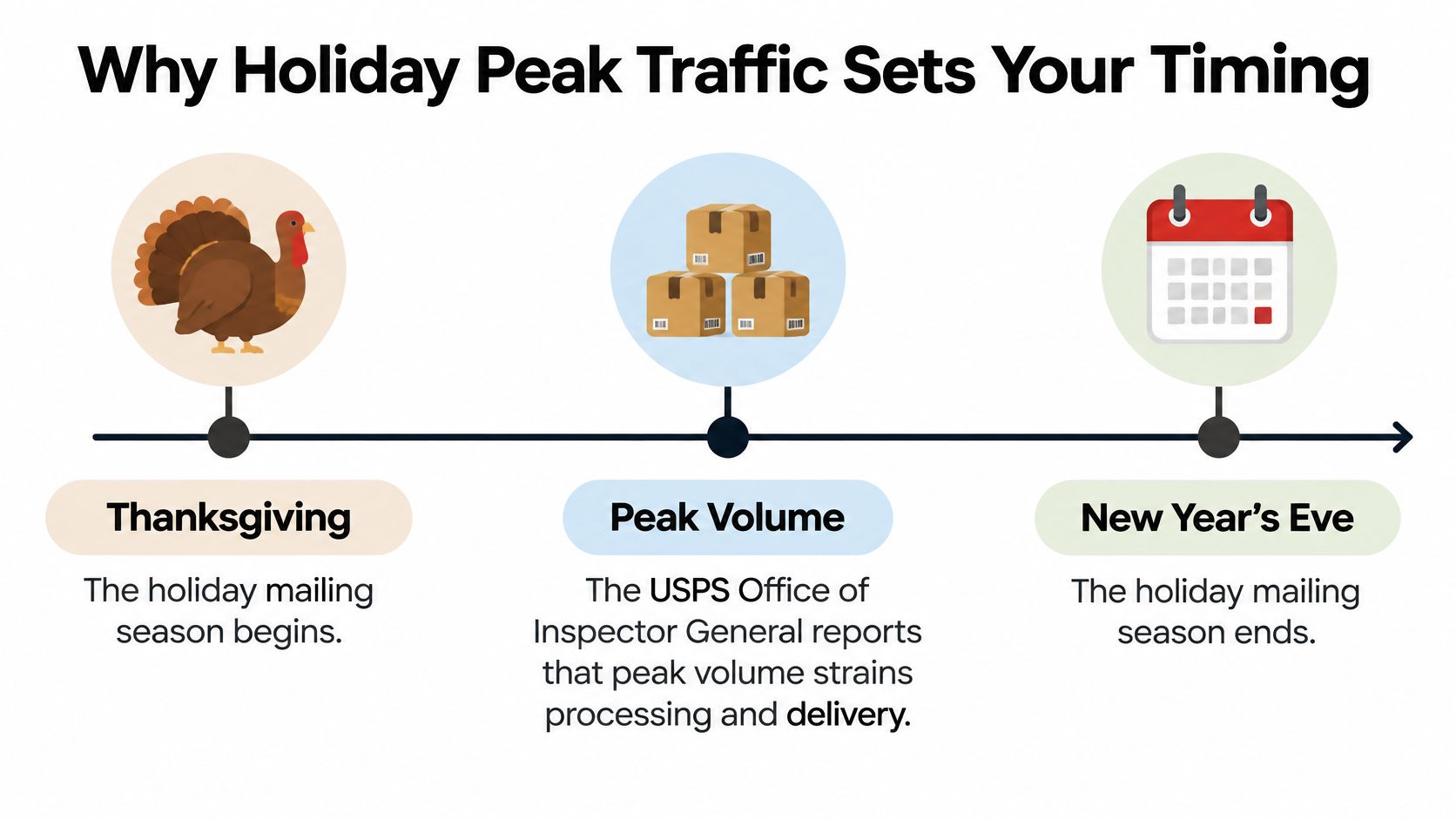
Holiday mail doesn't move through an otherwise empty network. Postal employees accept, sort, transport, and deliver seasonal correspondence while also handling the rest of the mail.
The USPS Office of Inspector General's FY2025 peak-season review describes significant processing and distribution strain from Thanksgiving through New Year's Eve and notes that USPS added an extra scheduled delivery day for packages during the peak period. That package adjustment matters when interpreting reported performance, but it isn't an instruction to add the same allowance to every greeting card.
Shared operations create uncertainty
A greeting card is letter mail rather than a package. Still, postal workers move both through shared acceptance, transportation, and delivery operations, so a letter isn't insulated from wider operational pressure.
For a sender, that means a small disruption can consume the remaining margin. An address correction before printing might be manageable early in the season. The same correction near the postal cutoff can leave you choosing between a faster service and a later greeting.
Use the early domestic window as your default. Treat the shorter lead time close to Christmas as a fallback, not the schedule you build around, especially when production hasn't started.
Use a window instead of a promise
An estimated arrival window is more useful than a single confident-looking date. It acknowledges that the sender controls preparation and approval, while the printer and carrier control later stages.
- Finish controllable tasks early. Finalize artwork, wording, destination, and payment before you need physical production to begin.
- Separate production from transit. A card can be ready to print without being ready for postal acceptance.
- Keep room for exceptions. Don't use every available day before the card has even left fulfillment.
Your internal target should be the date the card has already left, not the date you finally start getting it ready.
That distinction gives you a usable plan even when a carrier's estimate changes.
Adjusting Your Date for Distance and Address Risk
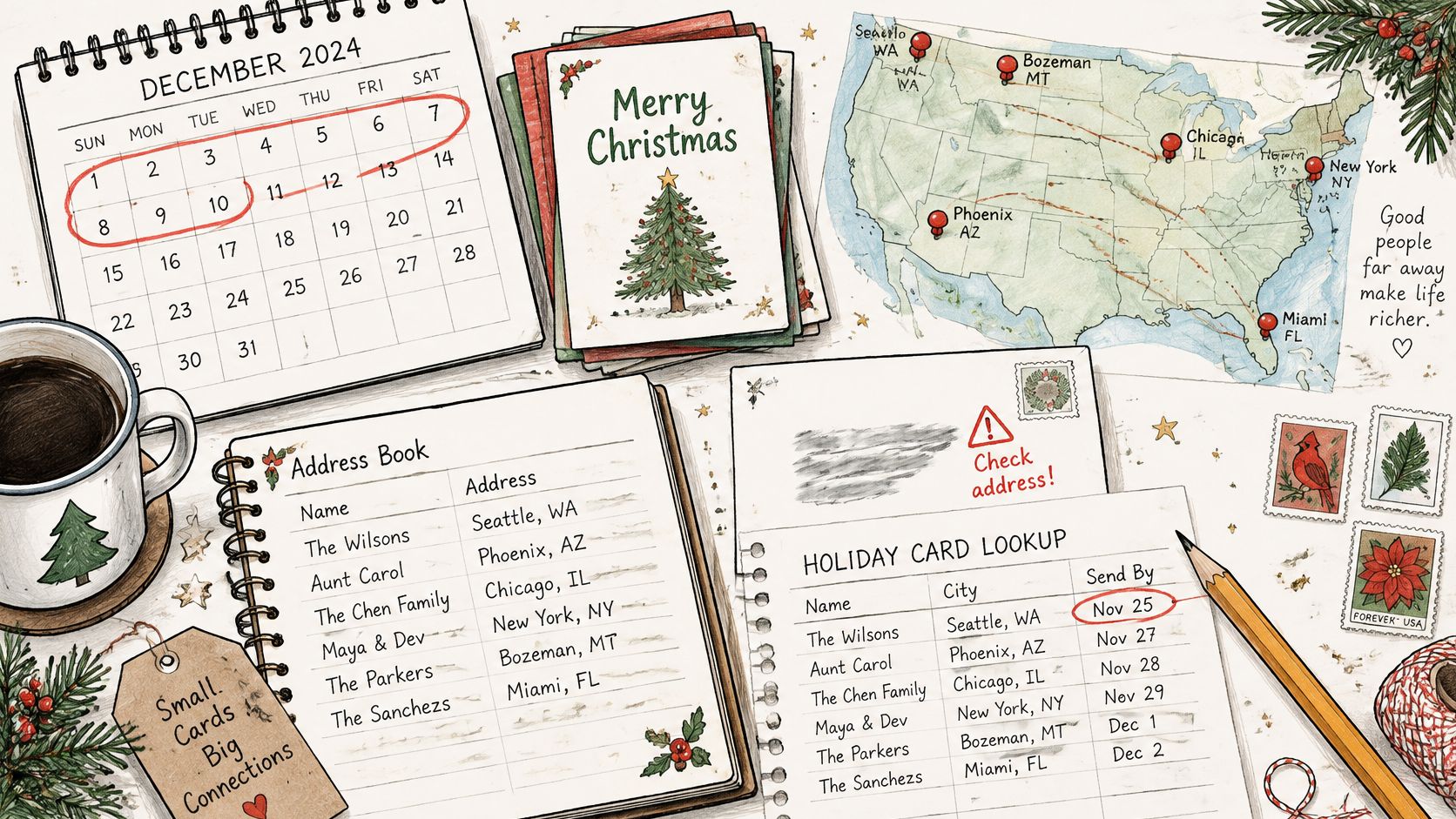
A familiar, verified address and an uncertain overseas destination shouldn't share the same mailing plan. Sort your recipients by routing and address risk before deciding which cards to prepare first.
Use this lookup as a planning schedule, not a set of destination-specific postal guarantees. The earlier recommendations reflect uncertainty you should accommodate rather than a promise about how quickly any individual route will operate.
Mailing date by recipient situation
| Recipient situation | Mail by | Reason |
|---|---|---|
| Standard contiguous US address | December 1-10 | Default target with room for weekends and weather |
| Long-distance or rural address | First week of December | Allow more room for remote delivery and routing |
| Military address | Before the standard target | Longer and less predictable routing |
| Unverified or recently changed address | Before the standard target | Verify the address when the card is written |
| International recipient | Late November or earlier | Customs and national postal schedules differ |
| New Year greeting | No December 25 constraint | Can be mailed later |
Don't interpret distance alone as a reliable transit calculator. A nearby recipient with a missing apartment number can present more avoidable trouble than a distant recipient whose address is complete and current.
For recently moved friends, ask for the full mailing address rather than relying on an old envelope or a contact entry that someone may not have updated. Our guide to addressing a greeting card can help you arrange the recipient details clearly.
Prepare the uncertain cards first
Military addresses need their own routing checks. International recipients also need the correct country-specific address format and an appropriate mailing service, rather than a domestic envelope prepared with an extra line.
A New Year greeting offers a different trade-off. If the Christmas window has become unrealistic, changing the message can preserve the thoughtfulness without pretending the card will arrive before the holiday.
The general rule is simple: the more uncertainty a card carries, the earlier it should leave. Confirm separate USPS schedules for Alaska, Hawaii, Puerto Rico, and territories before purchase, and verify that your chosen sending service supports the exact destination.
How to Work Backward from Your Deadline
Build your schedule around the moment the envelope must leave fulfillment. Then place approval and payment earlier, with enough room for the physical work that follows.
A calendar and a simple recipient spreadsheet are sufficient. Give each recipient group its own row so an easy domestic batch doesn't conceal an unresolved international or military address.
Build the schedule in order
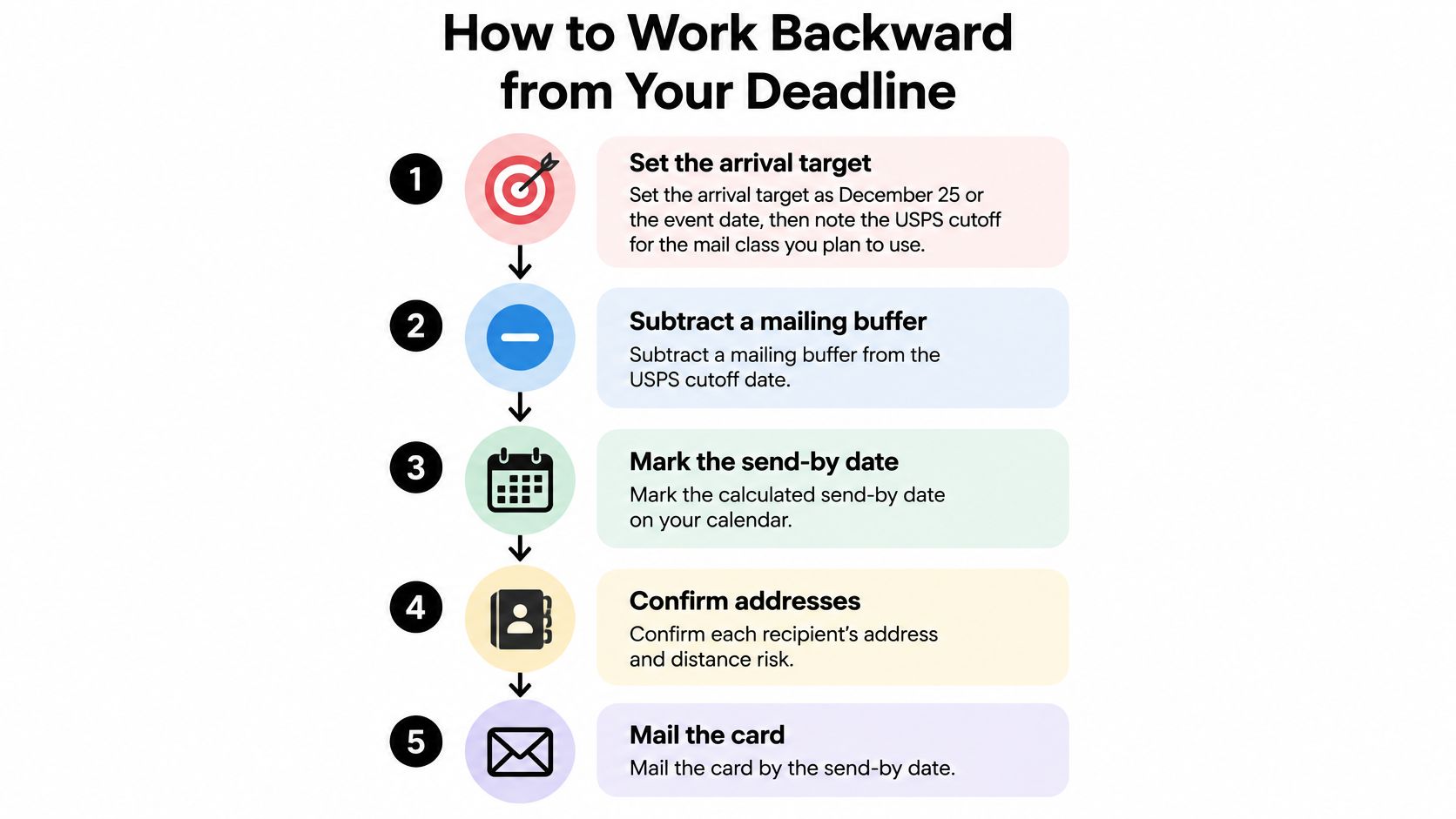
Set the arrival target. Choose Christmas Day or the actual event date, then identify the recommended cutoff for your intended mail class and destination. Don't select a service solely because its name sounds faster; confirm that it applies to your mailing situation.
Subtract a mailing buffer. A buffer of 10 to 14 days before December 25 gives a latest internal handoff target of December 11 to 15, while the default target remains December 1 to 10. Use the earlier window whenever the recipient's routing or address uncertainty calls for it, and place production before that handoff.
Confirm names and addresses before approval. Check the recipient's spelling, street address, apartment or unit, city, state, and postal code against a current record. If something is uncertain, ask the recipient while you're writing the card, not after submitting the order.
Approve the exact card and destination. Inspect the final wording and artwork rather than approving a rough concept. Our process requires approval and completed payment before the card is printed and mailed, so an unfinished preview hasn't started physical fulfillment.
Pay and check the order status. Confirm that checkout is complete, then review the estimated arrival window. Our explanation of how long a mailed card takes to arrive helps distinguish preparation from delivery, but an estimate still isn't a guarantee.
Record handoff against your target. Note the mailing status separately from the order date. This prevents you from treating a receipt as evidence that the envelope is already moving through the postal network.
What the finished plan should contain
Your completed list should show approval, payment, intended handoff, and the relevant postal cutoff for each recipient group. Put actual calendar dates in those fields once you've checked the destination and the production estimate.
Keep unresolved items visible. A blank apartment number or an unapproved message belongs in a pending column, not in a completed batch.
Useful distinction: The postal cutoff is an outside limit. Your approval deadline is an earlier commitment that makes that limit achievable.
If the production estimate won't fit between approval and your planned handoff, change the schedule before paying. Don't solve that conflict by removing the buffer.
Mistakes That Push Cards Past Christmas
Most avoidable delays begin before postal acceptance. A sender uses the wrong destination schedule, leaves approval unfinished, or assumes a requested arrival date changes the service being purchased.
These failures need different fixes. Paying for faster transport won't correct an incomplete address, and finishing the artwork won't help if checkout remains incomplete.
Wrong assumptions about the route
- Using the contiguous-US cutoff everywhere. Alaska, Hawaii, Puerto Rico, and territories require their own schedule checks. Confirm the destination-specific date before buying, rather than treating a domestic label as sufficient.
- Putting overseas cards in the domestic batch. Prepare international greetings ahead of ordinary domestic cards. If that opportunity has passed, reassess the message and arrival expectations instead of assuming the routes are interchangeable.
Unfinished preparation disguised as progress
Approving the design at the last moment leaves production and handoff competing for the same remaining time. Complete the approval task in step 4 before your internal mailing target, not on the postal cutoff.
Requesting a particular arrival date doesn't upgrade the mailing service. Our delivery dates are estimates, not guarantees, so allow extra time for important occasions and use the status check in step 5 to manage expectations.
Leaving an uncertain address unresolved can make all the design work unusable. Finish the verification in step 3 while the card is being written; don't rely on forwarding to rescue an outdated destination.
If you're handling the envelope yourself, use the guide to sending a card in the mail to check the physical mailing tasks before you leave home.
If a card will miss its window, compare the cost of a faster class with the consequence of a later arrival before paying.
Confirm Your Mailing Date Before December 17
Make the final decision using the destination, service, and readiness of the card, not just the date on your calendar. A card with a complete address and approved message is in a different position from one that still needs a photograph or recipient confirmation.
Check that the destination fits the schedule you're using. Then confirm the relevant mail-class cutoff and make sure approval and payment leave room for production before your internal handoff target.
Check readiness before purchase
- Destination eligibility. Confirm that the exact address is supported before completing the order.
- Final preview. Review the recipient, artwork, and inside message together so a late edit doesn't interrupt fulfillment.
- Completed payment. Verify that the order has moved beyond a saved preview or draft.
- Arrival estimate. Read the window shown for the order and keep a buffer for an important occasion.
Mail This offers a practical way to take a personalized card through design, approval, and payment, then handle printing, the envelope, postage, and mailing. We deliver to all US states and Washington, DC, but you should still confirm the exact destination's eligibility before purchase rather than assume every address format or routing category is supported.
Make the approval date your action date
Choose your intended handoff date first, then finish the creative decisions early enough to support it. The approval-and-payment stage is the start of physical fulfillment, not a substitute for mailing.
Review the estimated arrival on the order status page after checkout. If the window no longer fits your occasion, address that promptly rather than treating a desired date as a promise.
The useful next move is concrete: confirm the address, finish the message, and approve the card while there's still time between production and the postal cutoff.
Visit Mail This to create a personalized Christmas card, review the exact design and address, and complete payment before your mailing target. We'll print and mail your approved card, so plan the approval date early enough to leave room for both fulfillment and estimated postal delivery.