You're standing in the card aisle with five minutes left, and every Father's Day card looks like it came from the same joke factory. One has a grill, one has a fish, and one says almost what you wanted to say, but not quite. That's the moment a personalized Father's Day card earns its place, because it can sound like you, look like him, and feel tied to your actual relationship instead of a shelf display.
Table of Contents
- Why a Personalized Father's Day Card Beats the Rack
- What Makes Personalization Actually Work
- Message Prompts for Every Kind of Dad
- Choosing Between Photo Cards and AI-Generated Artwork
- From Idea to Mailbox Without the Hassle
- Your Simple Plan for a Card He'll Keep
Why a Personalized Father's Day Card Beats the Rack
A store-bought card usually gives you a broad sentiment and a generic image. A personalized one lets you point directly at the man you know, the quiet fixer, the bad-joke king, the new dad running on coffee, or the stepdad who showed up and stayed. It's less about decoration and more about specificity, the kind that makes him pause for a second because the message feels unmistakably intended for him.
That's why the best cards don't just swap in a name. They carry a detail from your life, a line that sounds like your voice, or a visual that matches his world, whether that's tools, golf, gardening, or the family dog. If you're choosing between formats, it helps to think first about what kind of memory or feeling you want the card to hold, then build from there, rather than starting with a template and trying to make it fit.
The practical part matters too. A thoughtful card is only useful if it gets written, approved, and mailed without turning into a last-minute scramble. This guide to greeting card types is a useful companion if you're deciding between folded cards, photo cards, and other formats before you start writing.
What Makes Personalization Actually Work
A generic card is like a billboard. A personalized one is more like a letter slipped into an envelope with his name on it. The message doesn't just say “Father's Day,” it says, “I know who you are, and I wrote this for you.”

The deeper the fit, the stronger the response
Personalization works on a few levels. Name-only swapping is the lightest touch, and it can still help a card feel less mass-produced. Occasion-specific creative goes further, because the wording and imagery line up with Father's Day itself. One-to-one wording goes deepest, because it reflects a real relationship, a shared memory, or a detail only the two of you would understand.
Practical rule: the best card usually combines at least two kinds of specificity, not just one.
That fits what direct mail research shows about personalization depth. A static, non-personalized piece typically converts at about 1.0–2.0%, while name-only personalization lands at 1.4–3.0%, segment-level creative at 2.5–5.5%, and one-to-one variable-data pieces at 5.0–9.0%+ when data quality and offer relevance are strong (Mailpro's direct mail personalization overview). In plain English, the more the card feels like it was made for a specific person, the less it feels like an ad and the more it feels like care.
The personalized card market is also a durable category, not a novelty. One market estimate puts personalized greeting cards at USD 7.07 billion in 2025 with growth projected to USD 9.21 billion by 2034, and another report places the category at USD 3.0 billion in 2024 with a forecast of USD 4.5 billion by 2032 (market estimate). That doesn't mean every card needs bells and whistles. It does mean people keep choosing cards that feel more specific than a generic shelf option.
Message Prompts for Every Kind of Dad
The blank inside of the card is where many people freeze. The easiest way through is to start with the kind of dad, or father figure, you're writing to, then match the tone to him instead of forcing a single “perfect” message.
Quiet dads, jokesters, new dads, and more
For the dad who shows love by fixing things, try this kind of line: “Thanks for the ride to practice, the tools I borrowed, and the way you always made time when I needed help.” It works because it names a real pattern, not a generic thank-you. If you want it shorter, “You've always shown up, and I've noticed more than I said” carries the same feeling with less polish.
For the jokester dad, keep the humor familiar instead of trying too hard. “I'm returning one dad joke to you, with interest. Happy Father's Day to the original source.” That kind of line lands because it sounds like a family habit, not a card-aisle pun pasted on top. A dad-joke style card also fits the trend toward playful, low-pressure messages that feel like a wink instead of a speech.
For a new dad, the best messages sound encouraging, not grand. “You're already learning the rhythm of this, and it looks like you've been doing it forever.” For a stepfather, honesty usually wins, such as “You didn't have to be there the way you were, but you were, and that's what I'll always remember.” For a long-distance dad, try “We may not share the same table today, but I still carry your voice with me.”
For a dad you mostly know through memory, go gentler and more nostalgic. “Some of my favorite moments still have you in them, and I'm grateful for every one.” That tone fits the minimalist and nostalgic style that's been showing up in recent card trend roundups, where the message carries more weight than the decoration. If you need more general phrasing ideas, this Father's Day message guide can spark a few lines you can adapt without sounding stiff.
A good message doesn't need to be long. It needs one real detail, one true emotion, and enough room to sound like you.
Choosing Between Photo Cards and AI-Generated Artwork
The visual choice changes the whole feel of the card. A photo card says, “This is one of our moments.” AI-generated artwork says, “I made something for your world,” even if there wasn't a perfect photo to begin with.
When a photo wins
Use a photo when you have a good image that already carries meaning. A candid shot usually beats a stiff pose, because it feels lived-in and real. JPEG, PNG, and WebP are all practical formats, so you're usually choosing based on image quality and clarity rather than chasing some special effect.
A photo card works best when the picture does the emotional heavy lifting. A fishing trip, a kitchen moment, a game-day snapshot, or a quick phone photo from a regular afternoon can be enough if the memory behind it is strong. The key is to choose a picture that makes him recognize the moment before he even reads the message.
When artwork wins
AI-generated artwork is the better choice when there isn't a good photo, when you want a stylized scene of his hobby, or when the card should feel playful instead of literal. It's also useful when you want the visual to echo his personality without feeling like a family album page. In many setups, you can generate one custom artwork option free after sign-in, then decide whether you need more.
Best test: if the image makes him smile or remember something, it's working. If it just fills space, keep looking.
| Consideration | Photo Card | AI-Generated Artwork |
|---|---|---|
| Best when | You have a strong shared photo | You want a stylized or playful scene |
| Emotional effect | Direct and memory-driven | Creative and symbolic |
| Tone | Personal, familiar, specific | Whimsical, polished, flexible |
| Common risk | Blurry or awkward photos | Artwork that feels too generic |
| Good fit for | Family moments, candid shots, keepsake cards | Hobbies, inside jokes, visual metaphors |
If you want to see how visual style can shift a card's mood, this family Christmas card ideas guide is a useful comparison point even outside the holiday season, because the same visual thinking applies.
From Idea to Mailbox Without the Hassle
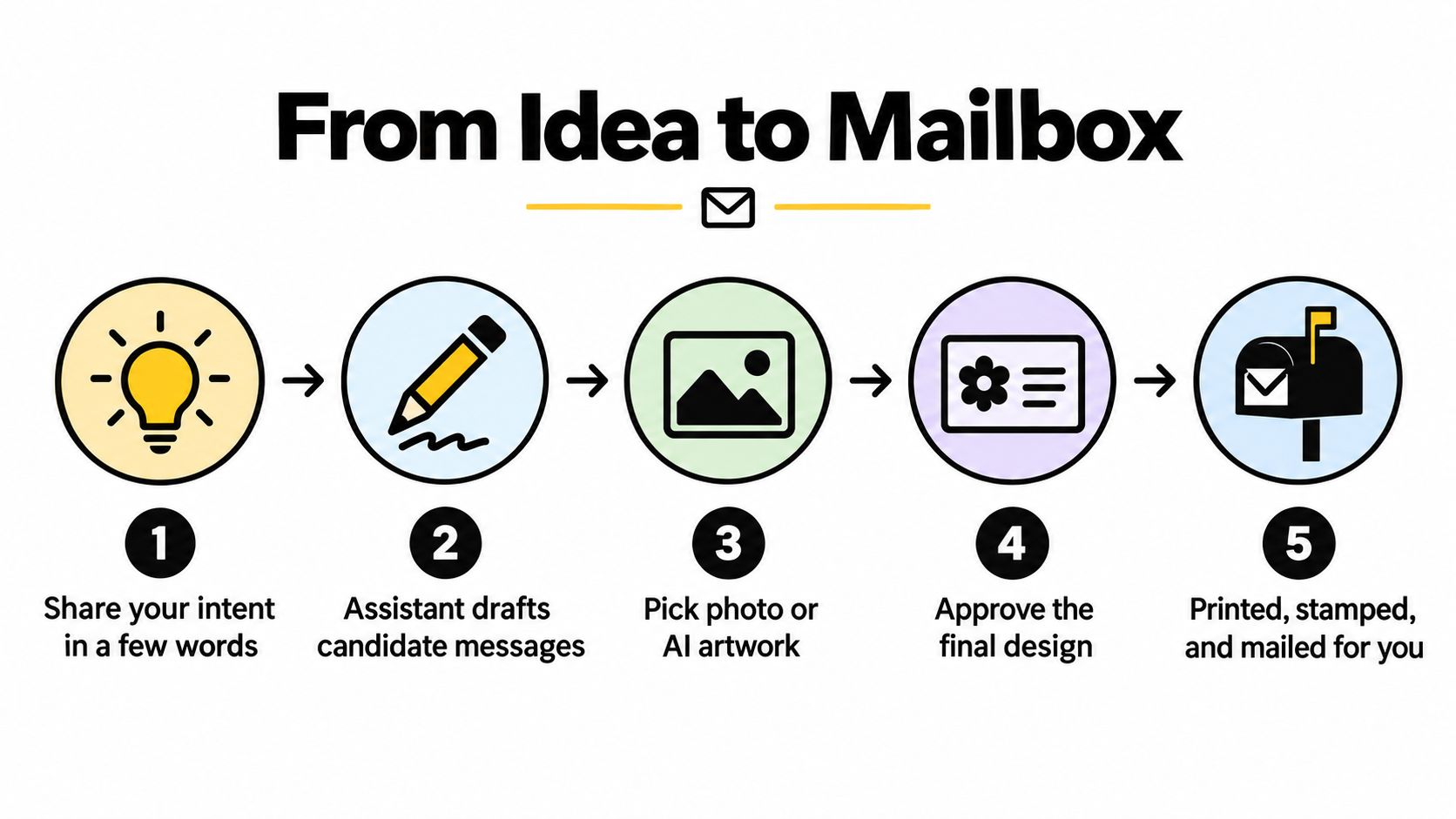
The part that feels most daunting is the invisible middle, the bit between “I have a good idea” and “there's a card on his way.” A smoother workflow starts with a short intent, like the kind of dad you're writing to and the tone you want, then turns that into candidate wording and artwork before you ever pay.
What happens after you approve it
The preview step matters more than people expect. You can check the design, recipient, and total before payment, which keeps surprise costs out of the process. Then the exact message gets typeset separately from the artwork, so the wording stays clean and legible instead of getting embedded awkwardly inside an image.
That separation is a quiet but important detail. It means your approved words stay your approved words, and the card still looks polished when it's printed.
Useful habit: read the final preview once out loud before you approve it. If it sounds natural spoken aloud, it usually reads naturally on paper.
The practical logistics are straightforward. A card can be priced at $9.99 per card, including the envelope and domestic postage, with tax shown upfront, and domestic delivery is handled within the U.S. states and Washington, DC, with some destination limits. There's also an estimated arrival window rather than a guaranteed date, so the safest move is still to mail early instead of hoping the calendar will cooperate.
The whole point is to remove friction. You get the feeling of a thoughtful physical card without turning the process into a design project, a print shop errand, and a post office run all at once.
Your Simple Plan for a Card He'll Keep
Pick the level of personalization first. Then choose the message tone, decide whether a photo or artwork fits better, preview the final card, and send it early enough to beat the usual last-minute rush. If you're doing it in one sitting, keep it simple: relationship, message, visual, preview, mail.
A quick checklist helps:
- Choose one real detail you want him to recognize.
- Match the tone to his personality, not to a generic template.
- Use a photo if the memory is already strong, or artwork if the image needs imagination.
- Check the final preview carefully before you approve anything.
- Mail early so the card has time to arrive without stress.
The biggest mistake is waiting until the last weekend and then settling for something vague. A card that specific enough to feel unmistakably his, and arrives in his mailbox instead of disappearing into an inbox, tends to become the one he keeps.
If you want the easy version of this process, Mail This can help turn a short idea into a physical card without the usual printing and mailing hassle. Visit Mail This to create a personalized Father's Day card that feels like it came straight from your own handwriting, even if you typed it in ten minutes flat.