Many US birthday cards fold to 5 × 7 inches (127 × 178 mm). The Mail This card folds to 125 × 175 mm, about 4.9 × 6.9 inches. Two millimetres of width and three of height separate those formats. The finished card still reads as a classic birthday card. A file built for one size will not sit cleanly on the other.
Retail sizes are not one number. A Hallmark birthday card listed at 4.75 × 6 inches is half an inch wider than the 4.25-inch postcard width limit and stays within letter limits. It sells beside cards at 4 × 6, 4.25 × 5.5, and 5 × 7. Calling one of those standard does not decide whether the piece stays flat, makes the mail on time, or pays the right postage.
Three specs do: the folded size, the envelope the card slides into, and the artwork file that goes to press. They are linked. Get one wrong and the other two fail with it. The working path runs from flat artwork and bleed through a 300 DPI file and USPS letter limits. The chart below holds the numbers for each common format, including the Mail This specification.
Table of Contents
- What Birthday Card Size Really Measures
- Birthday Card Size Chart for 2026
- The Mail This Card Size in Detail
- Choosing Portrait or Landscape Orientation
- USPS Size Rules for Mailing Birthday Cards
- Bleed and Margin Rules for Card Artwork
- File Formats and Resolution for Print-Ready Cards
- Pick Your Card Size and Send It with Confidence
What Birthday Card Size Really Measures
Three different measurements share the name birthday card size, and confusing them is where most print problems start.
The folded size is the closed card, the object a recipient holds. Retail birthday cards commonly measure between 4 × 6 and 5 × 7 inches folded, according to MarkWide Research's greeting cards market report. The flat size is the sheet before folding, twice the folded width on a side-fold card, and it defines the artwork canvas. The envelope size is the piece that enters the mailstream, and it runs roughly a quarter inch larger on each dimension so the card slides in without bending.
Size is a production decision, not an aesthetic one. It sets whether the card fits its envelope, the pixel count the artwork needs, how much room a long message and a photo get, and which rate category the mailed piece lands in. The Mail This format, for reference, folds to 125 × 175 mm, roughly 4.9 × 6.9 inches, in either orientation.
Read the chart, choose a row, then check that row against the envelope, the postal limits and the file spec before anything goes to press. Skip one of those and a handsome card turns into a bent corner and a reprint.
Birthday Card Size Chart for 2026
| Format | Folded size | Flat (open) size | Best for |
|---|---|---|---|
| A2 | 4.25 × 5.5 in | 5.5 × 8.5 in | everyday notes and shorter messages |
| A6 | 105 × 148 mm (4.1 × 5.8 in) | 148 × 210 mm (5.8 × 8.3 in) | photo cards and mid-length messages |
| 5 × 7 in | 5 × 7 in (127 × 178 mm) | 7 × 10 in | the classic US birthday card with room to write |
| Common small | 4.25 × 5.5 in | 5.5 × 8.5 in | everyday birthday cards |
| Retail standard | 4 × 6 to 5 × 7 in | 8 × 6 in up to 10 × 7 in | mass-market birthday cards |
| Mail This | 125 × 175 mm (4.9 × 6.9 in) | 250 × 175 mm (9.8 × 6.9 in) | personalized photo and message cards |
| Compact | 4 × 6 in | 8 × 6 in | simple, low-cost greetings |
How to Read a Row
Each column answers a different question, and only one of them is about looks.
- Folded size is the finished card after the fold. This is the number a recipient feels in the hand and the number that has to clear the envelope opening.
- Flat size is the open sheet, doubled along the fold. Build artwork here, never on the folded dimensions, or the design will be ruined at the fold.
- Best for is a working recommendation, not a rule. A short note on a 5 × 7 leaves a lot of white space, and a two-paragraph message on a compact card forces cramped type.
A standard birthday card is 4.25 × 5.5 inches when folded, while a larger common format is 5 × 7 inches, as the 4OVER4 birthday card dimensions guide lays out. Read those two rows side by side and the so-called standard splits into a small card and a big one, with different amounts of usable interior space.
The Envelope Line Nobody Checks
Envelopes run roughly 0.25 in larger than the card on each dimension. A 5 × 7 card pairs with an A7 envelope, an A2 card pairs with an A2 envelope, and this is why buying envelopes after designing cards is backwards. Order the envelope first or use a service that supplies it.
The Mail This row is the planned production size, spelled out in full in the next section. Every format here, once properly enveloped, mails as a First-Class letter rather than at postcard rates, which the postal section covers with the exact thresholds.
Choose a row by message length and photo count first. A 40-word greeting and one portrait photo fits a compact card; three photos and a page of text wants 5 × 7 or larger. Then confirm the envelope, and only then open the design file.
The Mail This Card Size in Detail
The planned Mail This card folds to 125 × 175 mm, which converts to about 4.92 × 6.89 inches. Opened flat, the sheet measures 250 × 175 mm, roughly 9.8 × 6.9 inches, with the fold running down the middle of the long dimension.
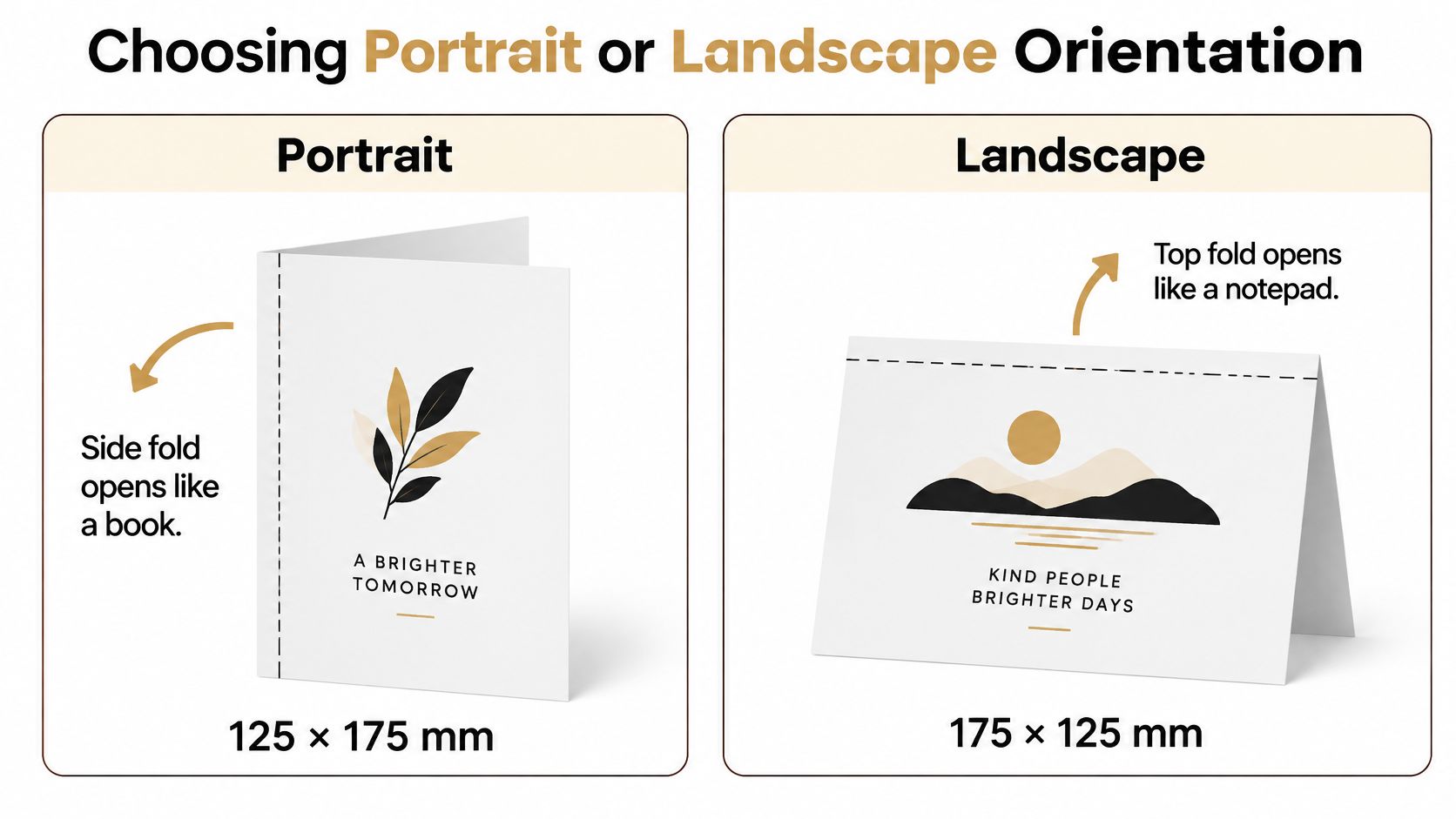
Both orientations are supported. Portrait means 125 mm wide by 175 mm tall, with a side fold so the card opens like a book. Horizontal means 175 mm wide by 125 mm tall, with the fold along the matching edge, which is what lets the card stand open on a shelf.
How It Sits Against 5 × 7
The US standard greeting card is 5 × 7 inches, equivalent to 127 × 178 millimetres, per 4OVER4's quick guide to standard greeting card sizes. Put the two formats next to each other and the Mail This card is 2 mm narrower and 3 mm shorter. On a table, that difference disappears.
In a print file, it doesn't. A 5 × 7 design rebuilt at 125 × 175 loses a sliver on the right edge and a sliver at the bottom, and those slivers are exactly where a logo, a border, or the last letter of a name tends to sit. Reusing a saved 5 × 7 template because it's close is the single most common way an otherwise fine card comes back with a clipped edge.
Working rule: treat 125 × 175 mm as the canvas and 250 × 175 mm as the flat sheet, and never scale a foreign template to fit. Rebuild on the correct document size.
The envelope is sized to the card and included, so there's no hunting for an A7 that turns out to be a hair too tight. That matters more than it sounds, because an envelope that grips the card makes insertion slow and leaves dents along the fold.
The practical takeaway is short. Design on the millimetre canvas, check the preview at full size before approving, and let the fold, not the trim, decide where the layout breathes.
Choosing Portrait or Landscape Orientation
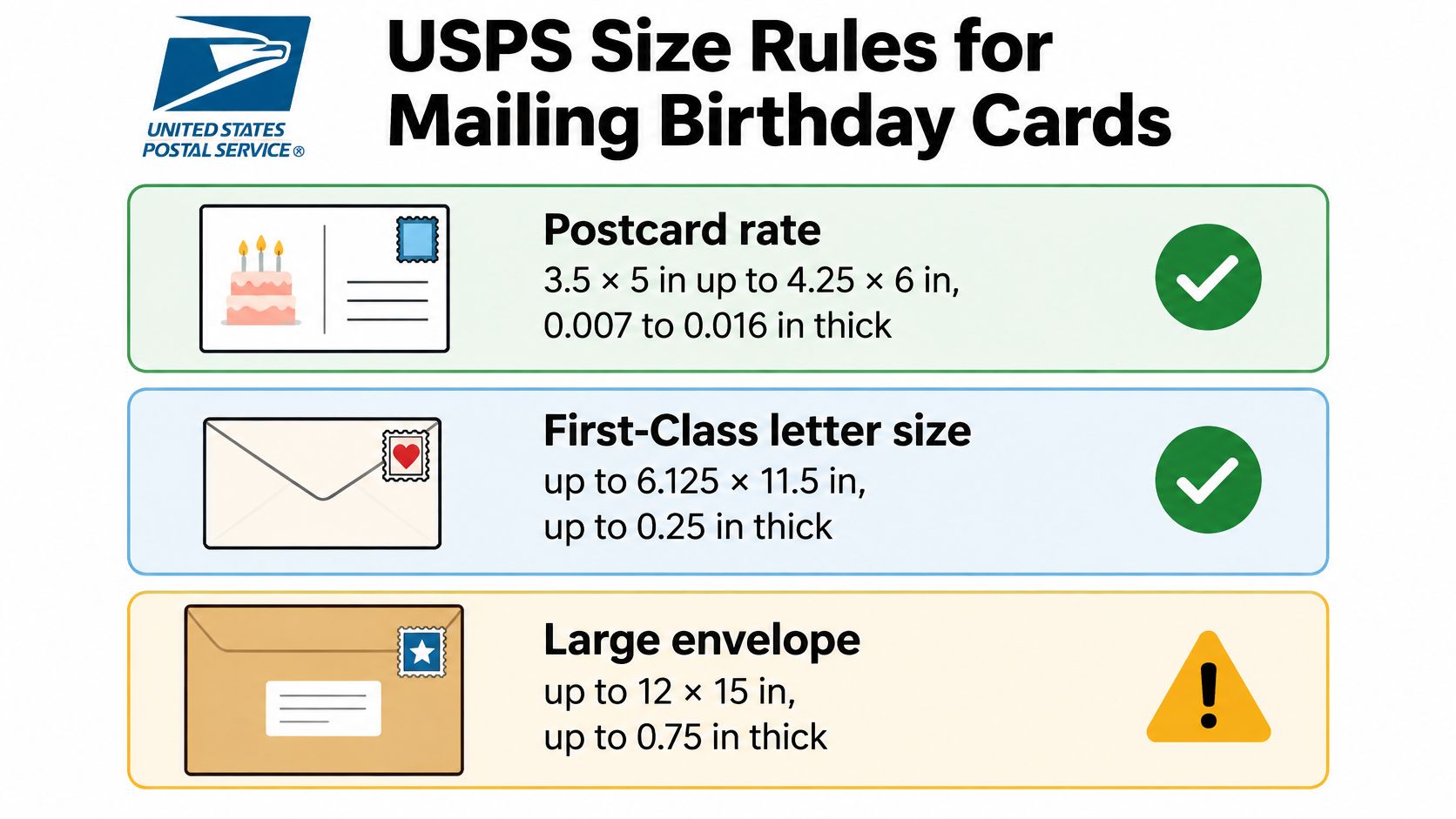
Orientation is the first real design decision, and it's separable from size. A folded card measures 125 × 175 mm either way, about 4.9 × 6.9 inches, and can be portrait or horizontal. What changes is where the fold sits and how the card behaves once opened.
What Each Orientation Suits
Portrait runs taller than wide and handles single vertical photos, traditional centered layouts, and messages that run long. The side fold means the card opens like a book and reads in a natural left-to-right sweep across the spread.
A horizontal layout runs wider than tall and handles panoramic shots, group photos, and collage front panels. The top fold lets the card stand open on a mantel or desk, which is a real advantage for a birthday card meant to be displayed rather than filed.
Interior text behaves differently too. Portrait gives a tall column, good for a letter. A horizontal layout gives a wide spread, better for two columns or for a photo on one side and text on the other.
Matching the image to the panel matters more than any of this. A square phone photo dropped into a portrait panel either gets cropped or stretched, and stretching is the one outcome nobody forgives. Crop inside the rendered preview so you see the actual cut, not the full original frame.
Readability Outranks Dimensions
Usable interior area and comfortable type size decide whether a card feels personal or cramped. That's a different question from which format is standard, and it's the one buyers care about. Demand keeps shifting toward personalized, photo-based cards, while recycled stock and plastic-free packaging have become selling points in their own right, as Grand View Research's US greeting cards market report tracks.
Those two pressures pull against each other. A larger folded card gives a long message room and separates image from text, at the cost of more paper and a bigger envelope. A smaller card uses less material and makes long greetings and large print harder to read.
The useful question isn't which size is standard. It's which size fits this recipient and this message.
For anyone planning a card through an approval-first flow, that argues for judging the finished preview rather than the raw dimensions. If a greeting runs long or a photo is doing the heavy lifting, pick the orientation and format that leave the message legible. More on format options sits in this guide to the types of greeting cards available for different occasions.
USPS Size Rules for Mailing Birthday Cards
Postage follows measurement, not intention. A folded card inside an envelope is priced by its dimensions and thickness, and a piece that's perfectly mailable can still miss the cheaper rate.
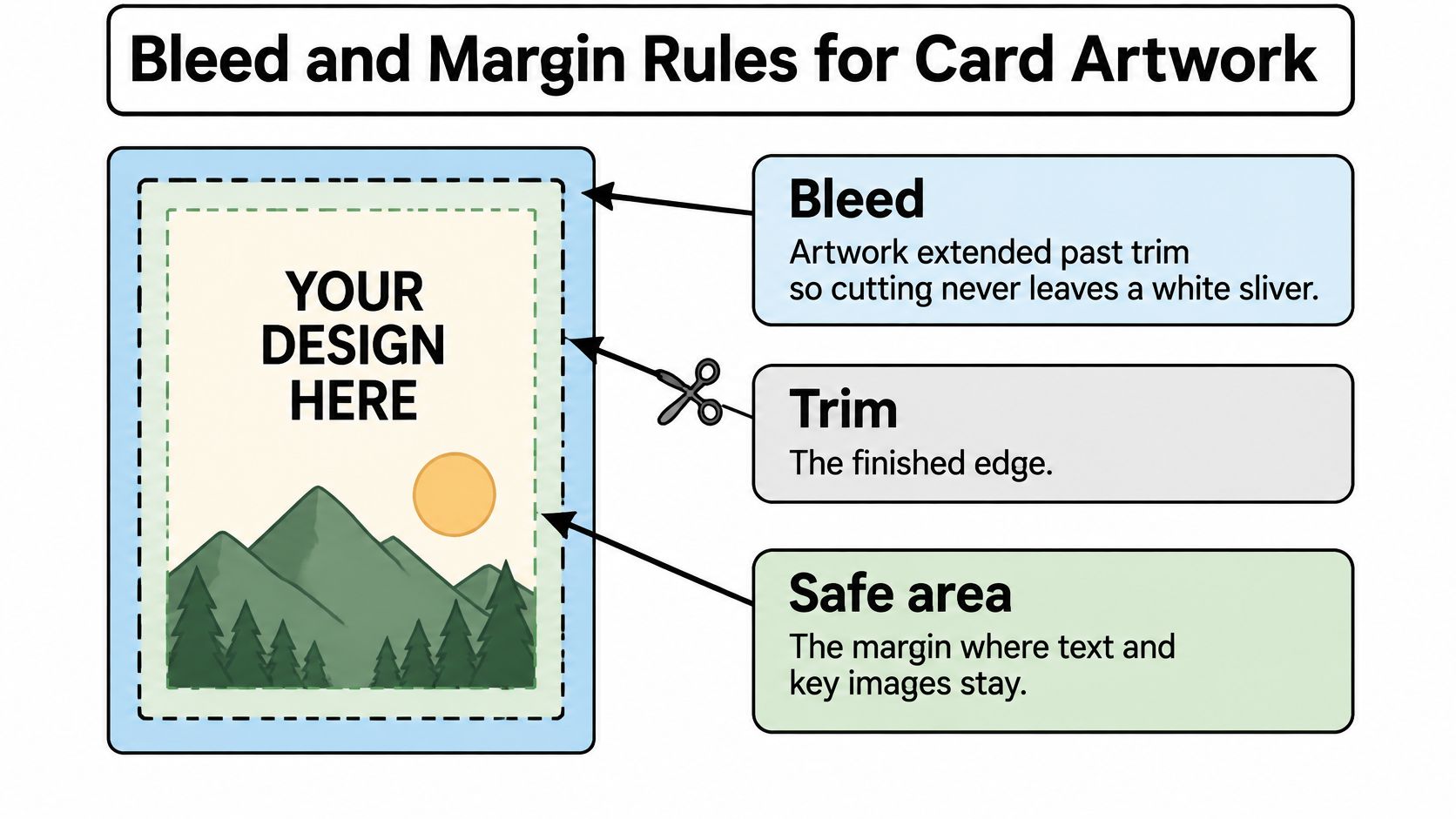
| Mail category | Minimum size | Maximum size | Thickness | Typical birthday-card outcome |
|---|---|---|---|---|
| Postcard (card rate) | 3.5 × 5 in | 4.25 × 6 in | 0.007 to 0.016 in | plain single-layer cardstock can qualify; most folded cards do not |
| First-Class letter | 3.5 × 5 in | 6.125 × 11.5 in (high × long) | 0.007 to 0.25 in | where standard folded birthday cards in envelopes mail |
| Large envelope (flat) | larger than letter minimums | 12 × 15 in | 0.75 in | oversized, rigid or embellished cards |
The USPS mailpiece design standards define letter-size mail as at least 5 inches long, 3.5 inches high and 0.007 inches thick, with maximums of 11.5 inches long, 6.125 inches high and 0.25 inches thick. Postcard pricing is tighter: a rectangular piece must measure at least 5 by 3.5 inches, no more than 6 by 4.25 inches, and fall between 0.007 and 0.016 inches thick. Pieces that exceed postcard dimensions but stay inside letter dimensions are charged the regular First-Class Mail letter price.
That last sentence settles the common question. A folded birthday card in an envelope is a letter, not a postcard, and it will be priced as one no matter how flat it looks.
Envelope First, Card Second
The envelope is the piece to validate, and the USPS letter-size and machinability standards spell out why. Machinable pieces must be rectangular with parallel sides, thickness is uniform, and the minimum thickness rises to 0.009 inch once a piece exceeds 6 inches in length or 4.25 inches in height.
A 125 × 175 mm card in its envelope clears both thresholds, so the 0.009 inch floor applies and a single folded card on standard cardstock meets it comfortably. What fails is everything added afterward: a rigid insert, a wax seal, a ribbon, a lump of glitter, a plastic badge. Those push the piece toward non-machinable treatment, which means different postage and slower handling.
Practical rule: mail the assembled unit, not the card. Weigh and measure the envelope with everything inside it before committing to a print run.
This is also where Mail This's backend matters to the sender. Printing is handled by Cardly, which prints each card and mails it to the recipient, and delivery covers all 50 US states and Washington, DC. The card's dimensions and envelope are specified together, so there's no gap between the design and the postal class it enters.
The Pre-Mail Checklist
Run this before any bulk order:
- Rectangular with parallel sides, no die-cut notches or rounded tabs that snag.
- Flexible contents, nothing rigid that stops the piece bending through sorting.
- Even thickness across the envelope, no bulges on one side.
- A legible address with clear space, not text printed over a busy photo.
- A secure closure, sealed along the flap and not lifted at a corner.
- No protruding embellishments, including anything that can catch on another piece.
Rate tables and automation thresholds get updated, so confirm current USPS rules before printing thousands of anything. The cost side of the same decision is broken down in this guide to how much it costs to mail a greeting card, which pairs well with the limits above.
Bleed and Margin Rules for Card Artwork
A print file has three zones, and confusing them produces the white sliver that ruins an otherwise clean card.
Trim is the finished edge, the line the guillotine follows. Bleed is artwork extended past trim so a slightly off cut never exposes bare paper. Safe area is the inner margin where text, faces and logos live, far enough from the blade to survive a shift.
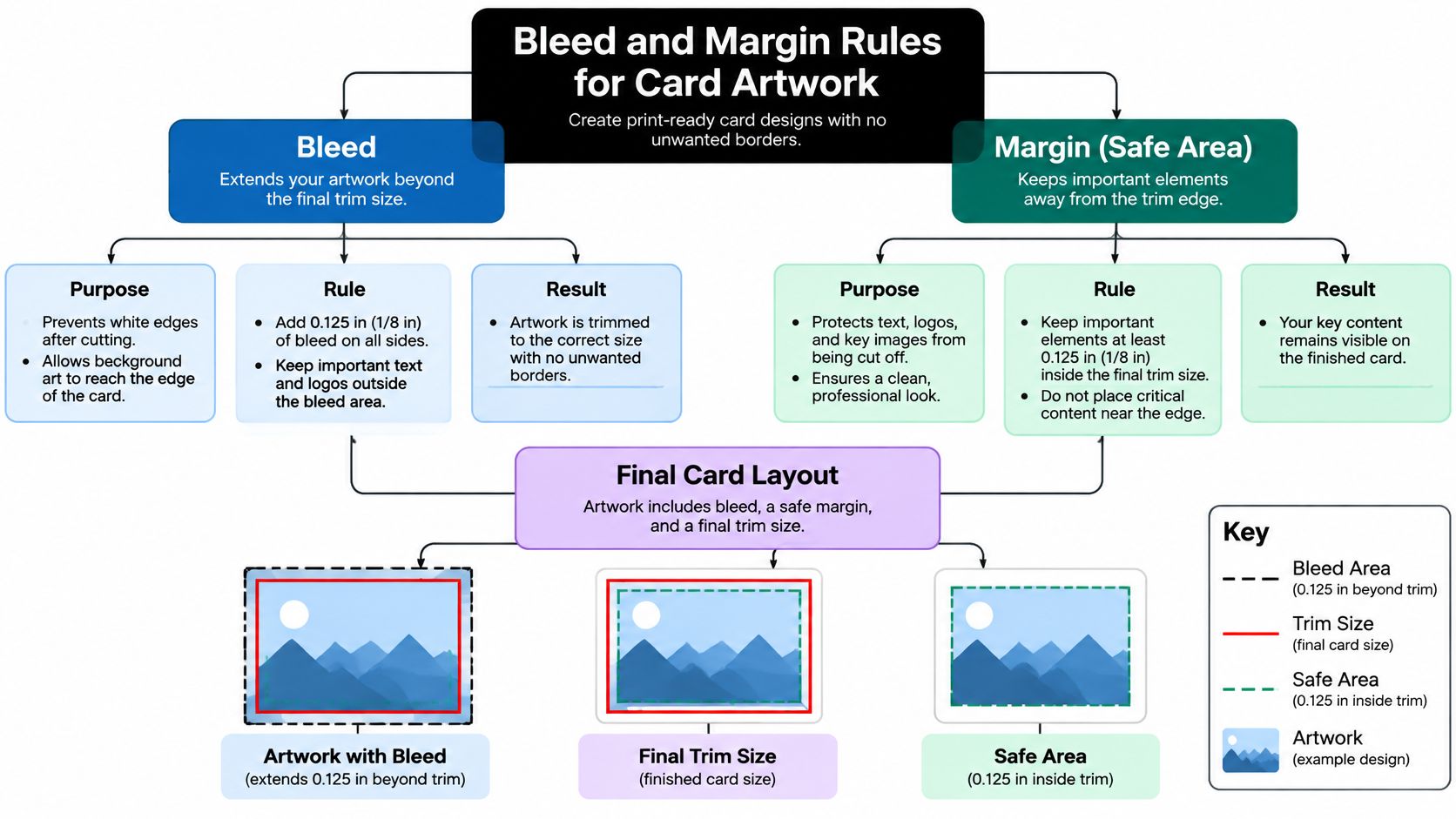
Standard working numbers: extend full-bleed artwork 0.125 inch (3 mm) beyond trim on every side, and keep text and critical elements at least 0.25 inch (6 mm) inside trim. Three millimetres is the floor, six millimetres is the target. Cutting tolerances drift by a millimetre or two across a stack, and the safe area absorbs that drift.
One Worked Example
Take a 5 × 7 inch folded card. It opens to a 7 × 10 inch flat sheet, so the file should be 7.25 × 10.25 inches after bleed, with text held inside roughly 6.5 × 9.5 inches.
For the Mail This format, the flat sheet is 250 × 175 mm, which means full-bleed artwork needs about 256 × 181 mm of image. Build the document at the flat size, add the bleed, then place guides at the safe line and leave them visible while you design.
What Actually Goes Wrong
- Thin borders and frames. A 1 mm rule around the card edge looks elegant in a proof and uneven in the hand, because no cutter is that precise. Use a wide band or no border at all.
- Critical elements near the fold. A face, a number, or the word "Happy" placed on the fold line will crease. Keep it at least 6 mm clear on both sides of the fold.
- Upscaling to fill bleed. Blowing up a small photo to reach the bleed edge softens it and shows pixelation on uncoated stock. Crop tighter, or extend a sampled background color into the bleed instead.
- Safe area treated as optional. Text that sits 1 mm inside trim looks fine on screen and loses a letter to the blade.
The fold deserves its own line in the spec. On a side-fold card, the fold sits at the left edge of the front panel, so any element crossing it gets a crease line through the middle. Keep type off it and let photography run across it deliberately, since a crease through a plain background is invisible and a crease through an eye is not.
File Formats and Resolution for Print-Ready Cards
Print at 300 DPI on the flat sheet, not the folded card. A 5 × 7 inch card opens to 7 × 10 inches, and that rectangle is what the pixel count has to cover. The postal service judges the sealed letter, not the file. Resolution only has to make that accepted flat size sharp.
| Card format | Flat size | Pixels at 300 DPI | Recommended file |
|---|---|---|---|
| 5 × 7 in | 7 × 10 in | 2100 × 3000 px | JPEG or PNG, sRGB |
| Mail This | 250 × 175 mm (9.8 × 6.9 in) | 2953 × 2067 px | JPEG, PNG or WebP, sRGB |
| Compact | 8 × 6 in | 2400 × 1800 px | JPEG or PNG, sRGB |
| Common small | 5.5 × 8.5 in | 1650 × 2550 px | JPEG or PNG, sRGB |
The Mail This row converts 250 mm and 175 mm to inches, then multiplies by 300. Use that same math for any custom flat size instead of trusting a template label.
Choosing a Format
JPEG suits photographs when it is exported at maximum quality. PNG suits flat graphics, text-heavy panels, and anything that needs transparency, because hard edges stay clean instead of picking up the fuzz JPEG leaves around lettering. WebP is fine when the pipeline accepts it. Mail This accepts JPEG, PNG, and WebP, which covers most files a phone or a layout tool already writes.
Export in sRGB. A browser shows that space, and the approval decision is made on the on-screen preview. Conversion to CMYK at the press pulls very saturated color back, so neon pink and electric blue print duller than they look on screen. Choose a slightly quieter tone while the file is still in sRGB.
Production Habits That Save Reprints
Flatten layers before export. A layered file can drop a shadow, an effect, or an entire text frame when another application opens it.
Match the file's aspect ratio to the panel. Do not let the software stretch the photo to fit. Forcing a 3:2 photo into a 4:5 panel either needs a heavy crop or stretches the image, so crop to the panel ratio inside the preview before exporting. How that crop changes by format is covered in this guide to personalized greeting cards with photos.
Keep the birthday message as typeset text in the layout, not pixels baked into the photo. Small type rendered inside an image goes soft at print size. AI lettering is worse: the shapes look like characters and often are not letters. Independent typesetting holds the exact wording the customer wrote and edited. Catalog cards are reviewed before payment, and custom artwork must be approved by the customer before a card can be sent.
Open the export at 100 percent and check the long edge against the table. A 7 × 10 inch file under 3000 pixels will print soft. Sharpening later cannot restore detail the file never had.
Pick Your Card Size and Send It with Confidence
- Choose the folded size from the chart. Default to 5 × 7 inches, or 125 × 175 mm for the Mail This format, unless the message is short. A two-line greeting on an oversized card looks unfinished; a page of text on a compact card looks cramped.
- Pick orientation by content. Portrait for text-led cards and single vertical photos; horizontal for panoramic shots, group photos and two-column interiors.
- Confirm the envelope against letter limits. Rectangular, flexible, evenly thick, and no more than 0.25 inch deep when sealed.
- Build the flat file at exact flat size. Three millimetres of bleed on every side, text at least six millimetres inside trim, exported at 300 DPI as JPEG, PNG or WebP in sRGB.
- Approve the rendered preview, not the source file. Read the message at full size, check the crop on every photo, confirm the address and the total before paying.
The step people skip is the fourth, and it's the one that decides whether the card arrives looking like the preview. Everything upstream, from folded size to fold direction, only holds together if the file matches the specification.
For senders who want the chain handled end to end, Mail This produces its planned 125 × 175 mm personalized folded card through a short workflow: choose a design, approve the exact card and delivery address, then pay securely. One personalized folded card costs $9.99, including the envelope and domestic postage, plus any applicable tax shown before purchase. If a card arrives damaged, misprinted, or materially different from the approved preview, the choice is a free reprint or a full refund.
Pick the size for the message and the recipient. Let the specification handle everything after that.
A birthday card only works when the format, the envelope and the file all agree, and that's the part Mail This takes off your hands: a 125 × 175 mm folded card, portrait orientation, printed with your approved message and mailed with the envelope and domestic postage included. You see the finished card and the total before you pay, and if anything arrives wrong, a free reprint or full refund is on the table. Start with the size that fits what you want to say at Mail This.