You're standing in the card aisle with a pen in one hand and a sympathy card in the other, reading the same three lines over and over because none of them feel right. That's the problem. It isn't finding a card, it's facing the blank space inside it and deciding how much to say without making things worse.
The answer is simpler than you might think. Short, specific notes beat long, sentimental ones because grieving people don't need a performance, they need clarity, care, and a message they can hold onto. A good sympathy card usually follows one plain structure, acknowledge the loss, share one brief personal note, offer one concrete kind of help. That's the framework I'd use every time, and it's the one that will keep you from overthinking every line in the aisle.
If you want a quick starting point while you're in the store, this practical card guide can help you narrow the wording without turning the note into a project. By the end of this article, you'll know exactly what to write, what to cut, and how to make the card sound human instead of polished in the wrong way.
Table of Contents
- The Moment You Are Standing in the Card Aisle
- How Sympathy Cards Became a Modern Ritual
- The Three-Part Structure Every Note Gets Right
- Phrases to Skip Even When You Mean Well
- Sample Phrases by Relationship Closeness
- Adapting Tone for Faith, Culture, and Unknown Beliefs
- Sending, Signing, and Finishing the Card Well
The Moment You Are Standing in the Card Aisle
You are not failing because you can't find the perfect phrase. You're hesitating because sympathy cards feel loaded, and every sentence seems like it has to carry more weight than it really should. That pressure makes people write too much, then delete too much, then settle on something bland.
The better move is to write like a calm person talking to a grieving friend. Keep the note small enough to fit comfortably in the card and specific enough to feel real. A short message can still be respectful when it names the loss plainly and says something the recipient can use.
Use the three-part structure
Start with acknowledge, move to share, then end with offer. Acknowledge means you say what happened in direct language, like “I'm so sorry to hear about your father's passing.” Share means one brief memory, quality, or observation, such as “I'll always remember how warmly he greeted everyone.” Offer means one concrete step, like “I'm dropping off dinner on Thursday.”
Practical rule: If the card sounds like a speech, it's too long. If it sounds like a kind note, it's close.
That's the whole job. You do not need to fill the space with polished lines or emotional buildup. You need three clear moves, a little warmth, and enough restraint to let the message breathe.
How Sympathy Cards Became a Modern Ritual
Sympathy cards did not always look or sound like they do now. Hallmark says it began producing sympathy cards in the 1920s, and its research division estimates that by 2000 Americans were sending around 125 million sympathy cards each year, with sympathy cards making up almost 6% of all greeting cards sent for everyday, non-seasonal purposes and nearly 90% of sympathy-card senders being over age 40. Hallmark's history of sympathy cards shows why the category still leans toward plain, respectful wording instead of elaborate sentiment.
From mourning stationery to modern comfort
The older tradition was far stiffer. In the 19th century, sympathy cards often acted more like death notices than comforting notes, with black borders, black envelopes, and direct references to death. That style made sense because mourning was highly formal and public.
By the time mass-produced cards normalized personal condolence notes, the tone loosened. People were no longer expected to write like officials announcing a loss. They were expected to write like neighbors, relatives, coworkers, and friends trying to comfort someone with a few honest lines.
That historical shift explains the anxiety many people feel today. The ritual is mainstream, but the wording is less rigid than it used to be, so people freeze and overcorrect. The safest result is still the simplest one, plain English, direct acknowledgment, and no ornamental language that creates distance.
Why plain wording wins
A 2022 study of sympathy card language found that the word “love” appeared 104 times, more than any other word, and it showed up in several distinct ways, including love for the bereaved, love surrounding the deceased, enduring love for the deceased, and divine love PMC study on sympathy-card language. That lines up with the practical reality of the card aisle. The strongest notes are usually not the fanciest ones, they are the clearest ones.
The point isn't to sound profound. It's to sound present. If your note can acknowledge the loss directly and offer comfort without over-explaining, it fits the modern ritual better than a paragraph full of polished sentiment ever will.
The Three-Part Structure Every Note Gets Right
Think of the card as three short sentences, or three short moves if you need to adjust the length. Acknowledge the loss, share one human detail, offer one concrete next step. That is enough for almost any sympathy card, and it keeps you from drifting into a long message that tries to do too much.
Acknowledge the loss directly
Say the loss out loud. “I'm so sorry to hear about your mother's passing” is better than “I was sad to hear your news” because it names what happened without hiding behind foggy language. Grief deserves directness. Euphemisms make the note feel timid.
If you knew the person who died, name them. “I was so sorry to hear about David's death” feels more grounded than “I'm thinking of your family right now.” The name matters because it shows you're not writing around the person who died, you're recognizing them.
Share one brief memory or quality
This part should be short. One line is enough. “I'll never forget how she laughed at every family gathering” works because it offers a real image, not a vague compliment. You are not trying to summarize a life in the card.
If you don't have a memory, share a quality. “He always made people feel welcome” is simple and respectful. A line like that gives the card a personal center without forcing you into a long anecdote.
Offer one concrete kind of help
This is the part many people get wrong. “Let me know if you need anything” sounds nice, but it asks the grieving person to do the work. A better line is “I'm dropping off dinner next Tuesday” or “I can help with the airport pickup on Friday.”
A specific offer is easier to accept than a vague promise. It also sounds more sincere because it names the action, not just the feeling.
Here's the difference in practice. A flat note says, “Thinking of you in this difficult time.” A stronger version says, “I'm so sorry about your dad's passing. I'll always remember how kind he was to me. I'm bringing dinner by Thursday.” Same space, much better result.
For most cards, the whole message can stay under 75 words without feeling thin. Short is not cold. Short is focused.
Phrases to Skip Even When You Mean Well
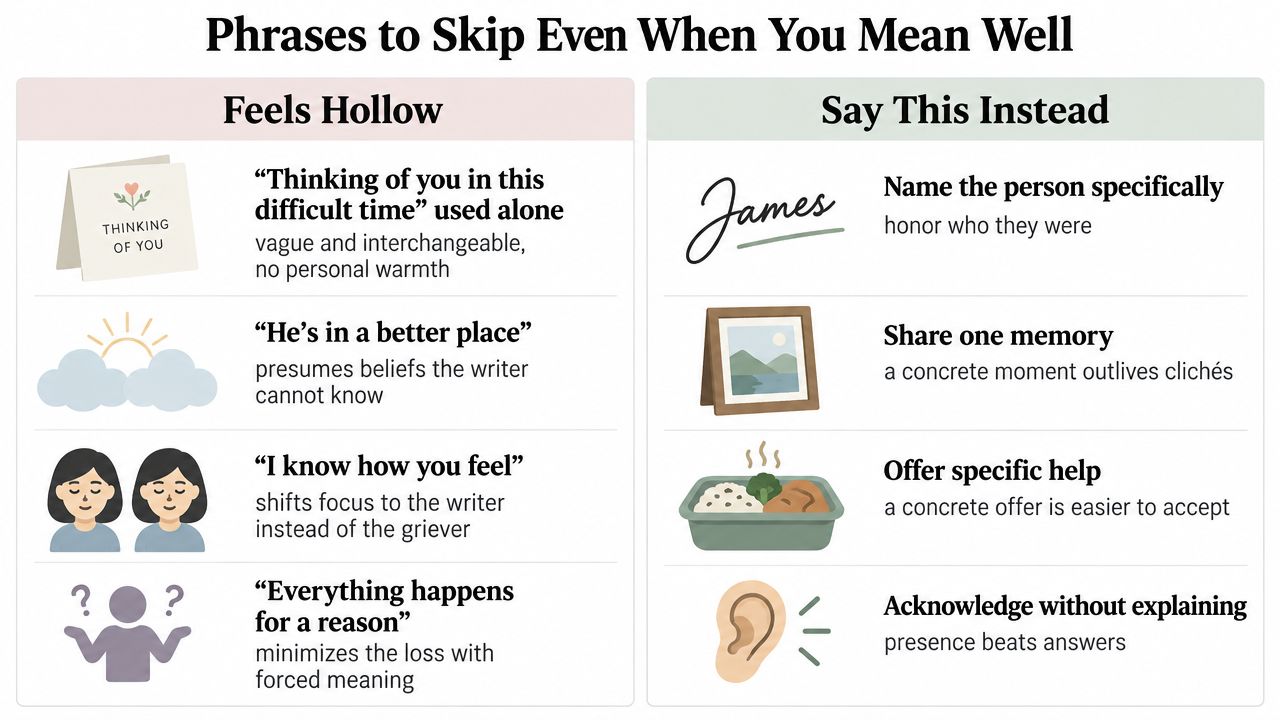
Some sympathy-card phrases are common because people repeat them, not because they help. The problem is not bad intent, it's that certain lines flatten grief, make assumptions, or shift attention away from the person who is hurting. Small cards force you to choose words that earn their place.
Generic comfort can sound hollow
“Thinking of you in this difficult time” is fine as a backup line, but it gets weak fast when it stands alone. It says you care, but it doesn't say how, why, or about whom. If you want to keep the sentiment, sharpen it: “Thinking of you as you grieve your father, and remembering how steady he always seemed.”
That version does more work without getting dramatic. It names the person, marks the loss, and gives the sentence a little gravity. The original line becomes meaningful only when it's attached to something specific.
Skip explanations that guess at beliefs
Lines like “He's in a better place” or “God needed another angel” can miss badly if the family doesn't share that belief or doesn't want it in the card. Even when the writer means well, the phrase can sound presumptive or dismissive. A safer pivot is: “I'm so sorry for your loss, and I'm holding you and your family in my thoughts.”
The same caution applies to “I know how you feel.” You probably don't. Grief is personal, and that phrase often puts your experience in the spotlight instead of theirs.
Cut stories that pull focus to you
It's tempting to tell a long story about the deceased because you want to show you cared. If the anecdote takes two sentences and ends with your reaction, it's too much. Trim it to one line that centers the person who died, like “I'll always remember her steady kindness at every visit.”
That keeps the note respectful and readable. You can honor the memory without turning the card into a memoir.
Stop explaining why you weren't there
“Sorry I couldn't be at the service because…” usually reads like self-justification. The card is not the place to defend your schedule. If you need to acknowledge the gap, keep it short: “I'm sorry I couldn't be there in person, and I wanted to reach out in writing.”
That version is cleaner because it moves straight back to care. Every line in a sympathy card has to earn its space.
Sample Phrases by Relationship Closeness
Use closeness to decide how personal to be. A close friend can handle a warmer memory and a more direct offer. A colleague needs kindness without overfamiliarity. A professional contact needs clean, respectful language that doesn't overreach. The strongest cards match tone to relationship instead of recycling the same sentence for everyone.
| Closeness | Sentence 1: Acknowledge | Sentence 2: Memory or Shared Note | Sentence 3: Offer | Tone |
|---|---|---|---|---|
| Close friend or family | “I'm so sorry about your mom's passing.” | “I'll never forget how she made every dinner feel welcoming.” | “I'm dropping off soup on Wednesday, and I'll text before I come.” | Warm, personal, direct |
| Close friend or family | “I'm heartbroken for you and your family.” | “He had a way of making everyone feel seen.” | “Call me tonight if you want company or quiet.” | Tender, steady |
| Colleague or neighbor | “I was saddened to hear about your loss.” | “Your father sounded like a truly kind man.” | “I can cover your morning meeting this week.” | Respectful, measured |
| Colleague or neighbor | “Please accept my condolences.” | “I know how much she meant to you and your family.” | “If it helps, I'm happy to handle the project update Friday.” | Professional warmth |
| Professional contact | “I'm sorry for your loss.” | “Thinking of you and your family during this time.” | “Please let me know if there's anything work-related I can take off your plate.” | Brief, courteous |
Use the right scale
“I can't imagine what you're going through” sounds heartfelt, but it can feel false if you barely know the person. Save language like that for relationships where you have the closeness to say it. With coworkers or acquaintances, clarity beats emotional inflation.
For a colleague, keep the note focused on support that fits the relationship. For a close friend, a more intimate line about a memory or shared moment is completely appropriate. The offer matters more than the prose, though. A specific, small commitment always beats a elegant paragraph that never says what you will do.
Adapting Tone for Faith, Culture, and Unknown Beliefs
When you don't know someone's beliefs, stay neutral. Mirror the language the bereaved has already used in conversation, in the obituary, or in public posts. If nothing points you toward a tradition, use plain condolence language and leave out assumptions.
Keep the wording safely neutral
A few lines work across many households because they stay human and simple. “I'm holding you in my thoughts” is one. “May you find comfort in the memories you shared” is another. “I'm so sorry for your loss and wishing you peace” works when you need something brief and neutral.
Those phrases are useful because they don't depend on a particular faith frame. They give comfort without guessing.
Only use faith-specific lines when you know they fit
If you share the person's tradition or have clear permission, faith-language can be meaningful. A psalm reference, “As-salamu alaykum,” or “Om shanti” can be appropriate in the right context. Outside that context, they can feel forced.
The same applies to assumptions about heaven, angels, or divine plans. If you don't know what someone believes, don't make the card do that work for you. Respect is more important than sounding spiritually polished.
Check cultural habits before you seal the envelope
Some families observe mourning customs that affect timing, visitation, or the way support is offered. Jewish families may observe shiva, and other communities may have extended or specific mourning practices. If you know those customs, match your note and your timing to them.
Checklist before you close the card: Is the wording neutral enough for unknown beliefs? Did you avoid advice and explanations? Did you use the deceased's name if appropriate? Did you keep the tone warm without guessing?
That quick check prevents most of the awkwardness people worry about. When in doubt, choose sincerity over symbolism.
Sending, Signing, and Finishing the Card Well
A strong message still needs a careful finish. The practical details matter because a sympathy card isn't just a sentence, it's a delivery. If you get the logistics right, the note feels more thoughtful before the recipient even opens it.
Send it promptly and sign it clearly
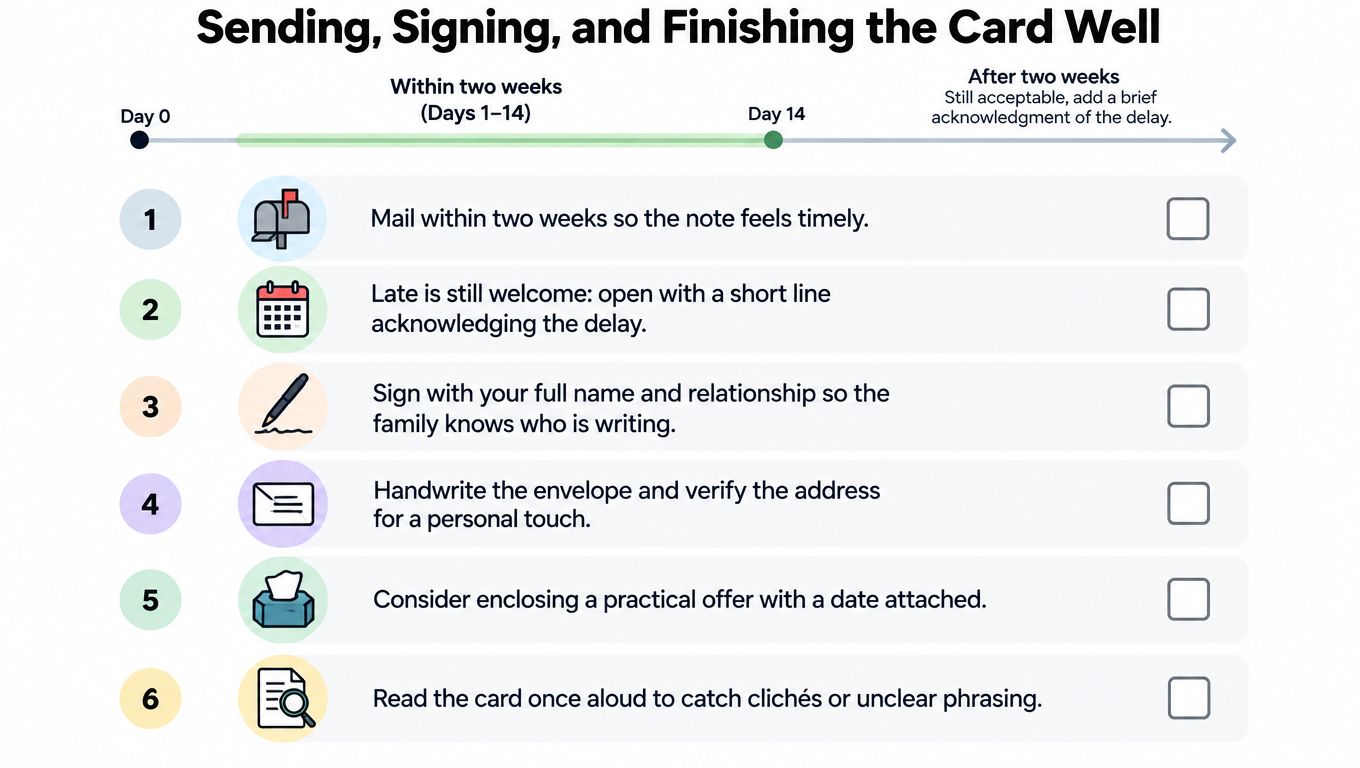
Mail the card within two weeks if you can, because that timing usually feels timely without being rushed. A later card is still welcome, especially when it includes a brief acknowledgment of the delay. The important part is that it arrives.
Sign your full name if the recipient may not know your handwriting right away, especially for acquaintances, coworkers, or extended family. For close relatives or very close friends, a first name can be enough if that's how you normally sign things.
Keep the outside calm and readable
Handwrite the envelope if you can, and make sure the address is correct and legible. If you're writing on paper, print clearly if your cursive is hard to read. Avoid glitter, stickers, or anything that feels celebratory instead of restrained.
If you need a quick reference for addressing, this card-addressing guide is useful for keeping the envelope clean and properly labeled. The envelope should look as thoughtful as the note inside.
Read the card once before you seal it
Read it aloud one time. That catches awkward wording, accidental clichés, and sentences that sound better in your head than on paper. It also tells you whether the message feels too long for the space.
A short, prompt card almost always beats a perfect one sent too late. If you keep the wording direct, the offer specific, and the tone calm, the card will do what it's meant to do, which is comfort someone without asking them to manage your phrasing.
If you want a simpler way to turn a thoughtful sentence into a real card, Mail This helps you send a physical note without the usual friction of printing, addressing, and mailing it yourself. It's a practical fit for sympathy cards because the message stays personal while the delivery gets handled for you. When you're ready to send something kind without overcomplicating it, visit Mail This.