You're at the kitchen table with a card open in front of you, and the pen keeps pausing over the same half-finished line. The friend in your head deserves more than a recycled “hope your day is amazing,” but you also don't want to overthink it into something stiff. That's where Happy Birthday, Fabulous Friend works so well, it gives you a warm starting point without forcing you into a generic script.
For a phrase like this, the job is simple but not easy. You want the compliment to fit the friendship, the warmth to sound real, and the final line to be something they'd happily read twice. If you usually reach for broad birthday advice, this birthday-card guide is a useful companion, but the sweet spot here is more specific, closer, and a little more stylish.
Table of Contents
- Finding the Right Words for a Fabulous Friend
- What Makes the Phrase Work
- Choosing a Tone That Matches the Friendship
- Building a Full Message Around the Phrase
- Five Card Examples You Can Adapt
- Pairing the Message With the Right Card
- A Quick Checklist Before You Send
Finding the Right Words for a Fabulous Friend
The blank card looks harmless until you start writing to someone who actually matters. Then every word feels like a test, and you can hear yourself asking whether the line sounds affectionate, polished, or just a little too much. Happy Birthday, Fabulous Friend solves part of that problem because it already carries a clear mood, friendly, admiring, and lightly celebratory.
Think of it as a tiny creative brief. You are not filling space, you are choosing how close, playful, or heartfelt you want to sound. A phrase that lands well usually does three things at once, it matches the relationship, sounds sincere, and ends with a line that feels worth keeping.
Practical rule: If you can say the phrase out loud and it sounds like something you'd actually say to that person, you're probably in good territory.
That mindset matters because the same words can feel warm in one friendship and awkward in another. A close friend might smile at a bold compliment, while a quieter friend may prefer something softer and more grounded. The rest of this piece gives you tonal options, expansion patterns, full examples, and a final check before you send.
What Makes the Phrase Work
Happy Birthday, Fabulous Friend works because each part does a different job. The greeting sets the emotional temperature, the compliment adds style, and the relationship label tells the reader this came from inside the friendship, not from some generic card shelf.
The three moving parts
| Part of Phrase | What It Controls |
|---|---|
| Happy birthday | Starts the message with ritual, warmth, and clarity |
| Fabulous | Adds personality, tone, and the level of compliment |
| Friend | Grounds the message in shared history and closeness |
“Happy birthday” is the easiest part to get right, and that's a good thing. It gives the card a familiar opening, so the reader knows immediately that this is celebration, not commentary. When you remove it, the message can start to feel like a caption instead of a birthday wish.
“Fabulous” is the load-bearing word. It lands between plain and over-the-top, which gives it range, it can feel playful, sincere, or just a little glam depending on the rest of the note. Swap it for “sweet,” “amazing,” or “legendary,” and the tone changes fast.
“Friend” is the anchor. It tells the recipient you're not performing friendship from a distance, you're speaking from within it. That matters in a card, because the best birthday lines usually sound like they belong to a real shared history, not a greeting-card generator.
A simple mental model helps here, greeting first, compliment second, relationship last. Change any one piece, and the whole message shifts in a predictable way.
If you want a slightly different frame, this overview of greeting-card types can help you match the wording to the card style itself. The phrase doesn't need to carry everything. It just needs to set the tone cleanly enough that the rest of the note has somewhere to land.
Choosing a Tone That Matches the Friendship
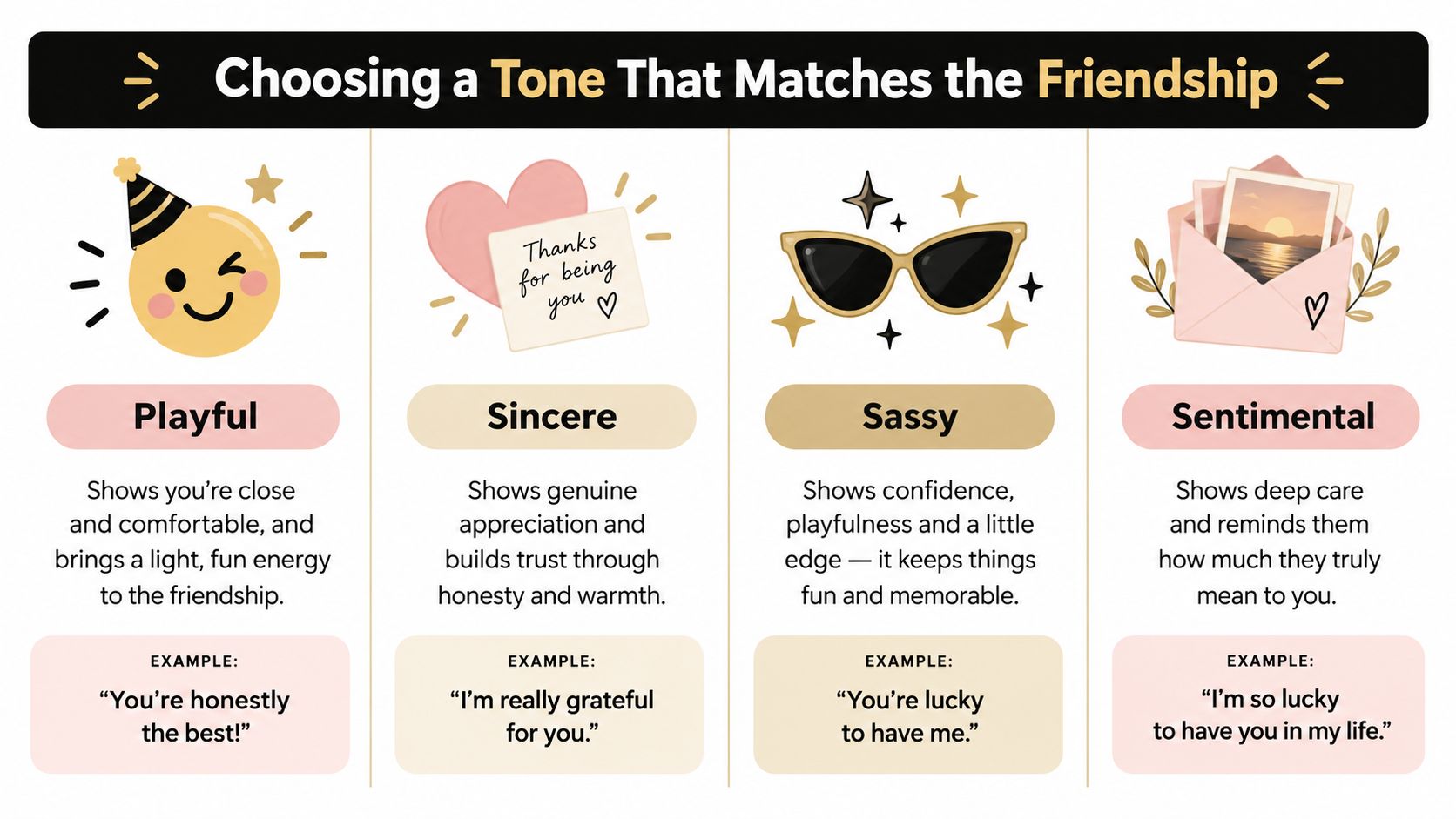
The right birthday message sounds like the friendship behind it. A joke between longtime friends may feel affectionate, while the same joke could seem awkward in a newer or quieter relationship. Treat the phrase as a frame for the card: the words stay familiar, but the tone changes the picture around them.
Playful
Choose a playful tone for the friend who answers affection with a joke and treats teasing as part of everyday conversation. Here, fabulous works like a wink rather than a formal compliment. Try: “Happy Birthday, Fabulous Friend. Still the one person who can make a group chat fun on purpose.”
The line feels natural because the humor reflects an established rhythm. A newer friendship, or one with someone who prefers private attention, may call for less volume and fewer jokes.
Sincere
Sincere wording keeps the compliment warm, specific, and easy to believe. “Happy Birthday, Fabulous Friend. You've always been the kind of person who makes life easier to be around” suits a longtime friend whose steady presence matters to you. The feeling comes through without making the card perform.
A friend who enjoys big celebrations may want more energy, such as an extra sentence about what makes them wonderful. For more ways to write to a close friend, see these birthday card ideas for your best friend.
Sassy
Sassy wording gives the card a little sparkle and attitude. The word fabulous becomes part of a playful performance: “Happy Birthday, Fabulous Friend. Obviously, the room improves when you walk in.” Use this approach with someone who enjoys confidence, exaggeration, and a sharp joke.
Read the line through the recipient's perspective. A friend who takes words at face value or dislikes being singled out may prefer a softer compliment with the same warmth.
Sentimental
Sentimental wording opens the door to gratitude and shared history. “Happy Birthday, Fabulous Friend. I'm grateful for every year that's had you in it” fits a friendship shaped by care, trust, and time. A short line can carry considerable feeling when the relationship gives it context.
For a friend who prefers bright, quick messages, keep the reflection brief and the emotion modest. The best tone should feel like your voice together, not a costume put on for the occasion.
Building a Full Message Around the Phrase
A strong birthday note usually moves in three beats, greeting, detail, wish. The phrase you started with becomes the spine, and everything else hangs off it without competing for attention. That keeps the message cohesive even when you stretch it beyond a single line.
A simple expansion pattern
Start with the birthday greeting. Add one specific thing that only fits this friendship, an inside joke, a shared memory, or a trait you genuinely admire. Close by looking forward, with a wish that feels like care rather than filler.
A bare version can become a real note very quickly. “Happy Birthday, Fabulous Friend” can grow into “Happy Birthday, Fabulous Friend. I still laugh thinking about our karaoke duet disaster, and I'm glad we've survived enough questionable choices to celebrate another year of you.” That works because the memory does the heavy lifting, not the birthday phrase.
For a mentor-friend, the same structure softens into something steadier. “Happy Birthday, Fabulous Friend. I've never forgotten the career advice you gave me when I needed it most, and I'm still grateful for how clearly you saw things.” The tone changes, but the spine stays strong.
For a milestone birthday, the note can open outward instead of inward. “Happy Birthday, Fabulous Friend. We've had years of good stories, honest talks, and enough shared history to fill more than one card, and I hope this year gives you a little extra joy back.” Here the phrase introduces the message, then the reflection carries it home.
Use the phrase as the frame, not the whole picture. Once it feels right, add one concrete detail and one forward-looking wish, and the card usually finds its shape on its own.
Five Card Examples You Can Adapt
The easiest way to hear the phrase in real life is to see it inside finished messages. Each of these is built to be copied, trimmed, or swapped around depending on the friendship.
Best friend from college
Happy Birthday, Fabulous Friend.
I still think about our late-night study sessions, the cafeteria coffee, and the ridiculous nickname we somehow made permanent. You've been my favorite kind of chaos for years, and I hope your day is full of everything you love.
This works because it leans on shared history without explaining the friendship from scratch. The private nickname makes it feel owned.
Work friend who became close
Happy Birthday, Fabulous Friend.
You started as the person I compared notes with at work, and somehow became one of the easiest people in my life to talk to. Wishing you a birthday that feels calm, fun, and very well deserved.
This one keeps the warmth real while staying a little polished. It suits a friendship that grew carefully and naturally.
Long-distance friend
Happy Birthday, Fabulous Friend.
Distance has never made you feel far away, because you still show up in the little moments that matter. I'm raising a glass from here and hoping your day feels full of love, cake, and people who know how special you are.
This version works because it acknowledges separation without turning the card into a complaint about it.
Friend in a new life chapter
Happy Birthday, Fabulous Friend.
You've stepped into a new season with more grace than most manage in a whole lifetime. I'm cheering for you, and I hope this birthday reminds you how much good is still ahead.
This fits a move, a new job, a breakup recovery, or any moment where the year ahead feels bigger than the one behind.
Friend who dislikes sentiment
Happy Birthday, Fabulous Friend.
You remain annoyingly excellent in the best possible way. Hope the cake is good, the people are fun, and the day doesn't involve any boring small talk.
That version keeps the compliment but strips out the extra softness. It works when the friendship thrives on wit instead of sentiment.
Pairing the Message With the Right Card
The card sets the stage for the words inside it. A brief, energetic line can get lost in a crowded design, while a thoughtful note may feel mismatched on a card covered with party graphics. Matching the format to the message helps the sentiment arrive in the right tone.
A postcard suits one strong sentence or two compact lines. A folded greeting card leaves space for a fuller note, including a more reflective version of Happy Birthday, Fabulous Friend. A flat note card falls between those options, giving you room for a clean message without the extra space of a fold.
The writing style should support the design. Left-aligned handwriting feels relaxed and conversational. Centered lines look more formal or decorative. A playful phrase pairs naturally with bold illustrations, while a heartfelt message often works best against a simple background that keeps attention on the words.
The inside layout matters as much as the cover. Leave enough open space for the greeting to breathe, especially if you plan to add a memory or a personal closing. Crowded lines can make even a sincere message feel hurried.
When you choose materials and preview the finished card, Mail This shows the folded card, typeset message, and total with postage before payment. That preview lets you catch awkward spacing or an unsuitable image before sending. For a milestone birthday, a photo card can add personality without requiring extra words.
A Quick Checklist Before You Send
A final read-through saves a lot of awkwardness later. The goal isn't perfection, it's making sure the card feels like you and sounds right for them.
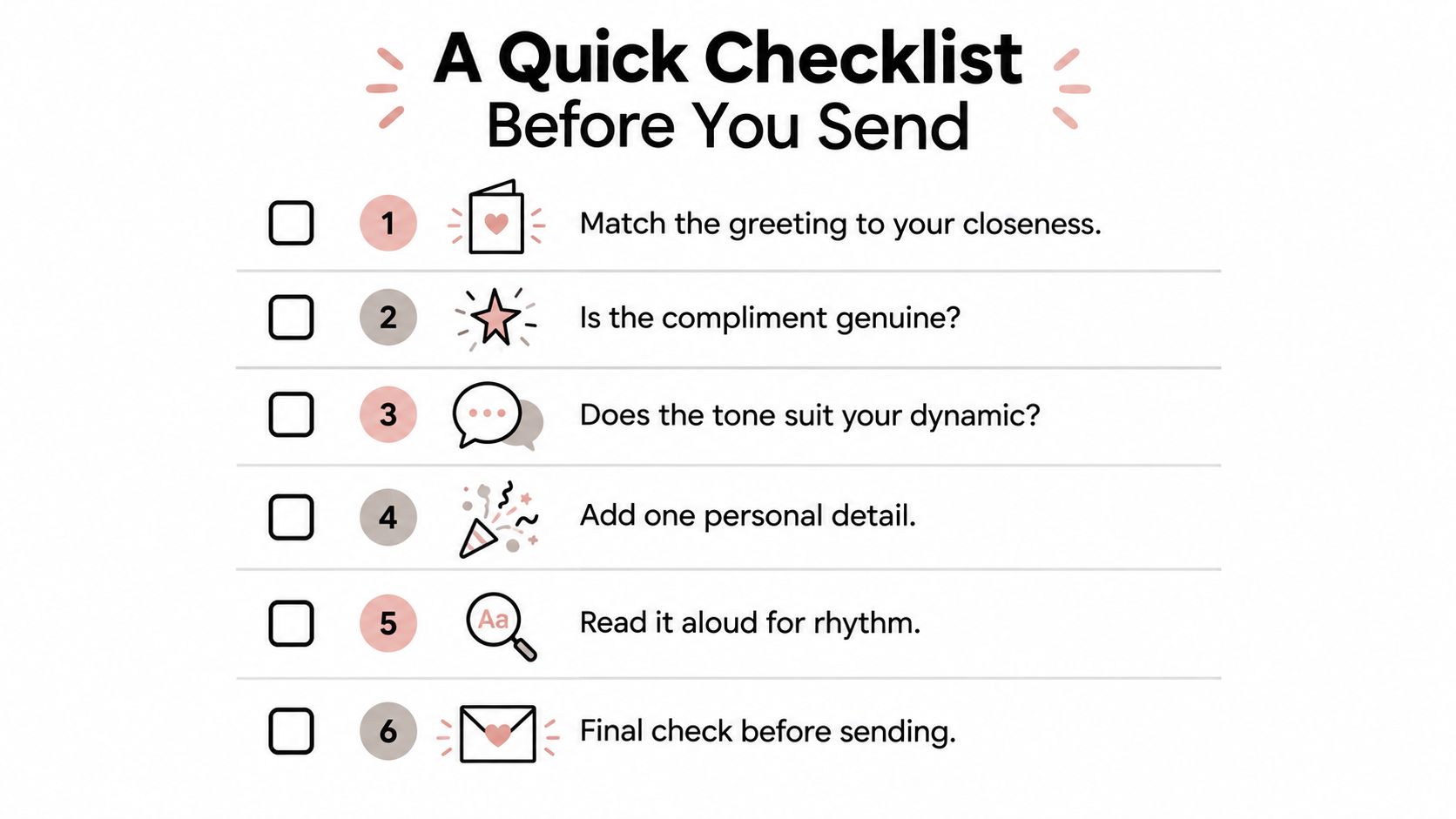
- Match the greeting to the closeness. “Happy birthday” usually fits almost everyone, but if the friendship is especially intimate, you can make the opening feel warmer.
- Check whether the compliment is genuine. If “fabulous” feels true, keep it. If it sounds too theatrical for this person, soften it.
- Make sure the tone suits the dynamic. A joking friend can carry playful language. A quieter friend may need something steadier.
- Add one personal detail. A memory, a nickname, a shared habit, something that proves this was written for one person.
- Read it aloud for rhythm. If you stumble over a line, your recipient probably will too.
- Confirm the sign-off and delivery details. A clean close, the right address, and the delivery method matter as much as the wording itself.
Keep the note short enough that the warm parts stand out and the awkward parts don't get room to grow.
If the message feels like it would make sense in your own voice, you're close. If it sounds like you borrowed it from a greeting-card shelf, trim it once more. A thoughtful line, a clean card, and the right address are usually enough to make the whole thing land well.
Mail This helps you turn a short birthday idea into a printed card with a preview-first workflow, so the wording, design, and delivery all match before anything is mailed. If you want to send a Happy Birthday, Fabulous Friend card without guessing how it will look in print, visit Mail This and build it from there.