A standard one-ounce greeting card in a rectangular envelope uses the USPS First-Class Mail letter rate for a Forever stamp. Check the USPS First-Class Mail pricing page for the current amount. The postage is only part of the total: the card, envelope, printing, and time spent writing and addressing it also count.
Separate postage from the cost of preparing a finished card. A stamp covers postage for a qualifying letter, not its materials or preparation. The finished mailpiece's shape, thickness, and weight determine whether it qualifies for the basic letter rate or costs more to send.
Table of Contents
- What a Greeting Card Costs to Mail Today
- Worked Cost Example for Real Mailings
- Card Shape, Weight and the Pre-Mailing Check
- Stamps, Metered Mail and Fulfillment Compared
- Planning the Mailing Date Around Delivery Time
- Choose the Cheapest Route That Fits Your Card
What a Greeting Card Costs to Mail Today
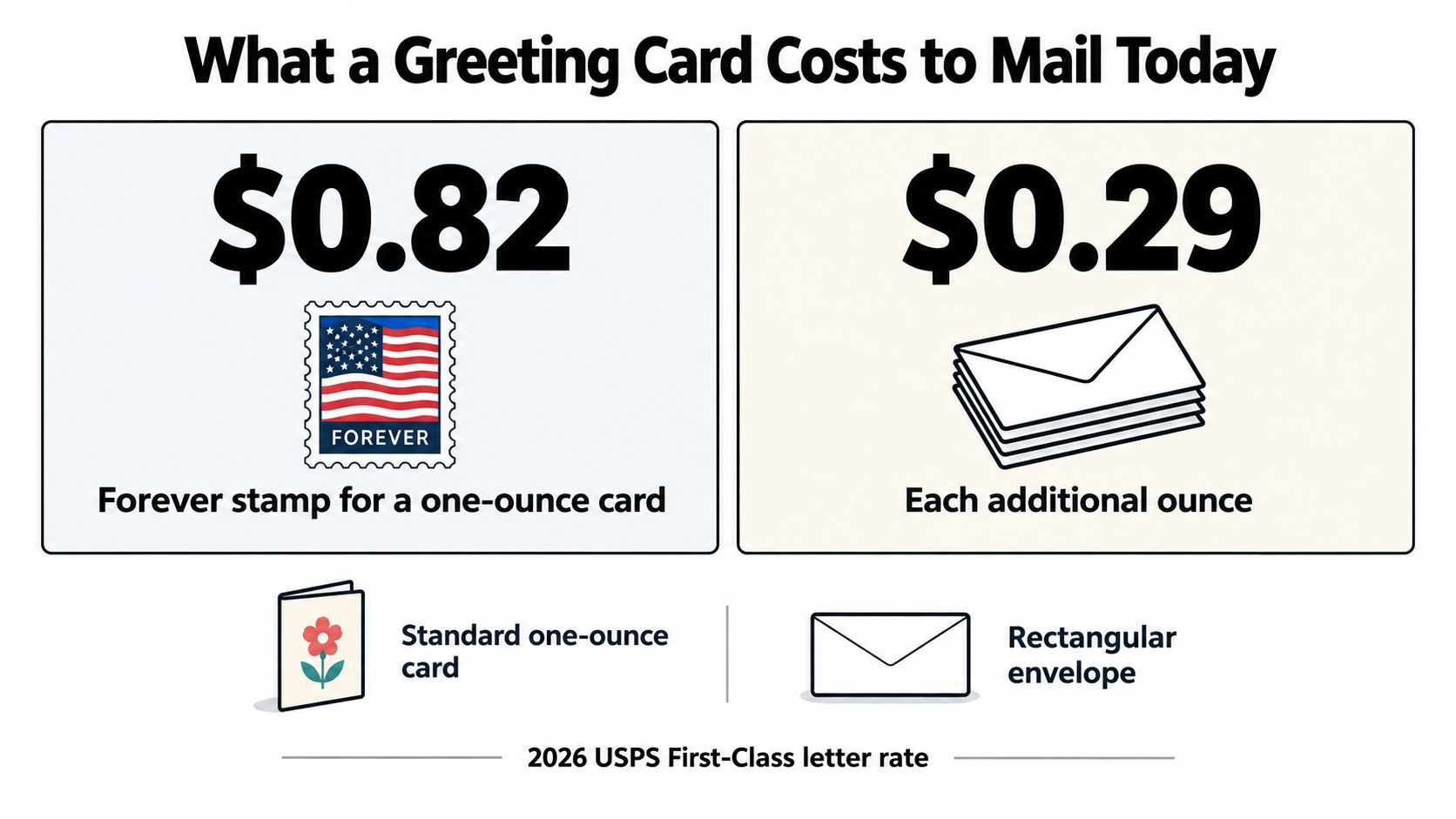
For a conventional card in a standard rectangular envelope, start with $0.82 for up to one ounce. Each additional ounce adds $0.29, according to the USPS guide to First-Class Mail types and pricing. That's the postage charge, not the total cost of buying or producing the card.
| Option | Postage or price | What is included | Watch for |
|---|---|---|---|
| Forever stamp, standard rectangular envelope | $0.82 | Postage for one ounce | Card, envelope, printing, and addressing are extra |
| Forever stamp, square, oversized, or unusual envelope | From $1.31 | Postage for one piece | Nonstandard shape changes the rate |
| Each additional ounce at letter rate | +$0.29 | Added postage for extra weight | Weigh the finished card, not the card alone |
| Metered postage at a post office counter | $0.82 letter rate | Postage printed on the envelope | Works best for batches of mail |
| Mail This fixed price | $9.99 per card | Card, envelope, printing, addressing, and domestic postage | Applicable tax is shown before purchase; New York State is not supported |
| Store-bought card plus stamp | Card price plus $0.82 postage | Card, envelope, and postage | Card price varies by retailer and design |
USPS lists standard rectangular envelopes from $0.82, while square, oversized, or unusual envelopes start at $1.31. Treat that as the published starting rate for those formats, not as the standard letter price with an assumed extra surcharge added on top. The finished piece's classification determines which postage applies.
For a do-it-yourself mailing, your budget line is $0.82 in postage, plus what you pay for the card and envelope, plus your writing and addressing time. That total can't be calculated from the stamp price alone. A fixed-price service can bundle those tasks, but its price isn't a like-for-like comparison with postage alone.
USPS has proposed new prices for July 2026, so check the current USPS postage price information on the day you mail. The practical rule is simple: the rate follows the finished piece, not the word “card.” A light, flexible card in a conventional envelope is easier to price than one that's square, bulky, or unusually shaped.
Worked Cost Example for Real Mailings
Consider five folded cards, each under one ounce and mailed in a standard rectangular envelope. With Forever stamps, postage totals 5 × $0.82 = $4.10. That figure doesn't include the cards, envelopes, or the sender's time to write, address, and take the batch to a mailbox.
Metered postage for the same five qualifying letters also totals $4.10 at the letter rate. It changes how postage is applied, not the cost of the cards or the work needed to prepare them.
A bundled option gives a different total. At $9.99 per card, five cards through Mail This come to $49.95 before applicable tax, with printing, addressing, packing, envelope, and domestic postage included. The $45.85 difference between that total and the stamps-only total is the cost of the additional production and fulfillment, not extra postage.
Budgeting rule: Compare the full service price with your own total for cards, envelopes, postage, and preparation. Comparing a bundled price only with the stamp amount leaves out most of what the service covers.
For a square card weighing 1.2 ounces, an illustrative starting calculation is $1.31 + $0.29 = $1.60, using the published starting rate for a nonstandard envelope and one additional-ounce charge. Check the current USPS price list and the card's classification before printing or mailing; the example isn't a guarantee of the final charge. Each scenario can be checked at home by weighing and measuring the completed piece.
Card Shape, Weight and the Pre-Mailing Check
Postal sorting equipment is designed for flat, even, rectangular pieces. A square, stiff, lumpy, or unevenly thick card may require different handling and postage, even when it weighs less than an ounce. USPS sets letter-size maximum dimensions at 11.5 by 6.125 inches, with a maximum thickness of 0.25 inch. Rigidity, uneven thickness, and unusual shape can also affect machinability under its letter-size standards.
Shape and weight are separate checks. A square letter, or one with an aspect ratio below 1.3 or above 2.5, can be classified as nonmachinable. The published starting price for a square, oversized, or unusual envelope is $1.31. Other nonmachinable features, including rigidity and uneven thickness, may carry an additional USPS surcharge. Check the current USPS price list to confirm the amount and how the completed piece is classified.
| Card feature | Postal rule triggered | Postage effect |
|---|---|---|
| Square shape or aspect ratio below 1.3 or above 2.5 | Nonmachinable letter | Published starting rate of $1.31 for square, oversized, or unusual envelopes |
| Rigid stock, such as chipboard or stiff cardboard | Nonmachinable letter | An additional USPS surcharge may apply; check the current price list |
| Uneven thickness from layered embellishments | Nonmachinable letter | An additional USPS surcharge may apply; check the current price list |
| Loose items, such as coins, charms, or confetti | Nonmachinable letter | An additional USPS surcharge may apply; check the current price list |
| Finished piece over one ounce | Additional-ounce charge | +$0.29 for each additional ounce |
| Height over 6-1/8 inches or weight over 3.5 ounces | Flat pricing instead of letter pricing | Flat rate applies |
Weight creates a separate threshold. A First-Class letter incurs an additional $0.29 per extra ounce, so weigh the card, envelope, inserts, and decorations together. The finished, sealed mailpiece determines the weight, not the card by itself.
Check the finished card before mailing
- Measure the folded card and envelope. Compare them with the letter-size limits of 11.5 by 6.125 inches. A piece over 6-1/8 inches high or weighing more than 3.5 ounces can move to flat pricing rather than letter pricing.
- Weigh the complete mailpiece. Include the card, envelope, insert, and sticker. One stamp covers the standard one-ounce letter rate only if the finished piece stays within that weight.
- Check thickness as well as size. A letter-size piece longer than 6 inches or higher than 4.25 inches should be at least 0.009 inch thick to avoid a thin-piece machinability issue. A card measuring 125 by 175 mm is about 4.9 by 6.9 inches, so it is longer than 6 inches and needs this thickness check.
- Choose a rectangular envelope. A standard rectangle avoids the extra classification uncertainty associated with square or unusual formats.
- Remove rigid or loose additions. Coins, charms, stiff boards, and layered decorations can make a mailpiece rigid or uneven. Flat decorations are less likely to affect its machinability.
- Place the stamp at the upper right. Keep the address clear and legible.
- Ask at the counter if the card feels bulky or unusual. A postal clerk can help check the classification before you send a batch.
For format ideas before printing, browse these types of greeting cards. Base the mailing check on the completed envelope, since the card design alone does not show its final size, thickness, or weight.
Stamps, Metered Mail and Fulfillment Compared
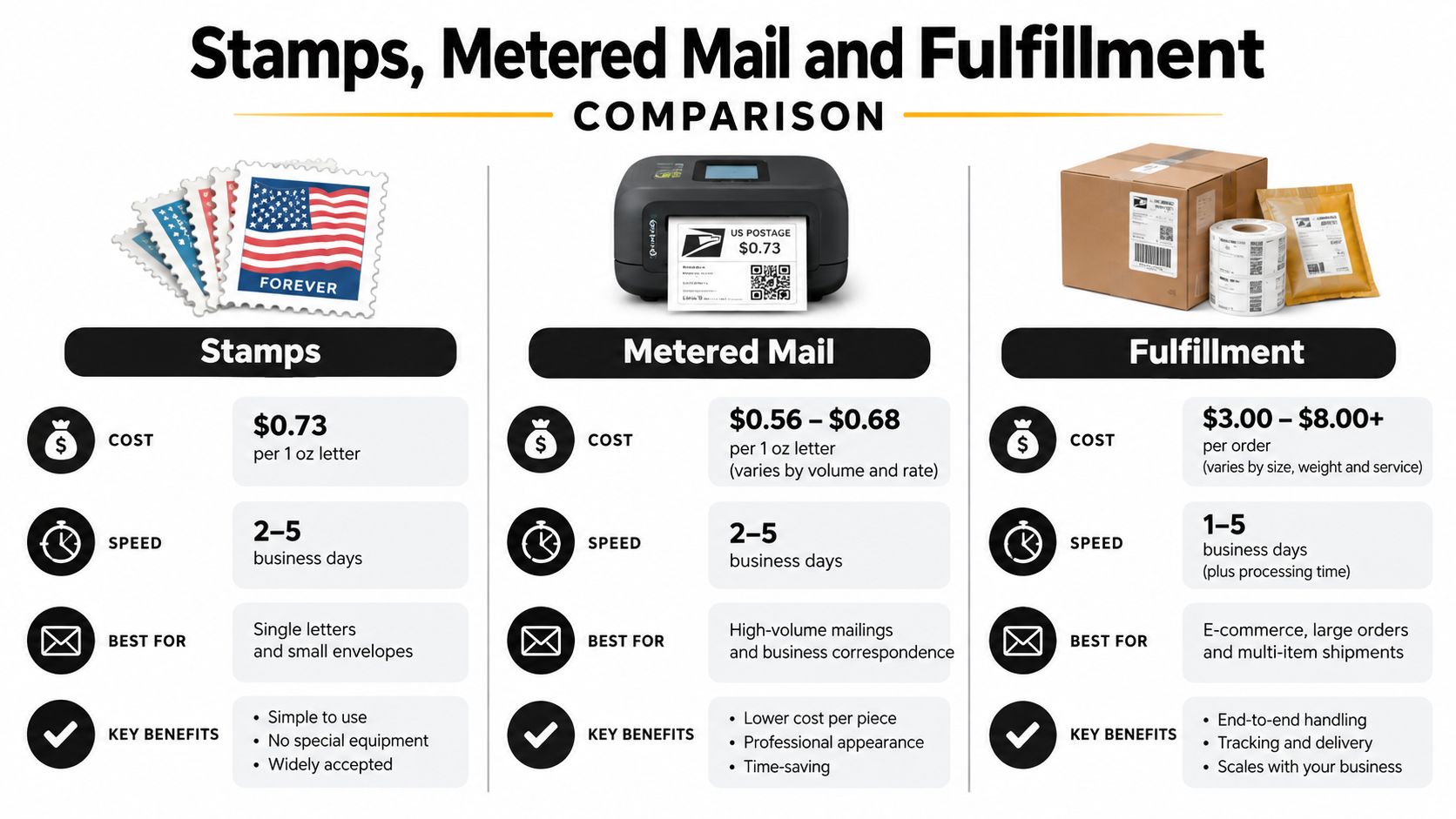
These mailing routes trade off price per card, hands-on effort, and convenience. Stamps keep the postage cost low but leave the preparation to you. Metered postage can make a batch easier to process. A fulfillment service costs more than postage alone because the displayed price can include production and handling.
| Route | Cost per card | Hands-on effort | Best use |
|---|---|---|---|
| Forever stamp | $0.82 for a standard one-ounce letter | Buy the card, write and address it, add postage, and mail it | A small number of cards when you want to prepare them yourself |
| Metered postage | $0.82 letter rate | Prepare the cards and have postage printed at the counter | A batch when avoiding individual stamps is useful |
| Mail This | $9.99 per card | Approve the card and recipient; printing, addressing, packing, and domestic postage are included | A personalized card when you don't want to print and mail it yourself |
A postcard is not a cheaper substitute for every greeting card. USPS lists the 2026 postcard price at $0.65, compared with $0.82 for a one-ounce letter. A folded greeting card inside an envelope generally uses the letter category, because it's an enclosed card and envelope rather than a single postcard-format piece, according to the USPS 2026 postage price information.
Think of a stamp as a bus ticket: it covers the postage, but you still make the trip to prepare and mail the card. Fulfillment is more like a taxi that comes to the door. It costs more, but it removes printing, addressing, packing, and the trip to hand off the mail.
Mail This includes an envelope and domestic postage in its fixed price, with applicable tax shown before purchase. Its service doesn't support New York State, U.S. territories, or military addresses, and its arrival window is an estimate rather than a guaranteed delivery date. Choose by what you need: the stamp route minimizes postage spending, metered mail suits prepared batches, and fulfillment reduces the work you handle yourself.
The comparison infographic below puts those trade-offs side by side.
For a visual overview of sending a card, watch the video below.
Planning the Mailing Date Around Delivery Time
Correct postage doesn't guarantee that a card will arrive on a particular day. USPS maintains a one-to-five-day First-Class Mail service range, while distance-based service-standard changes introduced in 2025 mean route timing can vary. The Postal Regulatory Commission's information on USPS service-standard changes describes a mix of shorter and longer standards depending on the origin, destination, and distance.
Use that range as a planning guide, not a promise. These are practical buffers, not USPS guarantees:
- Same-region card: Allow at least three business days.
- Cross-country card: Allow about five business days.
- Birthday or holiday card: Mail a week or more ahead if the date matters.
Count backward from the occasion, allow for the expected transit range, then add a buffer for weekends and holidays. That gives you a mailing date you can act on rather than relying on the recipient to receive the card exactly when you expect.
The same caution applies to a mailing service that displays an estimated arrival window. An estimate can help you plan, but it isn't a guaranteed delivery date. If you're new to preparing a card for postal delivery, follow this guide to sending a card in the mail.
Choose the Cheapest Route That Fits Your Card
The cheapest route depends on more than the stamp price. Choose based on how many cards you're sending, how much preparation you're willing to do, and whether the completed card qualifies as a standard letter.
- For a handful of cards: If you have time to write and address them, use Forever stamps and a suitable rectangular envelope. Your postage starts at $0.82 per standard one-ounce card, plus the card and envelope.
- For a larger batch: If you're preparing many cards on the same day, ask about metered postage at the counter. It avoids applying an individual stamp to each envelope.
- For a card you don't want to print or address yourself: Mail This offers personalized folded cards, with printing, addressing, packing, and domestic postage included in its fixed price. The service doesn't support New York State, U.S. territories, or military addresses.
Before paying postage or approving a fulfillment order, check three things: the piece is flat and rectangular, the finished envelope is within the weight you've budgeted for, and the recipient's address is eligible for your chosen mailing route. For an order through Mail This, review the full preview, including the design, recipient, and total, before payment. The preview gives you a final chance to catch a wrong address or an unexpected total.
If you're also comparing physical cards with digital greetings, this overview of paperless post alternatives can help frame the choice. For a physical card, calculate postage and preparation together, then confirm the finished piece's shape and weight before mailing.
Mail This turns a short idea into a personalized physical greeting card and includes the envelope, printing, addressing, and domestic postage in its price. Visit Mail This to preview the card, recipient, and total before you decide to send.