You've got the cards spread across the table, the pens are uncapped, and the stack of envelopes still looks taller than your patience. The front of the card was easy, but the inside is where people stall, because one line has to feel warm, broad enough for a mixed group of recipients, and not awkward on the page. Merry Everything Happy Always works like a ready-made closing line when you want to stop rewriting and start signing.
For a quick dose of card-inspo while you're sorting your list, these family Christmas card ideas can help you see how a short greeting fits into a real card without taking over the whole note. The phrase is flexible, but it's not automatic. A good card editor asks three questions first, whether to use it, whether to adapt it, and whether to skip it entirely.
Table of Contents
- A Blank Card in December
- What the Phrase Actually Means
- Where the Wording Came From
- Who the Greeting Works Best For
- Pairing the Phrase with the Rest of the Card
- Personalization Trends Shaping 2026 Cards
- Friendly Alternatives When the Phrase Doesn't Fit
- Making the Greeting Feel Like You
A Blank Card in December
The scene is familiar. The address list is half checked, the table is covered with card stock, and one envelope keeps getting opened and closed because the inside panel feels blank in the wrong way. The front design took two minutes, but the message has already taken an hour.
That's where Merry Everything Happy Always earns its keep. It gives you a tested closing line so you're not inventing a clever ending for every single card, and it keeps the tone upbeat without forcing a specific holiday on the reader. If you're sending a lot of cards, that matters, because every extra decision slows the whole batch down.
Practical rule: use the phrase when you want the card to feel broadly cheerful, not when you need each envelope to sound fully custom.
The easiest way to think about it is as a reusable sign-off template, not a quotation you have to preserve with museum-level accuracy. You can pair it with a short personal note, a photo card, or a simple year-end update, then move on to the next envelope. That's often the difference between “I'll mail these someday” and “these are ready to go.”
What the Phrase Actually Means
The line works because it splits cleanly into two ideas. “Merry everything” reaches across the season instead of naming one holiday, and “happy always” stretches the wish beyond December. Together, the wording feels inclusive, because it doesn't assume the reader celebrates Christmas, Hanukkah, the winter solstice, or any one tradition in particular.
Why the rhythm lands well
The phrase also sounds good out loud. It has a simple, balanced shape, and that balance helps it read smoothly at the end of a handwritten note or a printed card. In a greeting card, rhythm matters more than people expect, because clunky wording can make a warm message feel forced.
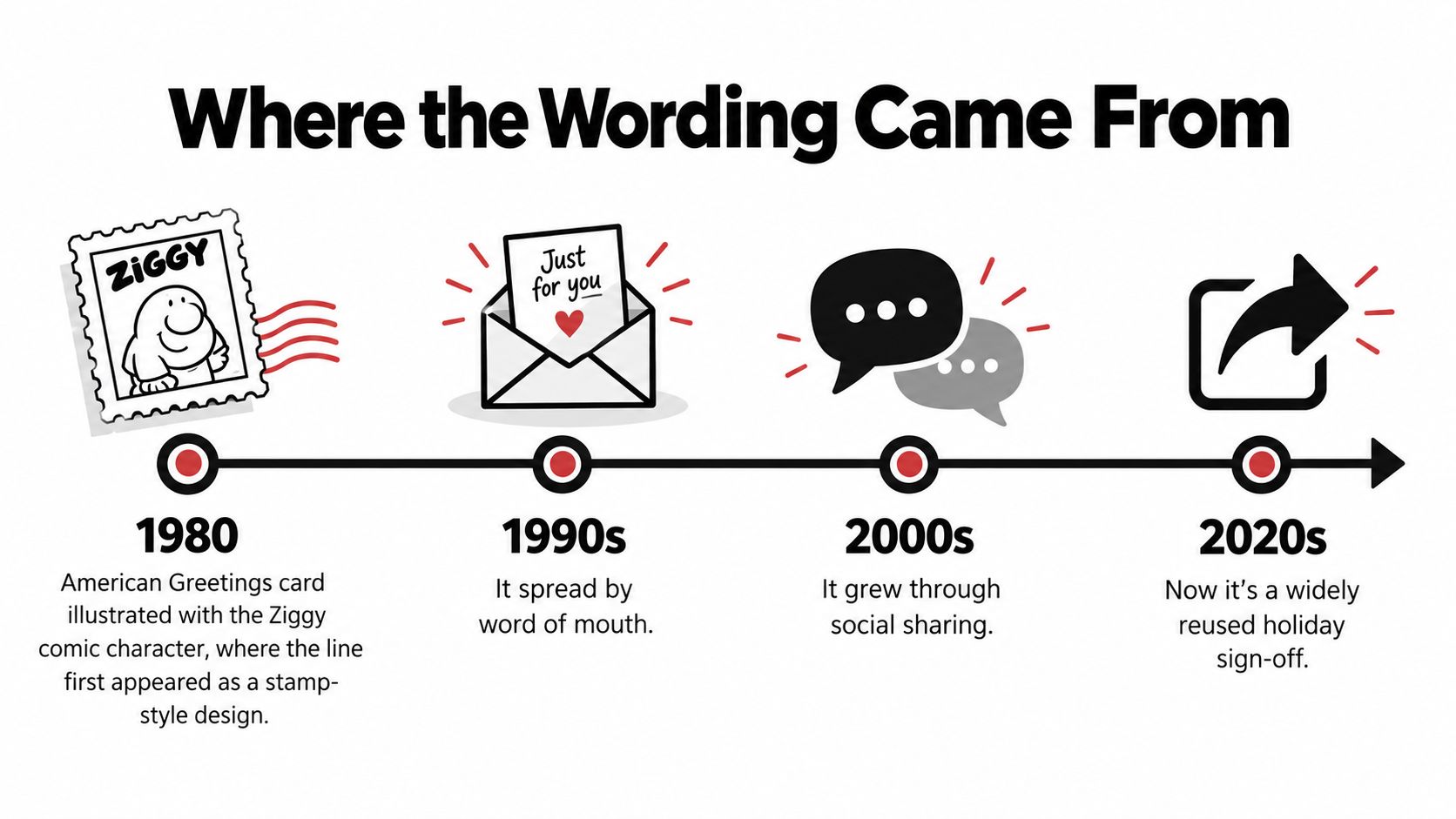
The phrase's history also shows it has been around long enough to feel familiar. A print trail traces “Merry Everything and a Happy Always” back to at least December 24, 1980 in an El Paso Times advertisement, with a December 28, 1980 Star-News column crediting the line to a Christmas card idea by “Ziggy” for American Greetings. It appeared again in the Chicago Tribune on November 30, 1981, and later in a 1993 Los Angeles Times ad, which shows it had already become a recurring holiday greeting by the early 1980s and early 1990s. Barry Popik's phrase history is the cleanest trail for that early print record.
One caution belongs here, too. “Always” is a strong word, so it can feel too chipper for someone going through grief or a hard year. That doesn't make the phrase wrong, it just means tone matters more than novelty.
Where the Wording Came From
The phrase's origin story matters because it explains why it feels like a greeting card line instead of a polished literary quote. The confirmed print record points to an American Greetings card tied to Ziggy, where the wording first appeared as a stamp-style design. That kind of card line travels differently from a poem or a scripted slogan, because it enters daily use as something people repeat without always remembering where it started.
What is confirmed, and what is folklore
What's confirmed is the early print appearance and the card connection. What often gets blurred in casual retellings is the leap from one novelty card to wider holiday speech, because once a line starts circulating, people reuse it in notes, captions, and small-business holiday mailings. That orphan status helps it travel, since no one feels they need to quote it perfectly or credit a single owner every time.
It also fits a larger pattern in greeting-card language. Short seasonal phrases often move from one-off copy to ordinary speech, then settle into the background of holiday communication. Season's greetings works that way, and this phrase does something similar, only with a friendlier, more playful texture.
You can see the same logic in how physical card formats affect message choices. USPS guidance says most greeting cards qualify for letter mail if they meet uniform thickness and flexibility standards, but square cards can trigger a nonmachinable surcharge, and cards over 3.5 ounces are priced as flats rather than letters. In other words, format shapes postage class, and postage class shapes how much text people usually want to fit inside. USPS postcard and greeting card guidance makes that tradeoff plain.
Who the Greeting Works Best For
Some recipients will welcome the phrase immediately. Friends, casual coworkers, neighbors, and extended family usually receive it well because it sidesteps religious framing and doesn't pin the card to one holiday. It's especially handy when you're sending the same base design to a mixed group and want one line that won't feel off-target.
Quick fit check
| Recipient Type | Fits Well? | Suggested Adjustment |
|---|---|---|
| Close friend | Yes | Add one inside joke or memory |
| Casual coworker | Yes | Keep the note brief and polite |
| Neighbor | Yes | Use it as a cheerful all-purpose close |
| Devout religious recipient | Sometimes | Consider a faith-based closing instead |
| Recently bereaved household | Usually not | Choose a gentler, quieter line |
| Client or boss | Sometimes | Use a more formal sign-off |
The phrase is less useful when the relationship carries more weight or more sensitivity. A devout friend may prefer language that reflects their faith, and a recently bereaved household may not want a big, glowing wish at all. For clients, bosses, and professional contacts, a softer business-style close often lands better than a slogan-like line.
The timing matters, too. This wording assumes a December sender, so a card mailed in early November or mid-January can feel slightly out of season. If the occasion isn't clearly holiday-related, choose a simpler substitute and move on.
A good holiday greeting is a default, not a destiny. If one pairing feels wrong, switch the closing for that card and keep the rest of the batch moving.
Pairing the Phrase with the Rest of the Card
A strong card usually gives the greeting a supporting role, not the starring one. The line works best at the bottom, after a real sentence about the year, a shared memory, or a small update. That keeps the inside of the card from reading like a slogan pasted over a blank page.
Openers that sit comfortably above it
- Warm family opener: “We've had a full year, and we're glad to send you a little cheer.”
- Friendly neighbor opener: “Thanks for being the kind of neighbor who makes the block feel easy.”
- Light professional opener: “Wishing you a peaceful close to the year and a strong start to the next.”
A photo-card caption can be just as simple. “A few snapshots from our year, and one more wish for yours” sits above the greeting without competing with it. If the card is short, let the photo do the visual work and keep the inside text restrained.
Here are two full examples that show the phrase as a closing line:
- Short note: “It was good to catch up with you this year, and I'm grateful we stayed connected. Merry Everything Happy Always”
- Longer note: “This year brought a lot of little changes, and some of them turned out better than we expected. We hope the season gives you rest, good company, and a calm start to January. Merry Everything Happy Always”
Avoid putting the greeting at the top like a headline. Don't stack it next to a second closing such as Love, or repeat the same wording in a verse and again at the end. That just clutters the page. If you want a clean valediction, choose one that matches the tone, such as Love, With gratitude, Warmly, or From our family to yours.
For card formats, this guide to the main types of greeting cards can help you decide whether a folded note, a photo card, or a simpler layout will give you enough room for the greeting to breathe.
Personalization Trends Shaping 2026 Cards
A blank card sits on your desk in December, and Merry Everything Happy Always gives it a flexible starting point. Treat the phrase as a reusable greeting template, then shape the surrounding message for the recipient, relationship, and card format.
Holiday cards increasingly include details that show who sent them. One 2026 trend overview says customers want designs that reflect personality, milestones, and style. It also reports that 51% of respondents write a unique message for each recipient, while 23% personalize only for close friends and loved ones. PaperCulture's holiday card trend overview supports a simple editing rule: keep the familiar closing, but make the note around it specific. For example, add a milestone line such as “Year one in our new home” above the closing greeting.
What that means for your layout
Place the phrase near the bottom and give the personal message the main space. A clean lower band keeps the closing from crowding the design, while blank space leaves room for a handwritten sentence. For a closer look at how personal details change a card, see these personalized Father's Day card ideas alongside your holiday layout.
USPS format details also deserve a check before printing. The card's size, shape, and mailing class can affect postage assumptions, so confirm the finished format rather than relying on a general estimate. A folded card may need a different setup from a flat photo card.
Paper and color affect readability too. Muted neutrals and recycled stock can feel refined, but dark type still needs enough contrast. Keep the text large enough to read in person, and review the proof before payment so the printed version matches what you approved.
A proof-based workflow lets each card vary without losing a shared sender identity. One recipient might receive a printed greeting, another a handwritten insert, and another a photo collage. Mail This can turn a short message into a printed card with preview and approval before mailing. Mail This supports that approval-first process when exact wording matters.
Friendly Alternatives When the Phrase Doesn't Fit
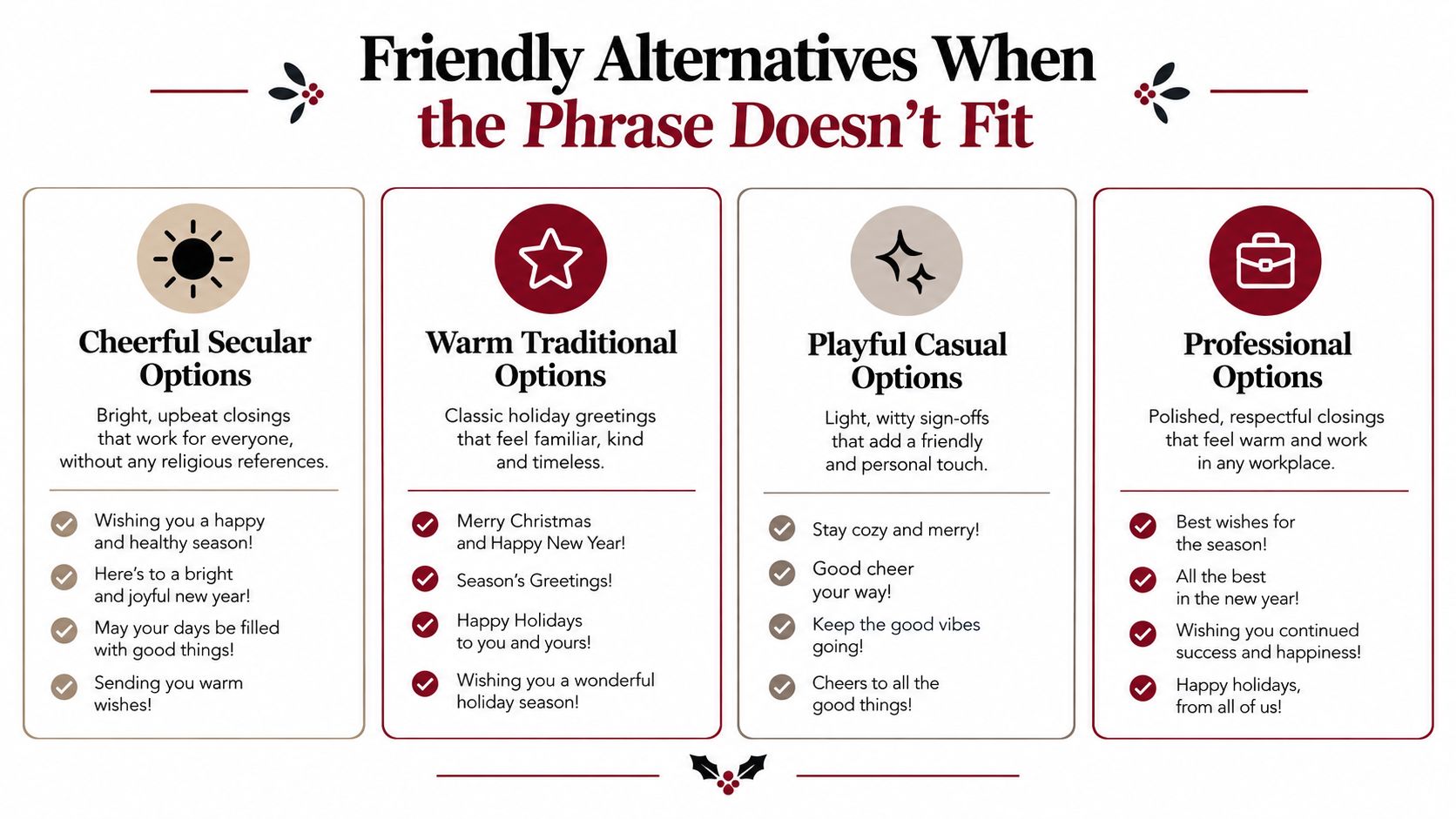
Sometimes the kindest choice is to swap the line out. That can happen when the recipient wants a more faith-centered message, when the year has been heavy, or when the card is for work and the tone needs to stay steady. A good substitute should feel as easy to place on the page as the original.
Cheerful secular options
- Wishing you joy and ease all season
Works well for mixed recipient lists and belief-neutral cards. - Warm wishes for a bright holiday
Good when you want something friendly but not playful. - Sending you cheer and a calm new year
Better for end-of-year mail than for nonseasonal occasions.
Reflective closings
- Thinking of you with care this season
Fits grief, illness, or a difficult year. - Hoping the days ahead bring rest
Gentle and low-pressure. - With quiet support and warm thoughts
Best when cheer would feel too loud.
Faith-based lines
- Blessings to you and your family
Good for Christian recipients who welcome religious language. - Merry Christmas and many blessings
Straightforward and traditional. - Rejoicing in the hope of the season
Use when a more devotional tone is wanted.
Professional closings
- Warm regards for the season ahead
Safe for coworkers and clients. - Best wishes as the year closes
Useful for formal work cards. - With appreciation and good wishes
Best for business relationships and vendor notes.
Keep the replacement close to the original length so your layout doesn't break. The goal is not to memorize a giant phrase bank, it's to choose one line that fits the person in front of you.
Making the Greeting Feel Like You
A seasonal template feels personal when it follows one sentence only you could write. Add a shared memory, a quick update, or a small inside joke. That line gives Merry Everything Happy Always a job: it closes the thought instead of carrying the whole card.
Use one prompt before sealing the envelope:
- “In 2026 we finally [blank], and I'd love to hear what [blank] looked like for you.”
- “I still think about [blank], and it made me smile to send this your way.”
- “This year gave us [blank], and I'm glad we got to share it.”
- “Next time we're together, I want to hear more about [blank].”
Write the personal sentence first, then choose the greeting. This order keeps your voice at the center and leaves the seasonal line as a clean finishing touch. Keep both lines short enough to sit comfortably inside the card, especially if the message will be handwritten.
Mail This can turn a short idea into a physical card and lets you preview how the wording fits the design. Use one prompt above, add a single personal sentence, and visit Mail This to start the card.