"Just sign it with love" is popular advice, but it's not always good advice. Love, With love, and All my love aren't interchangeable, and choosing the warmest-sounding phrase can leave someone wondering whether you meant romance, reconciliation, or happy birthday. When you're signing a card with love, match the words to the relationship you have, not the feeling you hope the card will create.
Table of Contents
- Why the Last Line of a Card Matters More Than You Think
- What Love, With Love, and All My Love Signal
- Matching Your Closer to the Relationship and the Occasion
- Stronger and Softer Alternatives to With Love
- Upgrading a Generic Love Line Into a Specific One
- When Signing With Love Can Backfire
- Your Pre-Envelope Checklist for Signing a Card With Love
Why the Last Line of a Card Matters More Than You Think
A card's closing tells the recipient how to interpret everything above it. Write a friendly birthday message and finish with “Forever yours,” and you've introduced a different conversation. Write a tender note to your partner and finish with “Regards,” and you've made the affection sound oddly administrative.
That doesn't mean every recipient will dissect your punctuation. It means the closing should confirm the message, not complicate it. A good sign-off sounds like something you'd comfortably say to that person when nobody else is listening.
Personal words are the point
Written affection has a long history. Britannica's account of greeting cards dates paper valentines with inscribed sentiments to the 16th century, well before today's commercial card habits. The useful lesson isn't that you need an old-fashioned flourish. It's that your own words make an otherwise ordinary object personal.
Personalization still matters to senders. Industry coverage reports that 55% of Americans preferred a personalized message over a generic or AI-generated greeting, according to PostPress's greeting-card industry reporting. That preference supports a practical recommendation: choose language that belongs to your relationship rather than copying the most sentimental option.
Watch for these common mismatches:
- Accidental romance. An intimate closing underneath an ordinary message can suggest feelings you haven't discussed.
- Borrowed intensity. “All my love” can sound theatrical if you normally communicate through quiet, matter-of-fact affection.
- Unwanted distance. A stiff closing can make a close relative wonder why you sound like a business contact.
- False familiarity. A nickname or private joke won't create shared history where none exists.
Practical rule: Choose the closing you could say aloud without needing to explain what you meant.
Think like a musician tuning an instrument. You aren't trying to make every note louder. You're trying to make it fit. Start with the recipient's comfort, the established relationship, and the occasion's emotional tone. Your own urge to sound impressive comes last.
What Love, With Love, and All My Love Signal
A closing is not a decorative extra. Love, With love, and All my love carry different levels of warmth, so choose the one that fits how you and the recipient already speak to each other.
Love is compact and familiar. In a family that routinely uses it, “Love, Sam” feels natural. Between people who rarely express affection that way, the same word can sound like a declaration. Use it when it matches your established tone.
With love adds a little ceremony. Use it when you want the card to feel deliberately affectionate without making a sweeping statement. It can sound warmer than a bare “Love,” but the recipient's habits matter more than any universal ranking.
Read the modifiers, not just the word love
“All” and “always” add emotional weight. Don't use them just to fill space at the bottom of the card.
| Closing | Emotional signal | Recommended use |
|---|---|---|
| Love | Familiar affection, stated plainly | Established close relationships |
| With love | Affection offered deliberately | Family, close friends, established partners |
| All my love | Expansive, wholehearted affection | A partner or a very affectionate family relationship |
| Love always | Affection with a promise of continuity | Relationships where that commitment is welcome |
“All my love” can sound romantic, but it isn't reserved for romantic partners. A parent can use it beautifully with a child. The deciding question is whether that level of affection already feels comfortable between you.
“Love always” suggests permanence. That may reassure someone close to you, but it can also sound like a promise the recipient didn't ask for. Avoid using “always” to press past uncertainty or unresolved boundaries.
Your signed name changes the register
The name beneath the closing should match its warmth. A mismatched signature can make an otherwise fitting phrase feel distant or overly intimate.
- First name. Use your familiar everyday name for most personal cards. “With love, Alex” is clear and unforced.
- Nickname. Choose it only when the recipient already uses it. A pet name feels meaningful because it's shared, not because it sounds cute.
- Relationship name. “Love, Dad” or “With love, Aunt Jo” works for family cards when that's how the recipient knows you.
- Full name. Use it when identification matters, especially for professional contacts or someone who may know several people with your first name.
- Shared signature. Name the senders. “With love, Priya and Ben” is clearer than an unexplained “Us.”
Keep jokes recognizable and gentle. An established silly nickname can make a birthday card feel unmistakably yours. A new nickname may leave the recipient wondering what you meant.
Matching Your Closer to the Relationship and the Occasion
Choose for the relationship first, then adjust for the occasion. An anniversary doesn't authorize romantic language between friends, and a holiday doesn't make every coworker part of your inner circle. The event changes the mood, not the underlying relationship.
Use this matrix as a starting point, not a script. The same closing can be right for one sibling and wrong for another because shared habits matter more than the family label.
Card Closer Choices by Recipient and Occasion
| Recipient | Warm or formal occasions | Sympathy or difficult occasions |
|---|---|---|
| Romantic partner | Anniversary or birthday: All my love, Yours, With love | I'm here with you, With all my love |
| Parent | Birthday or milestone: With love, Love | With care, Thinking of you |
| Sibling | Birthday or congratulations: Love, With love | I'm here, Sending you love |
| Close friend | Birthday or holiday: With love, Sending hugs | Holding you in my thoughts, With care |
| New friend | Birthday or everyday note: Warm wishes, Take care | Thinking of you, With sympathy |
| Colleague | Congratulations or thanks: Warmly, All the best | With sympathy, Wishing you comfort |
| Mentor | Thank-you or milestone: With gratitude, Warmly | Thinking of you, With care |
| Grieving recipient | Follow their usual level of familiarity | With sympathy, Holding you in my thoughts |
| Child | Birthday or encouragement: Lots of love, Love from Aunt Jo | With love, I'm here for you |
For a long-term partner's anniversary, “All my love” can support an already intimate message. On a coworker's get-well card, it's usually excessive. “Wishing you a comfortable recovery. Warmly, Morgan” expresses kindness without pretending you share a different relationship.
Adjust for age and personal boundaries
With children, prefer straightforward affection over elaborate declarations. “Lots of love, Grandpa” is easier to understand than “Forever held within my heart.” With teenagers, respect their preferences about pet names, especially if other people may read the card.
Don't assume older recipients want formality or younger recipients want jokes. Follow the person's language, and don't assign emotional preferences based on age, gender, or cultural background.
- For birthdays, keep the closing consistent with the message's playfulness or tenderness. These birthday card message ideas can help you establish that tone before choosing the last line.
- For thank-you cards, appreciation usually matters more than intensity. “With gratitude” can be warmer than an unrelated declaration of love.
- For congratulations, center their achievement. Don't turn the closing into a statement about your importance in their life.
If you're unsure, move toward clearer wording rather than grander affection. “So glad we're friends” leaves less room for romantic interpretation than “Yours always.”
Stronger and Softer Alternatives to With Love
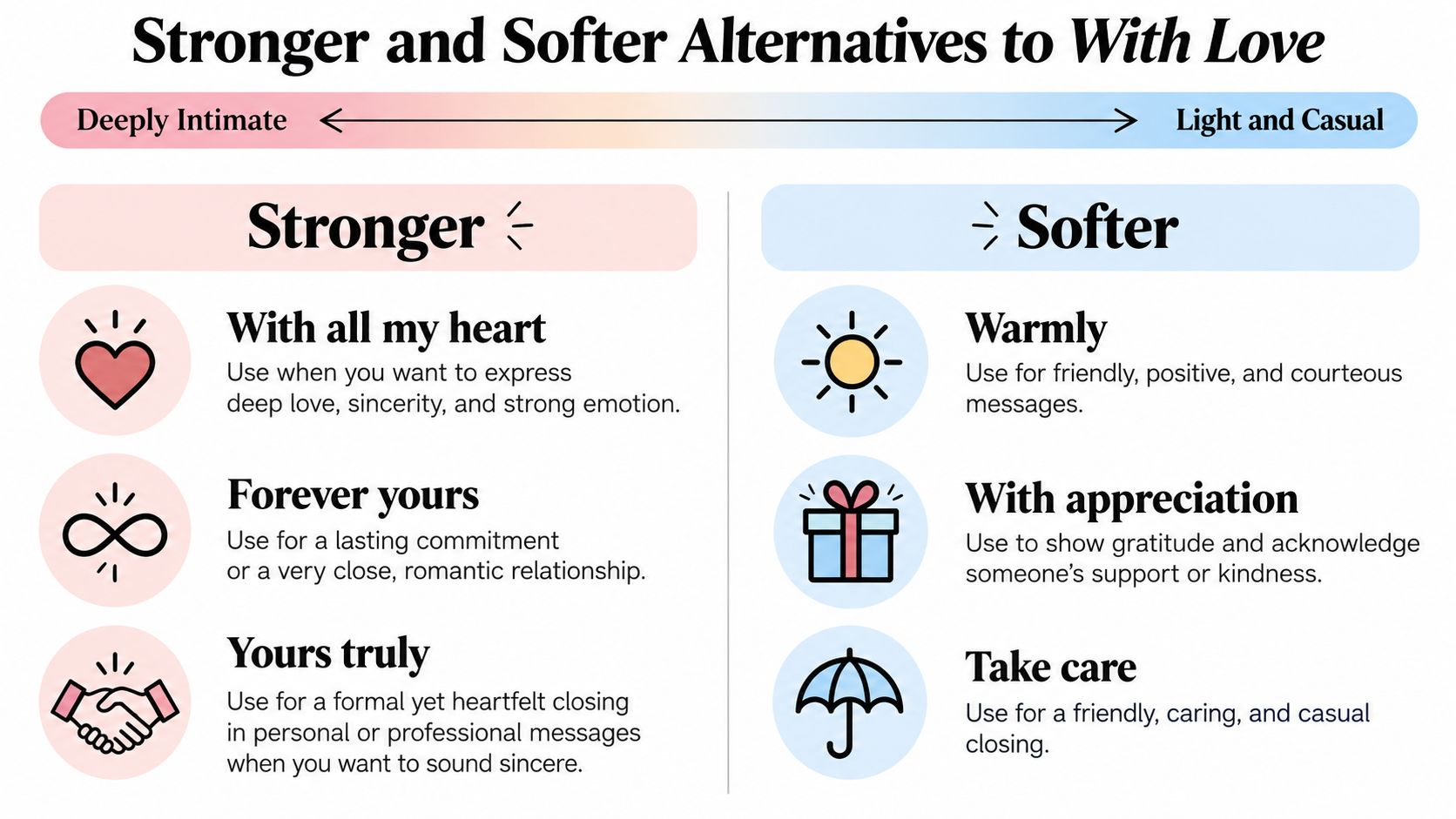
Sometimes the loving choice doesn't contain the word love. You can express tenderness through attention, appreciation, or a straightforward wish for someone's well-being. Don't treat a softer closing as a downgrade.
The useful distinction is between emotional intensity and emotional fit. A dramatic declaration can be less helpful than a quiet line that respects what the recipient needs.
When stronger language earns its place
Reach for “With all my heart” when you're expressing deep affection you've already established. “Forever yours” is a romantic commitment, not a decorative ending. Reserve “Always in my heart” for a relationship where enduring attachment is both true and welcome.
One important correction: “Yours” isn't automatically intimate. Despite the word “yours,” I wouldn't place it beside romantic commitments. It can sound conventional or formal, so it's a poor substitute when your aim is unmistakable tenderness.
| Alternative | What it emphasizes | Where I'd use it |
|---|---|---|
| With all my love | Wholehearted affection | An intimate partner or close family member |
| Thinking of you | Attention without a demand | Illness, distance, or an everyday check-in |
| With care | Gentle concern | A sensitive relationship or difficult moment |
| With appreciation | Recognition of someone's contribution | Thanks to a mentor, neighbor, or colleague |
| Warmly | Friendly respect | Professional-adjacent relationships |
| All the best | Positive wishes with space | Acquaintances, congratulations, or farewells |
Softer doesn't mean colder
“Holding you in my thoughts” can be more fitting than “With love” in a sympathy card because it names your attention without making the message about your feelings. “Sending hugs” works when hugs are welcome in that relationship. Don't assume they are.
Choose the phrase that gives the recipient room to receive your kindness in their own way.
For seasonal cards, “Warm wishes” often avoids the problem of making every recipient sound equally close. If you're sending to a mix of relatives, friends, and work contacts, use these holiday card sign-offs to vary the ending appropriately.
You don't need a huge vocabulary of closings. Keep a few that sound like you, and stop using any phrase you'd never say outside a greeting card.
Upgrading a Generic Love Line Into a Specific One
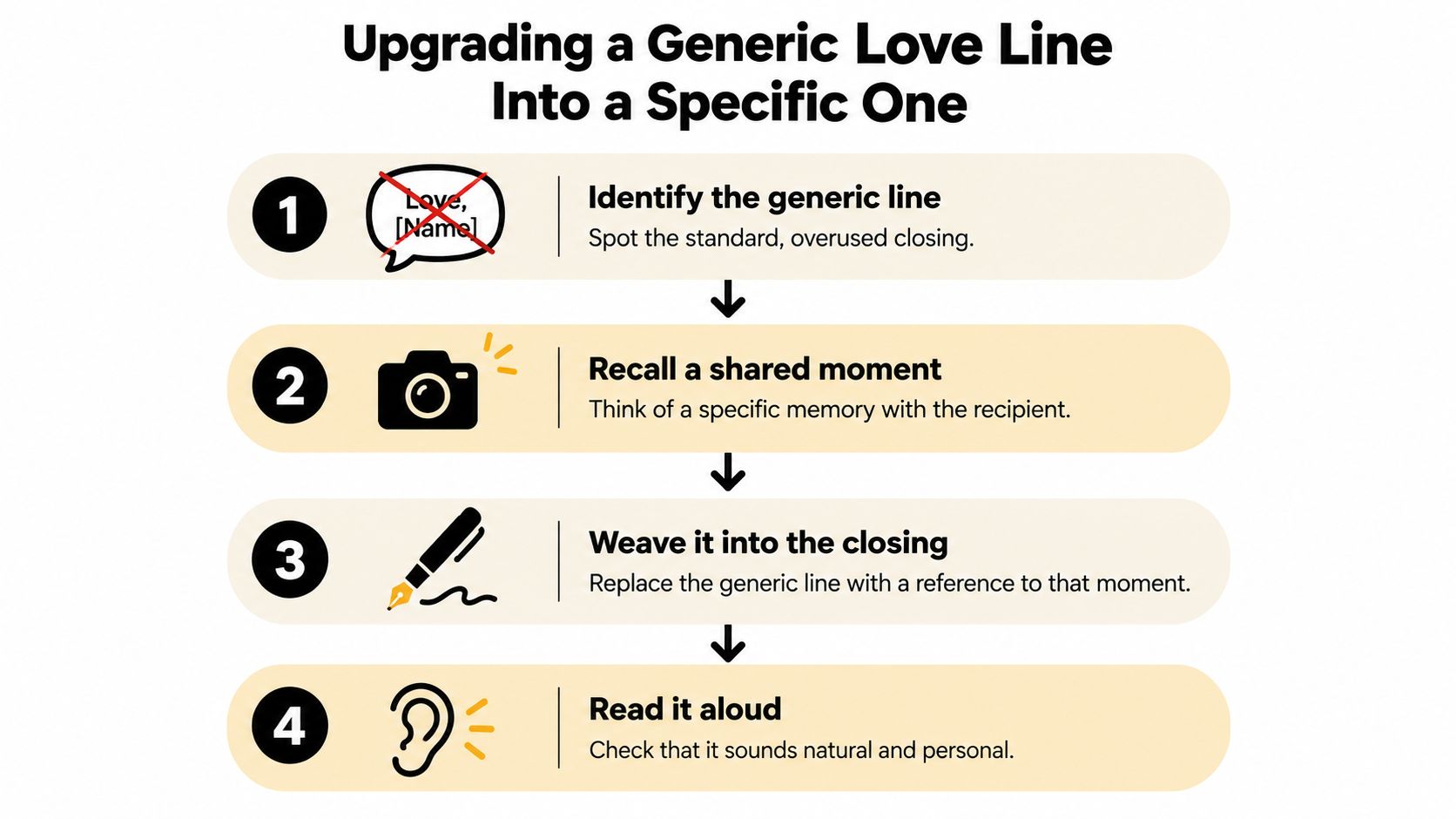
“Thanks for everything. Love, me” isn't necessarily wrong. It just leaves the recipient to supply all the meaning. Give them something concrete to recognize.
A randomized experiment found that gratitude letters to specific people produced stronger gratitude, positive affect, and social connectedness than gratitude lists or a control activity, according to research published in Affective Science. The study also found greater reported indebtedness among letter writers. My recommendation is to name what you appreciate without turning gratitude into a debt.
Build around a real moment
Use a short sequence: name the connection, recall something observable, explain its significance, and finish with affection or a genuine future intention. You can spread that across the message rather than cramming everything into the signature.
The following are sample drafts, not accounts of actual senders.
A thank-you card to a sister
“I'm grateful you're my sister. When you stayed on the phone after my difficult appointment, I didn't feel so alone. You listened without trying to fix everything. Looking forward to our next walk. With love, Maya.”
A birthday card to a longtime friend
“Happy birthday to my favorite road-trip companion. I still laugh about our rainy picnic and the sandwiches we rescued. You make even the unsuccessful plans worth remembering. Here's to another adventure together. Love, Jamie.”
A milestone card to a parent
“Dad, I'm proud of you as you begin retirement. I keep thinking about how patiently you helped me prepare for my first interview. You taught me to show up prepared without pretending to know everything. I'm looking forward to more unhurried afternoons together. With love, Chris.”
Edit for your speaking voice
Keep only details that are true. A plain sentence about a real phone call is stronger than an elegant description of support the person never gave.
- Replace inflated language. Change “Your boundless compassion illuminates my journey” to what you mean.
- Remove emotional accounting. “Your help mattered to me” doesn't burden the recipient like “I owe you everything.”
- Reduce punctuation. You don't need a string of exclamation marks to prove enthusiasm.
- Read the draft aloud. If you wouldn't say it, rewrite it.
The sign-off doesn't need to do all the emotional work. Let the message establish why the affection belongs there.
When Signing With Love Can Backfire
The following situations call for restraint, not because affection is wrong, but because the recipient shouldn't have to manage your intentions while reading the card.
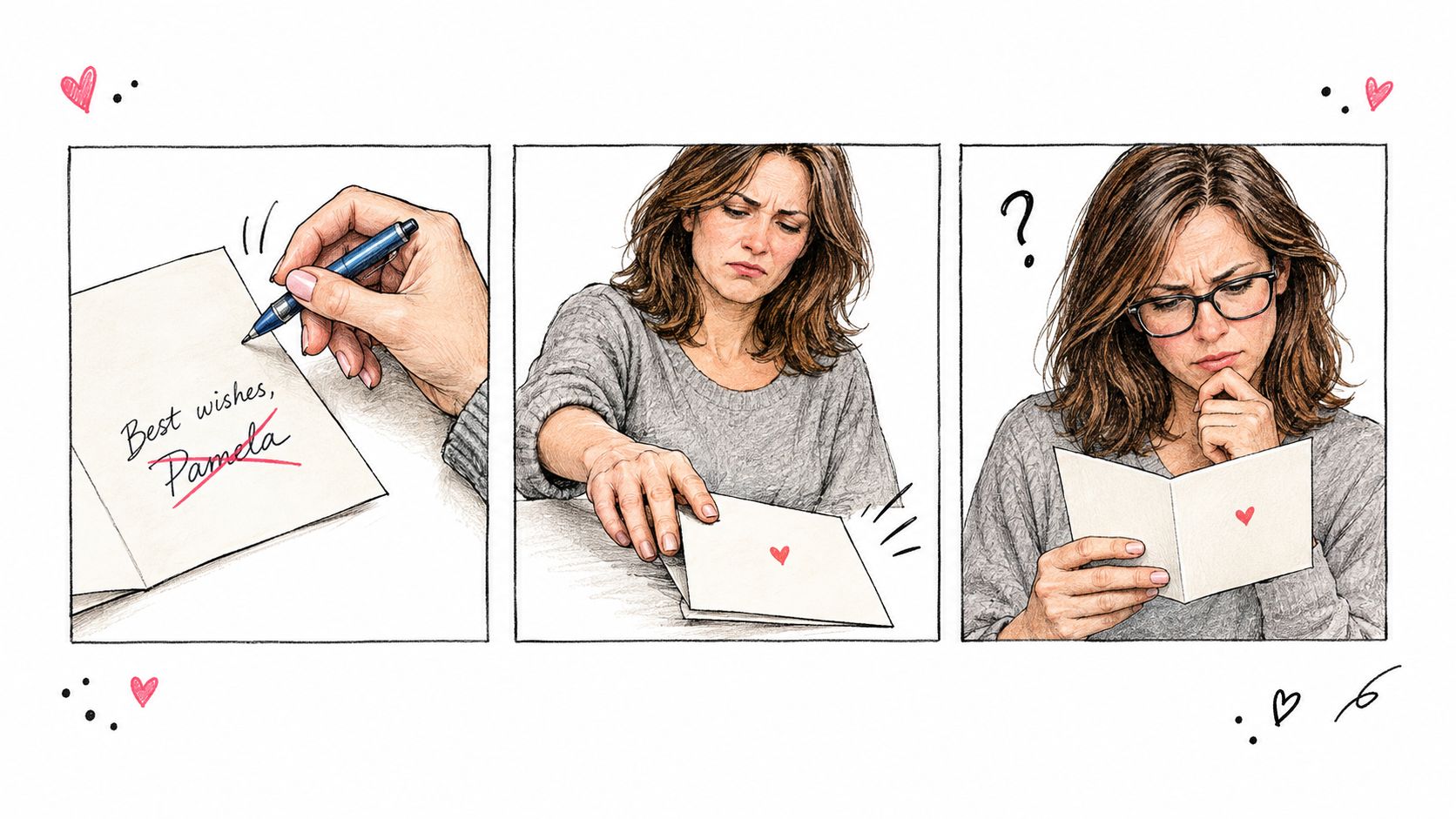
Grief without a request for reassurance
A grieving friend may welcome “Love always” if that's your usual closing. The problem is pairing affection with “Please call me so I know you're okay,” which asks them to reassure you.
Try: “I'm thinking of you and remembering your mother's kindness. No need to respond. With care, Leah.” For help with the main message, consult what to say in a sympathy card.
New affection without premature commitment
You've enjoyed spending time with someone, but you haven't discussed your relationship. “All my love” asks the card to make that declaration for you.
Try: “I had such a good time with you on Saturday. Looking forward to seeing you again, Daniel.” It's warm, specific, and doesn't pretend you've agreed on more.
Professional thanks without blurred boundaries
A mentor helped you prepare for an important presentation. You feel grateful, but “Love, Erin” doesn't accurately describe the professional connection.
Try: “Your feedback helped me explain my ideas more clearly. With gratitude, Erin.”
Boundary check: Don't use a card to obtain closeness the recipient hasn't offered.
For estrangement or apology, respect any stated limits. A affectionate closing isn't permission to bypass a request for no contact.
Your Pre-Envelope Checklist for Signing a Card With Love
Before you approve or seal the card, check the whole message rather than inspecting the closing alone. The recipient will read the greeting, body, sign-off, and name together.
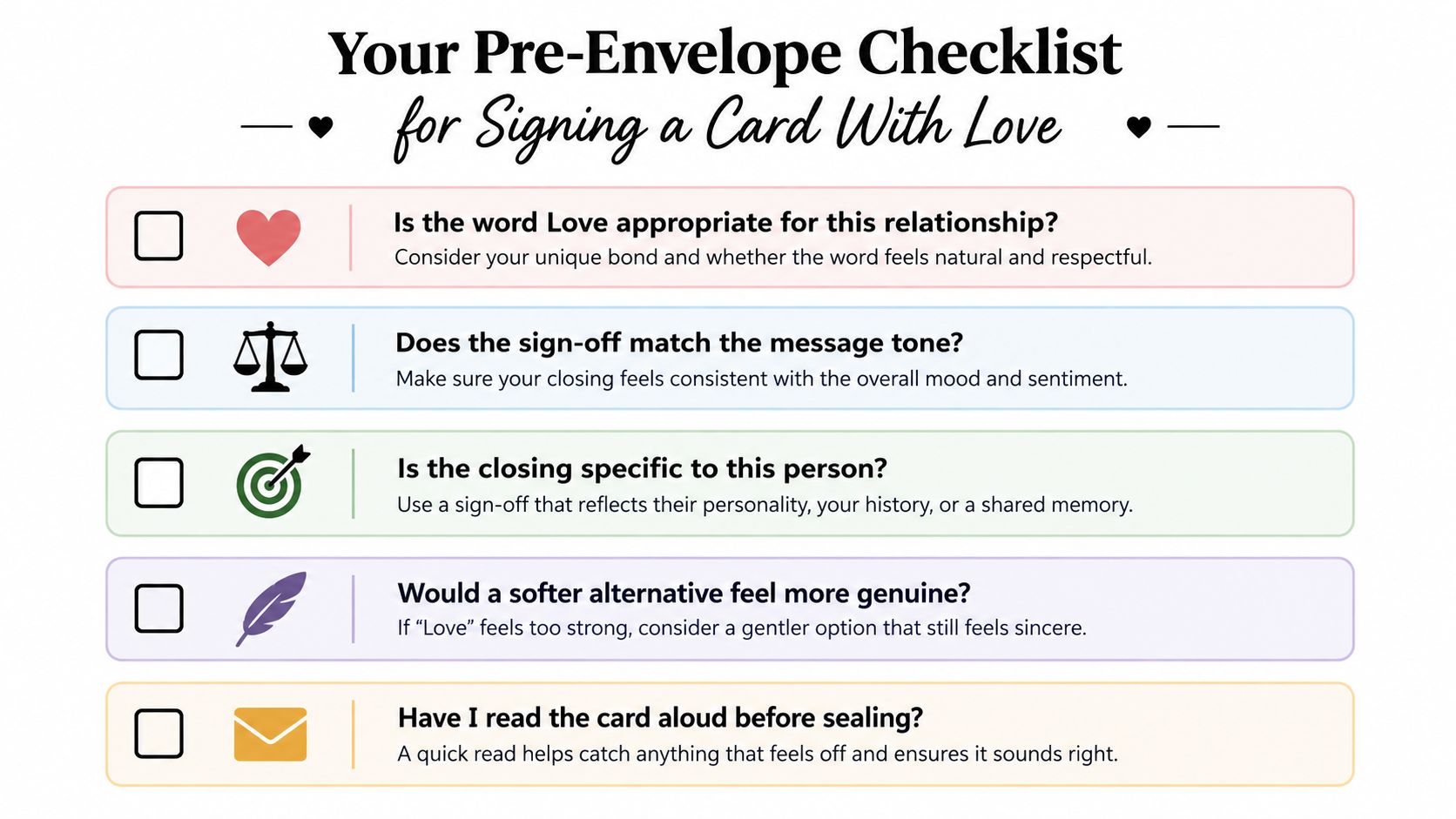
Check the emotional fit
- Does love belong here? Choose it because it fits your established connection, not because it sounds more impressive.
- Have I included something recognizable? Keep a true memory, action, or quality that makes the message theirs.
- Does the closing match the occasion? Remove jokes or flourishes that undermine a serious note.
- Am I asking for anything emotionally? Delete demands for reassurance, forgiveness, or an immediate response.
- Is the signature clear and familiar? Use the name the recipient knows, and identify everyone sending the card.
Approve the exact words
Writing assistance can help with a blank page. A controlled study of 246 participants found no significant differences between assisted and manual gratitude-letter writers in gratitude, subjective well-being, or relational closeness, according to the gratitude-letter study. That doesn't make every suggested phrase right for your recipient.
Read the final card aloud, check names and dates, and inspect the actual preview. If artwork is generated, keep the approved message separately typeset rather than relying on text inside the image. Approve what will be printed, not merely what you remember drafting.
Mail This is one option for turning a short, thoughtful idea into a personalized physical greeting card, with printing, addressing, and mailing handled for supported U.S. destinations. Visit to develop your wording, review the final card, and approve the exact closing before it's sent.