It's 11 p.m. the night before your anniversary. The card is blank on the desk, your phone has seven tabs open, and every draft you try sounds either too generic or oddly dramatic. You've written "my world" and crossed it out because you'd never say that out loud.
You don't need a longer message. You need a believable one. The Anniversary card message for wife that she'll keep usually follows a simple formula, one specific detail, one feeling, and one forward line. Name something only you two would recognize, say plainly what it means to you, then point to what's next.
The eight styles below cover the full range, from classic heartfelt notes and memory-based cards to playful inside jokes and minimalist one-liners. Each one is judged the same way, by how it reads on a 4.9 × 6.9 inch folded card, not just by how romantic it sounds on a screen. That means short lines, clear type, and room to breathe.
Pick the style that sounds most like you. Then swap in your detail, read it aloud once, and approve it. If you can finish that in ten minutes, you've done the hard part right.
Table of Contents
- 1. Classic Heartfelt Sentiment
- 2. Memory-Lane Message
- 3. Milestone Year Message
- 4. Playful Inside-Joke Message
- 5. Looking-Ahead Future Message
- 6. Personal Photo Card with Short Caption
- 7. Short Poem or Rhyming Couplet
- 8. Minimalist One-Line Note
- How the eight anniversary card message styles compare
- Turn Your Words Into a Card She Keeps
1. Classic Heartfelt Sentiment
Start here if you want warmth without trying to be clever. A classic note says the central thing directly, then proves it with one specific detail. Without that detail, it could go to anyone. With it, the card is unmistakably hers.
Try this structure. "Happy Anniversary to the love of my life. Every year with you feels like my best one yet." Then add the evidence, "I still love how you leave my coffee by the keys when I'm running late." Or use, "Thank you for another year of laughter, patience, and love. I'm so lucky it's you."
Make It Sound Like You
Keep this style under 40 words on the inside page. On a 125 × 175 mm card, that length stays large enough to read comfortably and leaves white space around the sign-off. For help choosing a closing that matches your tone, this guide to signing a card with love is worth checking before you finalize.
- Pick one detail: a place you met, a morning habit, or how she helped this month, not a list of adjectives.
- Use your normal words: if you don't say "darling" at home, don't write it here.
- Try three versions: draft romantic, warm, and understated options, then keep the one you'd say.
Practical rule: If you could send the same text to a stranger, it isn't personal yet. Replace one adjective with one fact.
This is the safest choice for a first anniversary, a card that accompanies flowers, or any year when you want sincerity to do the work. It's low risk, and that is the trade-off. It's also the easiest style to make forgettable, so the detail isn't optional.
2. Memory-Lane Message
A memory works better than general praise because it gives her something to picture. She doesn't have to wonder whether you mean it. She can see the place, hear the joke, and remember who you both were then.
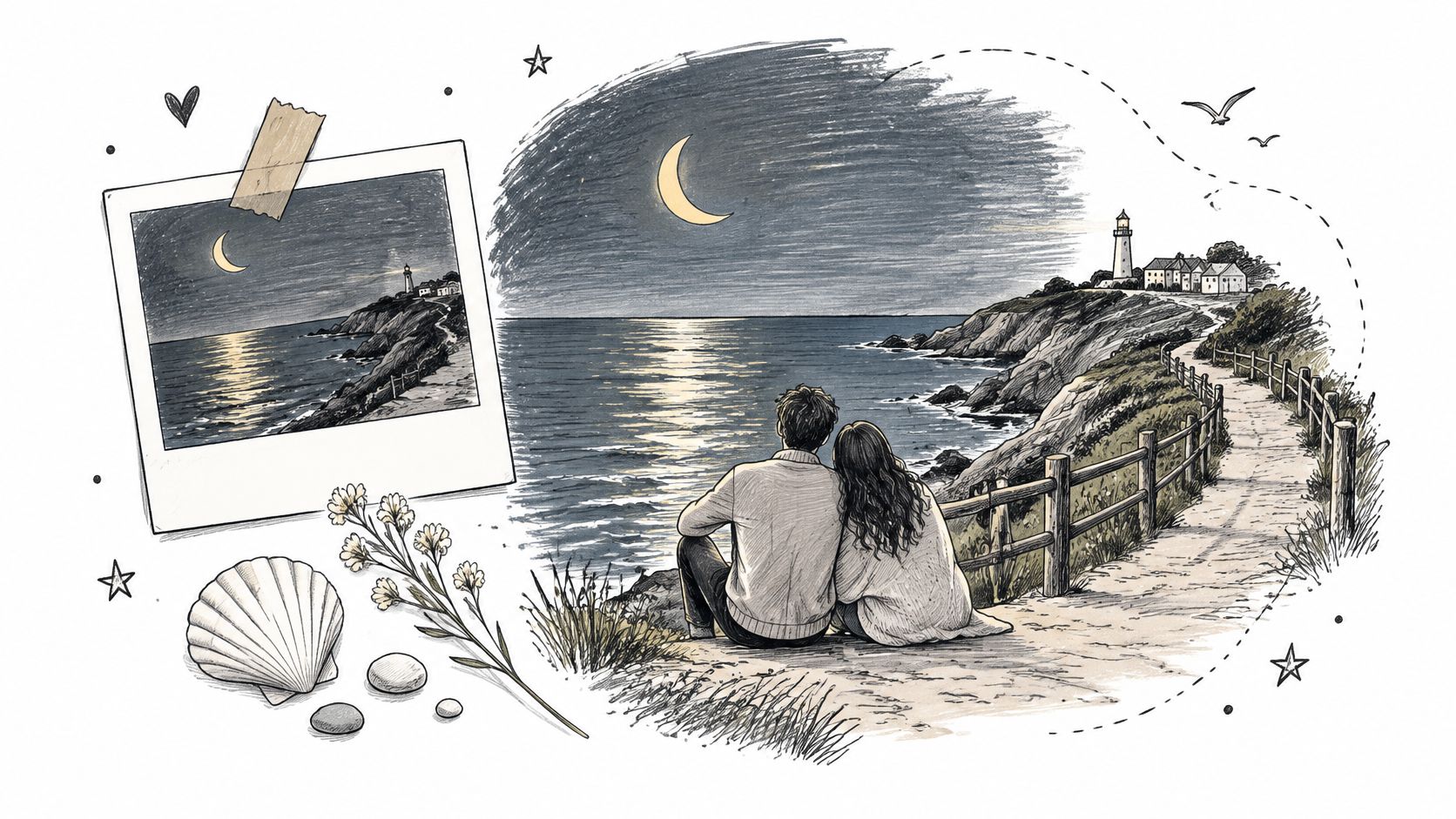
Lead with the scene, not the sentiment. "I still remember our first road trip to the coast and how you laughed at my terrible map reading. Here's to many more adventures." Or try, "Looking back at the year we moved into our first apartment, I'm amazed at how much we've built together."
Turning a Vague Memory Into a Line
Don't write "our trip was amazing." Name the coast road, the bad map, the laugh. That is the formula at work, a specific detail first, your feeling second, a forward line last. One sentence of description is enough to draft from, and it's stronger than trying to retell the whole weekend.
Choose a memory she'd smile about without explanation. A first date, a flat tire you handled badly together, or the tiny kitchen where you learned to cook one good meal all work. Avoid a memory that's happy for you but stressful for her, because the card will live longer than your intention.
If you have a photo from that moment, pair it with the text and let the image carry the background. Then your words can stay short. Say your memory is a sunset drive where you got lost twice. The photo shows the light, your line names the wrong turn, and she fills in the rest instantly. That's a complete card.
3. Milestone Year Message
Round numbers change the tone. A 10th anniversary can sound proud and settled. A 25th should acknowledge endurance. A 50th needs something closer to awe, because you're not just marking a year, you're marking a shared lifetime.
Those associations have deep roots, and the history of wedding anniversaries notes that silver for 25 years and gold for 50 years were documented in Germanic countries as early as the 1500s. Use the symbol lightly. "Twenty-five years of choosing you, and I'd choose you again in a heartbeat" says more than naming silver and stopping there.
For a decade marker, try, "Ten years in, and every day still feels like the best decision I've ever made." Then add what those years taught you. Maybe she taught you patience during a house move, or you learned how she likes bad news delivered straight. That second sentence keeps the milestone from sounding like a plaque.
Check the Number Twice
Confirm the exact year before you approve anything. On this card, the number is the headline, and a wrong number is the one error she'll notice first. Preview it at full size, just as you would double check names and dates on a wedding card before sending.
There's real weight behind these dates. The U.S. Census Bureau report reported that the median duration of American women's first marriages was 20.8 years in 2009. Reaching 20, 25, or 30 years therefore represents decades of shared responsibility, not just another calendar page. Write like you understand that, with gratitude for specific years and everyday support.
4. Playful Inside-Joke Message
Humor is personal by definition. A store-bought line can be romantic, but it can't know that you call her your co-pilot because she once steered you confidently into a dead end. That shared reference is proof of a life together.
Build the joke, then land it warmly. "Happy Anniversary to my favorite co-pilot. I promise to stop saying 'it's just down the road' on every trip." Or, "Another year of you putting up with my terrible puns. You are a saint, and I am so grateful."

Keep the Joke on Shared Ground
Choose a gag that has been affectionate for years, not one that has ever caused tension. If the joke is really about her driving, her family, or money, and it still has an edge, leave it out. A printed card doesn't come with your facial expression to soften it.
- End sincere: one plain sentence after the laugh tells her the card isn't only a joke.
- Keep it legible: a nickname and one punchline fit easily, a three-part story won't.
- Match the art: ask for an illustration tied to the joke, like a map, a coffee cup, or the dog who started it.
This style suits couples who tease each other daily and would find a formal poem stiff. Say she steals your fries after insisting she doesn't want any. Name that, thank her for another year of it, and you've written something no generic generator could invent for another couple.
5. Looking-Ahead Future Message
Most anniversary cards look backward. A forward-looking card does a different job, it tells her you're not only grateful for the history, you're invested in what comes next. That's reassuring in a way nostalgia alone can't be.
Keep the future concrete. "I can't wait to see where the next year takes us, from the trips we've planned to the quiet mornings I love sharing with you." Or shorter, "Here's to another year of new adventures, and to all the years after that." The first works because it names both a plan and an ordinary pleasure.
Hopeful Without Overpromising
Mention one specific plan, a trip you've booked, a garden you're finally planting, or a class you keep talking about. Don't promise a perfect year, a new house, or a personality overhaul. She'll trust a modest, real plan more than a grand declaration you can't control.
This is also the most honest option after a hard year. You don't have to pretend everything was wonderful, and you don't have to turn the card into an apology. A line like "This year tested us, and I'm grateful we kept showing up" acknowledges reality, then chooses her again. Name the difficulty once if you need to, without blame, then move forward.
One honest sentence about a tough year often lands better than cheerful wording you both know isn't true, as long as the card ends with commitment, not a complaint.
Mail matters here too. Order early enough for an estimated arrival window to land around the anniversary, because an estimate isn't a guarantee. A thoughtful future message that arrives a week late still counts, but it loses some of its timing.
6. Personal Photo Card with Short Caption
Let the photo do the heavy lifting. When the front of the card is the two of you at the lake, on your wedding day, or laughing in a kitchen that no longer exists, the caption only needs to tell her how to read the image.
Keep it to one or two short lines. Under a sunset trip photo, "Still my favorite view. Happy Anniversary." Under a wedding photo, "Look how far we've come. Love you more every year." Both work because they're short, specific, and readable at a glance.
This format matches how people use cards. Reporting on greeting card industry strength notes that two-thirds of surveyed U.S. adults prefer receiving physical cards over digital alternatives, and senders favored adding family, vacation, or pet photos. A printed photo card becomes a keepsake on a fridge or desk, not a notification she scrolls past.
Watch this short example of how a photo-led card comes together before you choose your image.
Photo Choices That Print Well
Pick a high-resolution photo with good lighting, since it'll print at about 4.9 × 6.9 inches. Faces too close to the edge can crop badly, and a dark restaurant shot that looks fine on your phone can turn muddy on paper. Check the preview for crop and orientation before paying, a step covered well in this guide to personalized greeting cards with photo options.
The trade-off is simple. A great photo needs very little text, but a mediocre photo can't be rescued by a long caption. Choose the image first, then write to it.
7. Short Poem or Rhyming Couplet
A poem signals effort before she even processes the words. Rhythm makes a line stick, and a couplet can feel complete where a short prose note might feel abrupt. You don't need to be a poet, you need four to eight lines that sound natural read aloud.
Write your own from the formula. Detail in line one, feeling in line two, future in the closing line. For example, "Through every season, every year, you've been my home, my favorite place. Happy Anniversary, my love." It's simple, and simplicity is why it fits a folded card.
Borrow Carefully, Then Add Your Own Line
Adapting a known poem can work if you make it yours. "How do I love thee? Let me count the years, and find I love you more with each one," adapted from Elizabeth Barrett Browning, is recognizable, but it needs a personal line after it. Add the coffee habit, the road trip, or the year you just finished, so she hears you and not only a quotation.
Personalization is where poems often fail, because borrowed language can sound polished and empty at the same time. Anniversary gift research summarized by Trans4mind reports that 50% of married respondents consider meaningfulness the most important gift attribute. A poem earns that meaningfulness through your detail, not through rhyme alone.
Read it aloud once. If you stumble, she will too. Keep it under eight lines, use line breaks generously, and check that the typeset text stays clear of the artwork so no word gets obscured.
8. Minimalist One-Line Note
Sometimes restraint is the most confident choice. If you're not a sentimental person, a long heartfelt paragraph will sound borrowed no matter how well it's written. One true sentence in your own voice is more romantic than three paragraphs she'd never believe you wrote.
Two reliable forms are "Happy Anniversary. Still choosing you." and "You, again. Happy Anniversary." Both are under ten words, both fit on any design, and both leave the emphasis on the act of sending a physical card.
That physical choice still matters. A report on paper greetings in America found that in 2024, 54% of Americans said they still mail greeting cards rather than sending greetings through digital or social platforms, according to a Shutterfly poll of 2,000 U.S. adults reported by Two Sides. A one-line note arrives as an object she can keep, which gives brevity weight.
When Short Works and When It Doesn't
Use one line for an everyday anniversary, a simple design, or a card paired with a gift and a planned evening. Choose a longer style for milestone years, after a difficult year, or when the card is the main gift. In those cases, one line can read as low effort rather than calm confidence.
- Choose clean design: let the typeset message be the focal point, with no busy pattern competing.
- Add one detail if you can: "Still choosing you, bad map and all" is stronger than the generic version.
- Sign it clearly: a recognizable signature line makes a minimal card feel finished.
Say you're a man of few words marking year seven. "You, again. Happy Anniversary." on a clean card, hand-delivered with coffee, sounds like you. For year 25, add the memory line and the forward line. She deserves the fuller version there.
How the eight anniversary card message styles compare
| Item | Best For | Typical Length | Tone | Effort to Personalize |
|---|---|---|---|---|
| Classic Heartfelt Sentiment | A sincere, versatile anniversary message | 2–4 sentences | Warm and heartfelt | Low; add a personal detail |
| Memory-Lane Message | Celebrating a meaningful shared memory | A few sentences | Nostalgic and appreciative | Medium; recall a specific memory |
| Milestone Year Message | Round-number or significant anniversaries | A few sentences | Celebratory and reflective | Low; confirm the year count |
| Playful Inside-Joke Message | Couples who share a favorite joke or nickname | A few sentences | Playful and affectionate | Medium; choose a joke she enjoys |
| Looking-Ahead Future Message | Expressing hopes and plans together | A few sentences | Hopeful and committed | Medium; mention a specific plan |
| Personal Photo Card with Short Caption | Turning a favorite photo into a keepsake | 1–3 lines | Personal and affectionate | Medium; select a suitable, high-quality photo |
| Short Poem or Rhyming Couplet | A creative, memorable anniversary message | 2–8 lines | Poetic and expressive | High; craft and check the wording |
| Minimalist One-Line Note | A simple message or understated design | One sentence or short phrase | Simple and modern | Low; choose a concise sentiment |
Turn Your Words Into a Card She Keeps
You now have eight ways to say it, and the right one depends less on occasion and more on voice. If you talk plainly, choose classic, minimalist, or looking-ahead. If your marriage runs on stories and jokes, choose memory-lane or playful. If the year number is the story, lead with the milestone.
Whatever style you pick, run the same final check. It takes two minutes and it catches the errors that matter, a wrong year, a cropped photo, a line that sounds warm on screen but stiff when read aloud.
- Pick the style that fits your relationship: don't force a poem if you never speak poetically, and don't hide behind a joke on a milestone year.
- Add one specific detail: one habit, one place, one moment from this year, and one forward line to close.
- Keep it card-sized: write for a 4.9 × 6.9 inch folded card, with short lines and enough white space to read easily.
- Check the exact wording: verify the year, her name or nickname, the crop, and the sign-off in the preview before you approve.
Personal doesn't mean complicated. A market survey cited in anniversary research and summarized by Market.us found that personalized greeting cards accounted for 44.9% of the global greeting-card market by product type in 2024, and that demand makes sense when a card carries a real photo or a line no one else could write. The goal isn't customization for its own sake. It's recipient-specific evidence that you were thinking of her, not of anniversaries in general.
With Mail This, you write and edit the inside message yourself, so the final wording stays in your control from draft to approval. We then print and mail your approved card for $9.99 per card, including the envelope and domestic postage plus applicable tax shown before purchase, with delivery to all 50 U.S. states and Washington, DC. That approval-first step matters for an Anniversary card message for wife, because you can fix tone, spelling, and the milestone number before anything is printed.
Draft your message now while the detail is fresh in your mind. Choose the photo or design, read the preview once at full size, and send it early enough to arrive around the day. A short, specific card mailed on time will mean more to her than a perfect paragraph that never leaves your notes app.
Turn your draft into a printed Anniversary card message for wife she can hold and keep, with your exact wording, a personal photo or design you describe, and mailing handled for you. Start your card at Mail This, preview every line before you pay, and approve it in minutes so it heads to her mailbox in time for your anniversary.