You're standing in the card aisle, holding something with gold lettering that looks lovely until you read the joke inside. Or you've opened a blank design and can't get past “Congratulations.” Choosing a wedding card gets easier when you judge it at three moments: the first read, the journey through the mail, and the day the couple finds it again years later.
A good card doesn't need elaborate artwork or a speech inside. It needs the right purpose, a message that sounds like you, and an envelope that arrives without damage or surprise postage.
Table of Contents
- What a Wedding Card Is For and Who Sends One
- Message Length and Tone for Each Relationship
- Writing a Message That Fits the Couple
- Choosing Paper Weight and Finish for a Mailed Card
- How to Personalize Your Card Step by Step
- Mailing Limits, Timing and Sending Your Card
What a Wedding Card Is For and Who Sends One
Say you're buying a card for your cousin's wedding. The congratulations card suits the engagement announcement, the well-wishes card belongs with your message for the wedding day, and the thank-you card is usually something the couple sends afterward. Those are different jobs, even when the cards share flowers, rings, and similar wording.
A wedding invitation is different again. It tells guests where to go, when to arrive, and how to respond. A guest's card carries affection, not instructions, and doesn't require a reply.
Which wedding card fits the moment
| Card type | When it is sent | What it carries |
|---|---|---|
| Congratulations card | At engagement or before the wedding | Warmth and good wishes, no reply needed |
| Well-wishes card | On the day or delivered to the couple's home | Warmth for the day, no reply needed |
| Thank-you card | After a gift or attendance | Gratitude, no reply needed |
| Wedding invitation | Sent before the wedding | Date, venue and response instructions |
Think of a card as a handshake on paper. It's brief, it makes an immediate impression, and, unlike a handshake, it can be kept.
Physical stationery still has a place: a WeddingWire stationery survey found that 78% of couples used paper wedding invitations, while 54% purchased invitations from an online site. That's evidence about invitations rather than guest cards, but it shows that online ordering and physical mail aren't opposites.
Start with purpose: Decide what the moment calls for before choosing the design. The purpose determines the message, size, and tone.
Message Length and Tone for Each Relationship
| Relationship | Tone | Suggested length | Sample opening |
|---|---|---|---|
| Immediate family | Warm, personal, can recall shared history | Three to five sentences | We're so proud to see you two start this life together. |
| Close friend | Affectionate, playful, with a specific memory | Three to six sentences | Remember that road trip? I can't wait to watch you both build your life together. |
| Colleague or manager | Polite, positive, professional | One to three sentences | Congratulations on your wedding. Wishing you a joyful day and a happy life together. |
| Extended family or acquaintance | Brief and warm, without unearned familiarity | One or two sentences | Congratulations to you both. We wish you every happiness. |
These lengths are writing suggestions, not etiquette requirements. Closeness determines how much personal material you have, not how much you like the couple. A colleague's short, sincere note can be more appropriate than a full page that tries to manufacture intimacy.
For immediate family, shared history can give the message depth. Keep the focus on the couple's present happiness, though, rather than turning the card into a tribute to the person you knew as a child. A close friend can be playful, provided both partners can enjoy the reference.
Warmth without awkwardness
Professional doesn't mean cold. If you know a colleague through work, a straightforward wish for a happy life together is enough. You don't need to comment on their relationship when you've barely met their partner.
Leave these out regardless of the relationship:
- Private jokes: Anything that leaves a partner confused or embarrassed.
- Comparisons: Previous partners, other weddings, or whose celebration was better.
- Uninvited advice: Predictions about arguments, children, or the supposed realities of marriage.
- Gift accounting: Amounts spent, what's enclosed, or explanations of why you didn't buy something.
That last point concerns a wedding well-wishes card. A thank-you card should, of course, acknowledge what you're thanking someone for.
Choose the closing with the same care. With love suits an affectionate relationship, while Warm wishes works without implying greater closeness. If you're unsure, this guide to signing a card with love can help you choose a natural sign-off.
Read the message aloud. Cut anything you wouldn't comfortably say in front of both partners.
Writing a Message That Fits the Couple
Name them, give one true detail, wish them well.
That's the core of a personal wedding message. Add your signature, and you have a complete note without needing to sound like a greeting-card writer.
Use this visual guide to plan the message before you polish it.
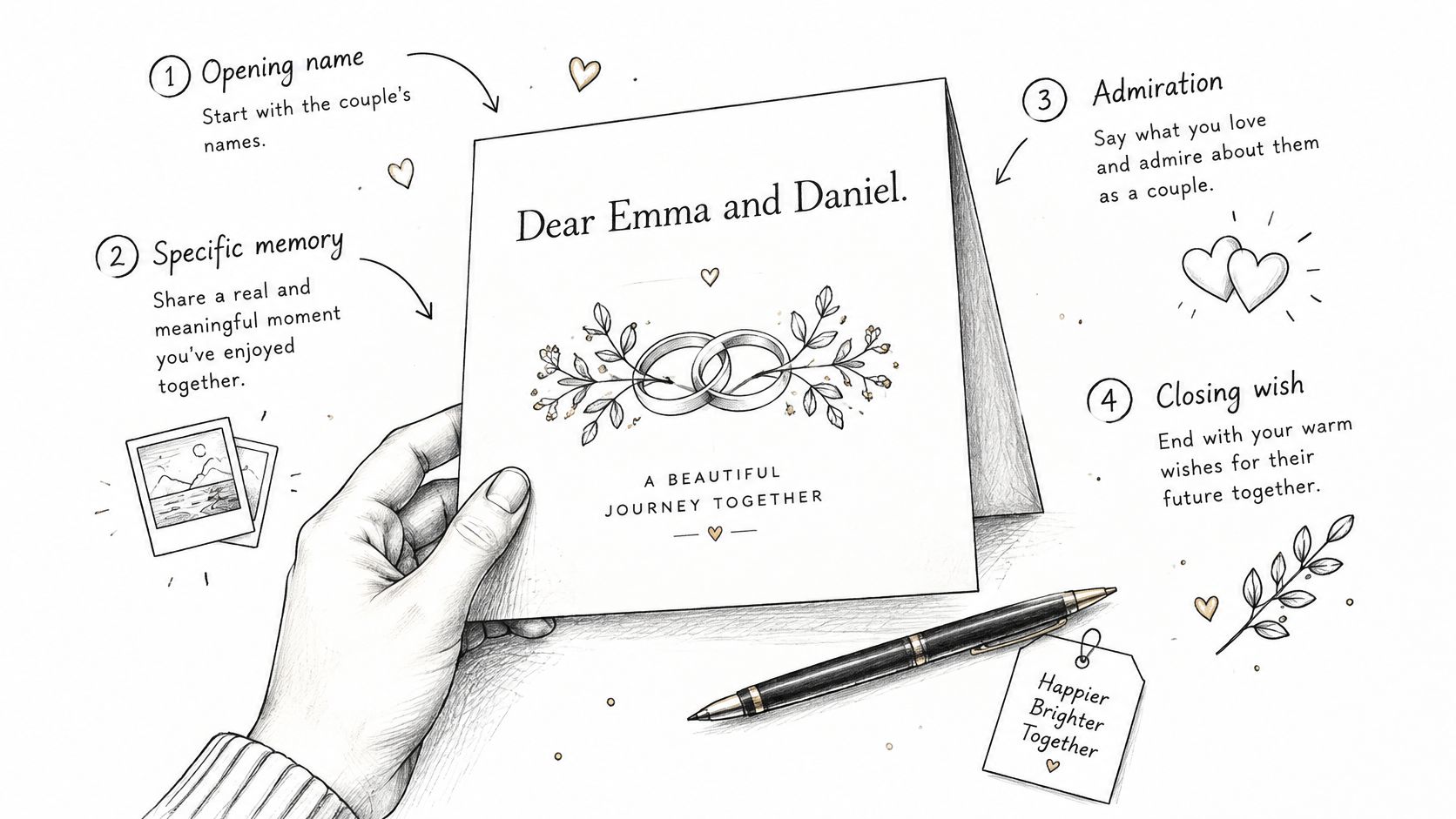
Start with both names. Then choose a detail that belongs to them: the way they welcome friends, their shared enthusiasm for cooking, or how they look after each other during stressful moments. You don't need a dramatic memory; an ordinary observation can feel more intimate.
Replace general praise with something recognizable
A weak opening
Wishing you all the best in the future.
There's nothing offensive about it. But it could go inside almost any wedding card, and it gives the couple little sense of who wrote it.
A stronger opening for a hypothetical couple
Watching you two laugh through the rain at your engagement party reminded me how well you fit together. Wishing you a lifetime of that same ease.
The opening sentence gives a recognizable scene. The next connects that scene to a wish for their marriage, rather than attaching a generic sentiment to an unrelated anecdote. Use this approach only with a memory that's yours, not an invented story borrowed because it sounds touching.
For another way to approach the wording, watch the video below.
Make room for both partners
If you know only one partner well, don't pretend otherwise. Address them both, mention a quality you've noticed, and offer a shared wish. You can write warmly without claiming special insight into their relationship.
Finish with your name and, when needed, enough context to identify you. A distant relative or a colleague whose surname the couple may not recognize should avoid an unexplained first-name-only signature.
Edit for recognition. Replace sentences that could describe any couple, but don't remove a plain congratulations merely because it's conventional. Familiar words become personal when they sit beside a truthful detail.
Choosing Paper Weight and Finish for a Mailed Card
| Paper type | Weight | Best use | Key trade-off |
|---|---|---|---|
| Printed cardstock | Approximately 300–350 gsm, about 110–120 lb cover | Standard digital or flat printing | Rigid, premium feel without excessive bulk |
| Heavy cotton stock | Often 110–220 lb | Letterpress, foil stamping, engraving | Compressible fibers accept impressions, but specialty production can cost more |
| Lighter insert stock | Around 270–300 gsm | Inserts and enclosures | Limits the weight added by extra components |
| Dark or coated stock | Choose weight for the printing process and assembled mailpiece | Heavily inked designs | Score before folding to reduce cracking |
The weight recommendations in this table follow The Perfect Wedding's cardstock guide, including 300–350 gsm for digitally or flat-printed cards, 110–220 lb cotton papers for impression-based finishes, and 270–300 gsm for inserts. Treat these as starting specifications, not a guarantee that every paper will behave identically.
The comparison below helps connect the stock choice to the finished card.
Match the finish to the message
For a card you'll write by hand, choose an uncoated writing surface and test your pen on a spare piece. Glossy coatings can smear or make ink bead, while textured stock can interrupt a fine pen stroke. A smooth interior is often more useful than an elaborate finish everywhere.
Cotton stock makes sense when the impression is part of the design. It's less compelling when you're paying for thickness that a flat-printed photograph won't particularly benefit from.
Score folded cards before folding. Scoring creates a controlled crease by compressing and displacing fibers, reducing cracking along the fold, especially on dark, heavily inked, or coated stock. Bending a thick sheet by hand can leave a ragged, pale line through the design.
Production check: Approve a finished sample, not just a paper swatch.
Examine the fold, corners, cut edges, and small lettering. Check whether the card closes naturally and whether the interior accepts your chosen ink. A beautiful sheet isn't enough if the finished card cracks or won't sit neatly inside its envelope.
How to Personalize Your Card Step by Step
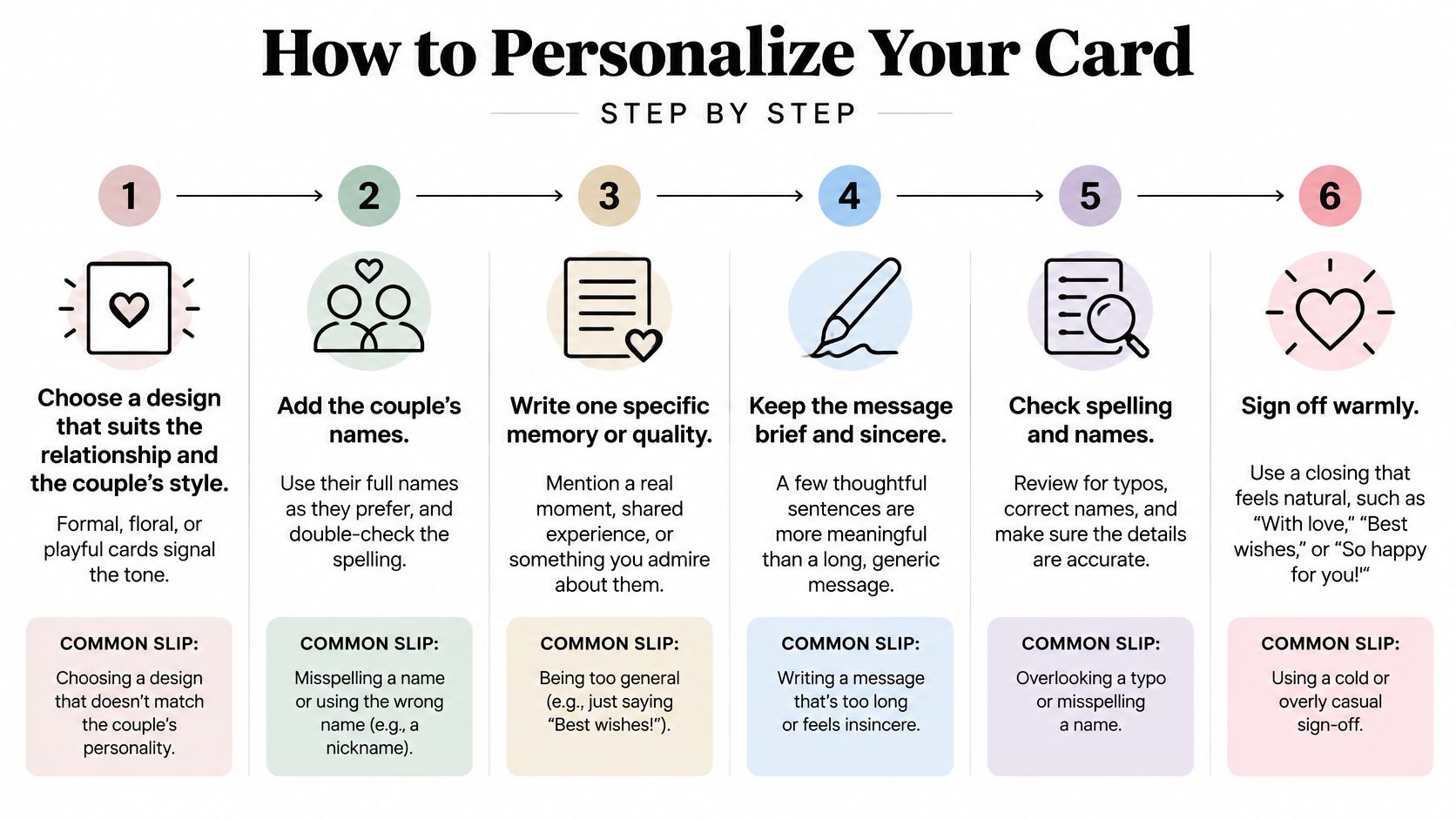
Personalization works best when you make the practical decisions before decorating. Use this sequence to keep the front inviting and the inside easy to read.
Choose the tone before the design. Formal lettering, botanical artwork, and playful illustration suggest different kinds of messages. The common slip is choosing a joke-led front and then trying to fit a restrained, professional note inside.
Confirm every name against the couple's wedding details. Check preferred names, titles, accents, and hyphenated surnames rather than relying on memory. Don't assume either partner will change their surname after the wedding.
Add a personal image or artwork, then leave breathing room. Choose a meaningful photograph or a simple illustration instead of filling every corner with pictures. If you're considering personalized greeting cards with a photo, check the crop so faces and important details stay clear of the fold and trim.
Set the message for comfortable reading. Dark text on cream or white is a reliable starting point, and a plain typeface works well for the body. The common mistake is shrinking delicate script until it looks elegant on screen but becomes difficult to read in print.
Confirm portrait or horizontal orientation before placing text. Orientation changes the available line length and the balance between artwork and margins. Don't rotate a finished layout and assume the fold, text, and image will still align.
Proof the entire card on screen and in print. Read the front, inside, and signature, then read the message aloud to catch missing words or stiff phrasing. Proofing only the cover leaves the most personal part unchecked.
Use the visual checklist as a final reminder before approving the design.
Inspect the card at its actual size
View the layout at print size rather than enlarging it until everything looks readable. Hold the printed proof at a comfortable arm's length and check whether you can follow the message without effort.
Keep wording separate from decorative artwork when designing digitally. Text baked into an image is harder to correct and can become blurry when resized.
The finished card should have clean margins, correct names, and readable wording. If an ornament competes with any of those, remove the ornament.
Mailing Limits, Timing and Sending Your Card
Send a congratulations card before the wedding if you want it to reach the couple during the planning period. For wedding-day wishes, leave room for production and postal delays rather than treating the ceremony date as your posting deadline. If you've missed the day, send a warm note afterward without making the whole message an apology.
US letter-format mailing limits for a 125 × 175 mm card
| Measure | US letter-format limit | 125 × 175 mm folded card |
|---|---|---|
| Minimum length | 5 in | About 6.9 in (175 mm) |
| Minimum height | 3.5 in | About 4.9 in (125 mm) |
| Maximum size | 11.5 × 6.125 in | Card itself is within the size limit |
| Maximum thickness | 0.25 in | Measure the sealed envelope with all inserts |
| Length-to-height ratio | 1.3 to 2.5 | About 1.40 |
The Voqado weddings and events mailing guide describes these US letter-format limits, including the 0.25-inch maximum thickness and 1.3–2.5 aspect-ratio range. The table compares the card's dimensions with those limits, but the assembled envelope determines mailing eligibility, not the card alone.
Check the complete mailpiece
- Measure it assembled: Put the card and every enclosure inside before checking dimensions.
- Weigh everything: Include the envelope, inserts, and anything attached to the card.
- Seal it flat: Bulky wax seals, rigid ornaments, and uneven closures can affect processing and charges.
- Address it clearly: Use full names, the confirmed delivery address, and your return address. Don't assume the couple will be home immediately after the wedding.
- Confirm the postage: Have the postal service assess an unusual or bulky piece before buying stamps.
A card can meet the size limits and still need different handling because of its rigidity or shape. This guide to how much it costs to mail a greeting card explains the postage considerations.
If you'd rather skip printing and posting, Mail This can turn a short idea into candidate artwork and wording in chat. You choose a design, edit your message, preview the exact card, recipient, and total, then approve and pay securely. A personalized folded card costs $9.99, including the envelope and domestic postage, plus applicable tax shown before purchase; printing and mailing happen only after approval and completed payment.
Arrival dates are estimates, not guarantees. New York State, US territories, and military addresses aren't currently supported.
Choose the card that fits the occasion, write to the relationship, and get it ready to send this week. Visit Mail This to create a personalized physical wedding card, review the finished design and message, and have it printed and mailed after you approve and pay.