The suitcase is still by the door. You've been home two days, you've shown the same photo of a harbour at dusk to three different people, and now there's a card on the table with a name at the top and nothing underneath it.
Everything you want to say doesn't fit. The week was too full, the photos are too many, and the moment you start writing you hear yourself producing an itinerary.
A card rewards the opposite. It wants one sharp moment, told in four or five sentences, with the rest of the trip left where it belongs, in the photos and in your own head. The strongest story about trip messages aren't summaries. They're slices, and the slice is what the recipient keeps on the fridge.
The eight formats below cover the situations you'll meet, from a two-line note scribbled on the road to a thank-you for a hosted stay to a retrospective that looks back on a journey a decade old. Each one opens with a paste-ready snippet you can drop straight into a card and edit in two minutes, then breaks down the beats behind it so you can write your own version next time without the template.
Swap in your own details, read the result back once out loud, and check names, addresses and line breaks in the preview before you approve. That last step is what keeps a good message from arriving with someone's name spelled wrong.
Table of Contents
- 1. Postcard-Style Travel Note
- 2. Travel Journal Entry Story
- 3. Road Trip Narrative
- 4. Hero's Journey Trip Story
- 5. Photo Essay Travel Story
- 6. Thank-You Trip Story
- 7. Anniversary or Milestone Trip Retrospective
- 8. Travel Letter Story
- How the eight trip story formats compare
- Pick One Story, Trim It to a Card, Send It
1. Postcard-Style Travel Note
Write this one from the road, not after it. It's the format for the sender with twenty minutes and a phone, and it works because the trip is still happening around you.
Valletta, Thursday. The bakery below my window opens at 5:50 and the whole street smells of bread before it's properly light. I've had the same breakfast three mornings running, and the woman at the counter now hands me the coffee before I ask for it. You'd have ordered the wrong thing on purpose just to make her laugh. Home Saturday.
That's 62 words and it does more than a two-page recap would. The reason is structural, not sentimental: a dateline anchors the reader in time, one sense does the heavy lifting, a stranger appears for a single line, and the last sentence turns toward the person holding the card.
The beats that do the work
- A time and place marker: "Valletta, Thursday" tells the reader where you are without a travel update.
- One sensory anchor: bread, a tram bell, cold water in a stone fountain. Pick the one you'd describe if someone woke you at midnight.
- One small human exchange: the counter woman, the bus driver, the man who pointed at your shoes. Strangers make a trip feel real in a way landmarks don't.
- A line aimed at the recipient: not "wish you were here" but a specific claim about them. The card is for them, not the destination.
Greeting cards sit inside ordinary household spending rather than on top of it, which is why a short note reads as a normal gesture instead of a production. The National Retail Federation's 2025 holiday survey found consumers planned to spend $262.56 on seasonal items including food, decorations, and greeting cards.
Working rule: one detail, one exchange, one turn toward the reader. Everything else belongs in the album.
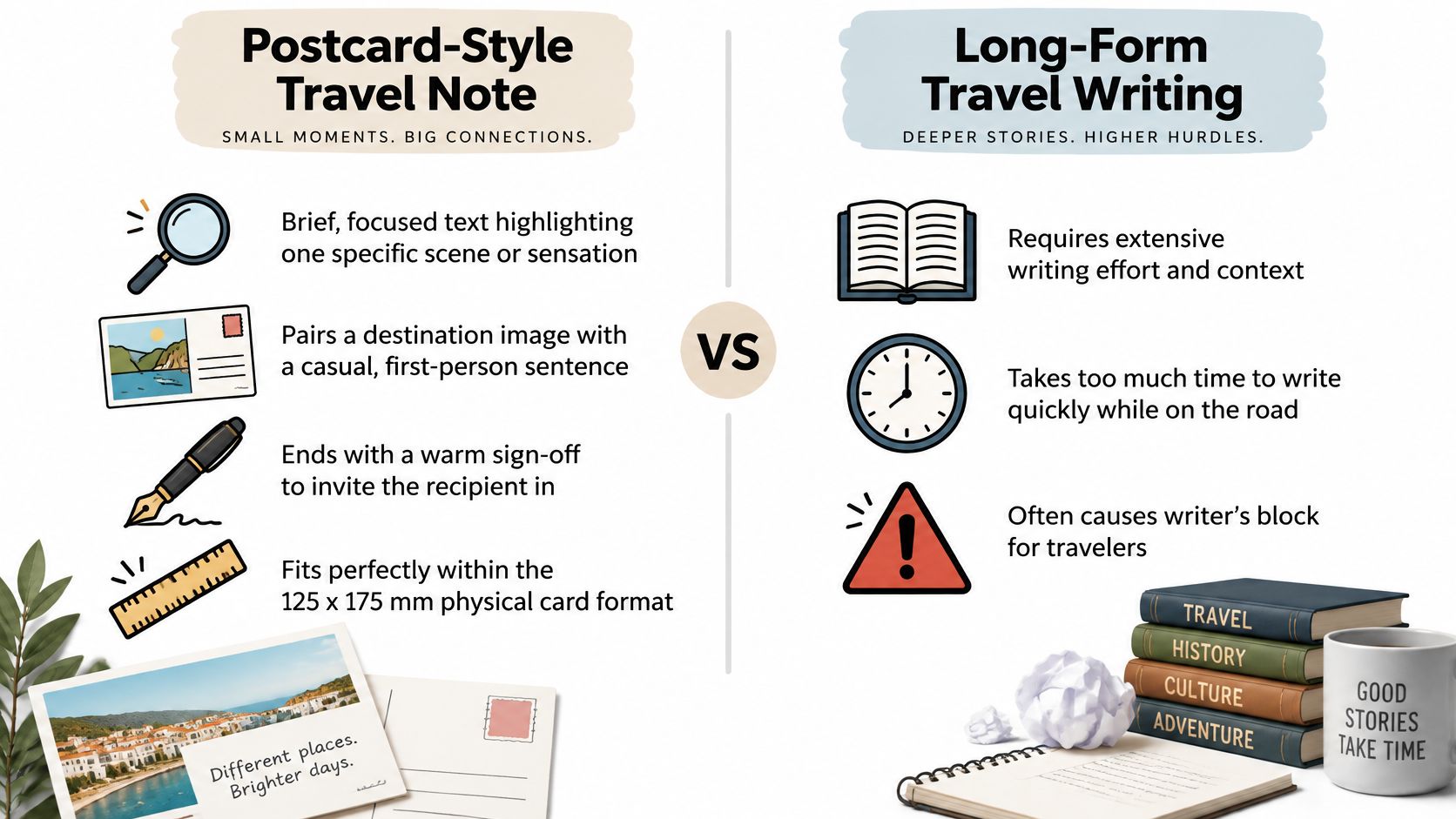
If you're sending while you're still away, order the card ahead so it lands before you do rather than three weeks after the trip has gone cold. Services built around cards by mail handle that timing for you. Here's how a short note compares with long-form travel writing:
2. Travel Journal Entry Story
Say you have three lines from a week away, each pinned to a different day. The journal can keep the full account; the card can carry a few entries that show how the trip shifted.
Tuesday. Rain until noon, so I sat in the covered market eating soup next to two men arguing about football in three languages. Felt ridiculous for being annoyed about weather.
Wednesday. Walked the ridge at 7 a.m. before the heat. Nothing up there but wind and one shepherd who pointed at my shoes and laughed.
Thursday. Took the slow bus back. Two hours, no photos, and the first time all week I stopped planning the next thing.
Three dated moments make a small arc without forcing the trip into a grand story. The dates give the reader a sense of sequence, while the details and feelings make each entry distinct. For context, UN Tourism's 50-year review reports that international tourist arrivals rose from 222 million in 1975 to a projected 1.5 billion in 2025.
Three moments beat thirty
- Cap it at three to five entries. More can make a card read like a log. Choose the moments that best show what changed from one day to the next.
- Attach one feeling to each entry. “Felt ridiculous” and “stopped planning the next thing” reveal more than a place name alone.
- Choose an ordinary moment sometimes. A slow bus with no photos can give the story a quieter ending than a familiar viewpoint.
- Keep the full journal separate. Let it hold the trip's details; use the card for the edited version.
Tuesday: weather and a market conversation. Wednesday: a ridge walk and a laugh. Thursday: a slow bus ride, and finally a pause.
This compact pattern keeps the sequence, one telling detail, and a shift in feeling. Adapt it by swapping in your own dates and moments, then leave out anything that doesn't help the reader follow the change.
3. Road Trip Narrative
Road trips resist compression because they contain too many places. The fix is to make the road itself the subject and let the stops become evidence.
Four days, one wrong turn that turned out to be the best part. We meant to be on the coast road by lunch and spent two hours instead in a town with one garage and a very good bakery, waiting on a hose. Past the pass the radio gave out and we sang badly for an hour. You were right about the detour rule, and I owe you a coffee.
Notice what's missing. No full route, no daily mileage, no list of viewpoints. The story has a spine (the mistake), a cast (the two of you), and a closing line that credits the recipient with being right.
Give the road a job
Pick one theme before you write a word, because a road trip will otherwise pull you toward chronology. Three themes work reliably:
- The detour: something went wrong and turned out better.
- The company: the trip was really about who was in the passenger seat.
- The discovery: a place you didn't plan to stop at and now can't stop mentioning.
Then name two or three stops only. A card that lists six towns reads like a route map. A card that names one garage town and one mountain pass reads like a memory.
For the card image, skip the postcard shot of the coastline. A photo of the car, a roadside sign, or the bakery counter does more narrative work because it's specific to your story. Write the message first, then choose the image to match it.
4. Hero's Journey Trip Story
Say a traveler heads to the mountains to prove they can still handle a hard climb alone. The Hero's Journey gives that change a clear shape, without making the card read like a therapy session.
I went to the mountains to prove I could still do something hard on my own. Day two I lost the marked trail in fog, sat down on a rock and cried, which was not the plan. An hour later the cloud lifted and I could see the car park about 400 metres below me the entire time I'd been lost. I came home less interested in proving things.
Four beats in four sentences: a stated want, a challenge, a turn, and a return that names what changed. The car park in view supplies the turn; the final sentence shows how the traveler came home differently.
Amadeus reports that 41% of travelers value returning home with a refreshed mind and calmer nervous system, while 74% say personalization is important. Those figures point to a useful card-writing choice: focus on what the trip meant to the traveler, not just where they went.
Keep two beats, cut the rest
You don't need all twelve stages of the monomyth. Choose one obstacle and one change.
- State the want up front, in a single clause. “To prove I could still do something hard” is enough.
- Name the low point plainly. The fog and the rock do the work without extra drama.
- Resolve it with a detail, not a moral. Seeing the car park from the trail gives the turn a concrete shape.
- End at home. Name what changed in one line, then stop.
One caution: The closing line can tip into self-help if it explains the lesson twice. Say it once and trust the reader.
For a card, the structure is simple: want, obstacle, turn, change. Keep the details that make the shift believable, and leave out the rest.
5. Photo Essay Travel Story
Captions are the part everyone skips and the part that decides whether a photo essay works. The image sets the scene. The line underneath tells the reader what they're looking at and why it mattered.
Photo 1. The steps up to the guesthouse. Fourteen of them, with the handrail I ended up needing.
Photo 2. Breakfast, exactly as it came, no styling, no rearranging.
Photo 3. The bus stop where the 7:15 actually stops, which is not where the map says it stops.
That sequence isn't a highlight reel. It's information, and it's the kind a reader can act on.
Practical detail is where most trip stories fall short. In a 2025 survey of 3,473 European travelers with mobility or accessibility needs, VisitBritain's accessible travel research found that more than 8 in 10 reported transportation challenges on their most recent trip, including long waits for assistance and inaccessible public transport. The same travelers said they need measurements, photos, videos and virtual tours before they book. A caption that says "step-free entrance round the side" is worth more than a hundred words of scenery.
Build the sequence before the card
- Shoot and choose first. Three to five images, one clear subject each. JPEG, PNG, or WebP files all work for card printing.
- Write the caption for the moment, not the place name. "The bakery at 6 a.m., before the queue" beats "Lisbon".
- One strong image and one caption is plenty for a single card. Save the collage for a bigger occasion.
- Include the boring photo. The bus stop, the doorway, the lift. It's the frame someone else will use.
If you want a sense of how a caption changes what the next photo means, the clip below is a useful two-minute reference.
When you're ready to put the sequence on a card, the guide to personalized greeting cards with a photo covers file formats and layout.
6. Thank-You Trip Story
Say a café owner hosts friends for a weekend by the lake. A card that names the early coffee and the quiet morning on the dock will feel more personal than a general “Thanks for having us.”
Thank you for the two nights at the lake house, and especially for the coffee you made at 6 a.m. before anyone else was up. I keep thinking about that first morning on the dock. Next time, it's our turn, and I have a plan involving the good bakery.
The message moves from a shared memory to a specific thank-you, then ends with an invitation. A sincere handwritten card can lift the recipient's wellbeing. In a national evaluation of the Kindness by Post project, published as a preprint on medRxiv, researchers analyzed 289 participants and found a statistically significant wellbeing improvement of 0.21 standard deviations, a raw gain of 0.77 points on the Short Warwick–Edinburgh Mental Wellbeing Scale. Improvements in loneliness, belonging, and hope also appeared.
Aim it at one concrete act
- Name the thing, not the vibe. “The coffee at 6 a.m.” gives the recipient a moment to remember. “Your hospitality” could fit almost any stay.
- Keep the thanks brief. One or two sentences leave room for the detail that makes the message yours.
- Offer a next step. Suggest a return visit, a shared meal, or a promise you can keep.
- Check the name and address in the preview. A misspelling can distract from the care behind the note.
If you're thanking someone for help rather than a place to stay, this guide to saying thank you for kindness offers wording for a more personal message. Keep the focus on what they did, and close with a next step that asks for nothing in return.
7. Anniversary or Milestone Trip Retrospective
Honeymoons, tenth anniversaries, a seventieth birthday trip. These cards look backward at a journey and forward at the relationship it marks.
Ten years ago we got on a night train in Prague with one sandwich and no reservation, and you said we'd laugh about it. We laugh about it. Here's to the next decade of bad planning and good company.
Two sentences of memory, one line of toast. The specific sandwich is what makes it a card rather than a greeting.
There's evidence for why those specifics matter. A longitudinal study of 87 adults published on PubMed tracked 1,405 received holiday cards and 1,152 sender-provided messages. More than half of received cards came from people recipients did not regard as close friends or family, and recipients reported emotional reactions to roughly one-third of cards. Cards from close social contacts were associated with stronger feelings of social embeddedness. The study also found an age split: younger adults treated greetings as a way to build ties, while older adults experienced them as links to personal history.
Look back once, then forward
That finding shapes the format. A retrospective should carry both directions.
- One shared memory with a physical detail. The train, the sandwich, the wrong platform.
- One hope for what comes next. A line that faces forward, not backward.
- A photo from the trip as the anchor image, not a current portrait. The older picture does the narrative work.
- Confirm the date in the preview. An anniversary card that lands on the wrong day is its own story.
Treat the association as a pattern rather than a promise. Cards from close contacts tended to accompany stronger connection. They aren't a guarantee, and you don't need one to write a good message.
Keep the whole card to four lines. The memory does the emotional heavy lifting, and the toast gets out of its way.
8. Travel Letter Story
A letter is the long form of the postcard, and it's the oldest shape in this list. Travel writing as a genre grew out of exactly this habit: accounts of foreign journeys circulated between people who couldn't make the trip themselves. The Encyclopedia of Social Sciences survey of travel writing traces it from fragmentary records in ancient Mesopotamia and Egypt through Petrarch's 1336 account of climbing Mount Ventoux, and on to the printed collections assembled by Richard Hakluyt and Samuel Purchas.
Dear Aunt Ruth, I'm writing this at a kitchen table in a town you've never heard of, and the woman who runs the place keeps refilling my cup without asking. You told me once that the best part of going away is the hour you spend thinking about home. I didn't understand that at nineteen. I do now. Tell me what's growing in the garden, and I'll write again from the next stop.
That's the format: a scene, a callback to something the recipient once said, and a question that invites a reply.
Address someone and ask something
- Open by name. "Dear Aunt Ruth" does more for tone than any first sentence can.
- Include one question. A letter without a question is an announcement. A letter with one is a conversation.
- Let it be slow. Speed is the default elsewhere. In a 2024 Fiserv survey of full-time U.S. workers, reported by Carat, 70% said instant delivery was a leading consideration when choosing digital gift cards. A letter's value runs the other way: it's an object that sat on a table in another country before it reached the doormat.
- Check line breaks as closely as the wording. A letter rhythm depends on where the lines fall, and the typesetting in the preview shows you exactly that.
If the message runs past about 150 words, the letter is really two cards. Send one now and save the second for the return leg.
How the eight trip story formats compare
Say a café owner is choosing a format for a card from a trip. A quick scene suits a postcard-style note; several stops call for a road-trip narrative. This table pairs each format with its purpose, typical length, tone, and image.
| Story format | Best for | Typical length | Tone | Card image pairing |
|---|---|---|---|---|
| Postcard-Style Travel Note | Sharing one vivid moment from a trip | Under 100 words | Casual, personal, warm | Destination image that sets the scene |
| Travel Journal Entry Story | Recounting a trip's sequence and reflections | Flexible, from a few lines to a full card message | Reflective, diary-like | Journal, map, or travel mementos |
| Road Trip Narrative | Connecting multiple stops with a clear journey arc | Short, punchy card message | Candid, humorous, engaging | Route, landmark, or vehicle photo |
| Hero's Journey Trip Story | Framing a challenge or milestone as personal growth | Short message centered on key story beats | Meaningful, reflective | Traveler or path suggesting challenge and growth |
| Photo Essay Travel Story | Sharing a trip through strong photos and captions | Short captions; one image or a small sequence | Visual, concise, expressive | One strong travel photo or simple collage |
| Thank-You Trip Story | Expressing gratitude for a shared trip or a recipient's help | One or two sentences | Sincere, warm, appreciative | Image of a shared trip moment |
| Anniversary or Milestone Trip Retrospective | Celebrating a relationship or life milestone through a shared memory | Brief, with room for a meaningful reflection | Nostalgic, intimate, hopeful | Photo from the trip being remembered |
| Travel Letter Story | Sending a personal, conversational update from the road | Short to longer; fit to the card | Warm, conversational | A photo of the place you're writing from, such as the café table or the street outside |
Use the “Best for” and “Typical length” columns to choose the message shape, then use tone and image pairing to make it feel personal. Each row can guide both the words you paste into a card and the scene you choose to accompany them.
Pick One Story, Trim It to a Card, Send It
Eight formats, one decision. Match the format to the recipient and the occasion first, because that choice does more than any amount of polishing. A thank-you for a hosted stay is a three-sentence note. A milestone retrospective is a memory and a toast. A note from the road is a dateline and one detail. Once the shape is right, the writing gets short.
Then trim to the single moment that carries the feeling. Nearly every weak travel card fails in the same place: it keeps too much. The itinerary stays in, the second-best anecdote stays in, and the one line that would have landed gets buried in the middle of a paragraph.
The editing pass that takes four minutes
- Cut the second-best detail. If two moments compete, keep the stranger one and let the other go. The reader can't miss what they never saw.
- Keep one concrete image. A sandwich, a handrail, a bus that stops in the wrong place. Concrete details are what a reader pictures a week later.
- End facing the recipient. The final line should be about them, not the destination. Replace "the views were unbelievable" with a claim only they would understand.
- Read it out loud once. Anything you stumble over gets cut. Cards are read once and remembered, so rhythm matters more than completeness.
- Confirm names, addresses and line breaks in the preview. This is the step people skip on the way to approving, and it's the one that decides whether the printed card says exactly what you intended.
That's the whole method. Choose the shape, find the one moment, cut everything that dilutes it, and verify the details before the card goes to print. A personalized card built around a single memory will beat a longer letter every time.
Mail This turns a short idea into a printed, mailed card: you describe the trip and the person, approve the exact wording and layout in a preview with the total shown upfront, and the printing, addressing and domestic postage are handled for you at a fixed $9.99 per card. It's a practical fit for the formats above, especially when you want a photo from the trip on the front and one carefully trimmed paragraph inside. Start with your one moment at Mail This and see it typeset before anything is sent.