It's 10:40 on a Tuesday night, and you've just remembered that your sister's birthday is Thursday. There's no card in the drawer, no stamp in the kitchen drawer, and the store nearest you closed at nine. You know exactly what you want to say. You just can't see a way to get it onto paper and across two time zones in two days.
That gap, between having the words and holding the card, is the space cards by mail were built for. The service sits between a message you write and a mailbox you can't reach, and it does the physical work in between.
What follows walks through that stretch in order: what the service is, how an order travels from a chat window to a mail truck, what it costs, how long it takes, and where it goes wrong. By the end you'll know precisely which parts of the timeline you control, which parts you can watch, and which parts nobody can promise you.
Table of Contents
- What Cards by Mail Means and Who Uses It
- How a Card by Mail Moves From Chat to Mailbox
- What Cards by Mail Costs and What Is Included
- How Long Cards by Mail Take and How to Plan Ahead
- Cards by Mail Versus Digital and Store-Bought Cards
- Common Problems With Mailed Cards and How to Fix Them
- Confirm Your First Card Before You Send It
What Cards by Mail Means and Who Uses It
Say you remember a birthday at 10:40 on a Tuesday night. The card you meant to buy is still unbought, the shop closed at nine, and the party is Thursday. You have the right words in your head and no realistic way to get them onto paper and into a mailbox across the country.
Cards by mail closes that gap. You write or approve a short message and a design, and the service prints a real folded card, addresses the envelope, adds postage, and mails it to your recipient. You make the decisions. Someone else runs the production line and makes the trip to the post office.
It's closer to ordering dinner than to cooking it. You choose the dish and the delivery address, and the kitchen and the driver handle everything between your order and your door.
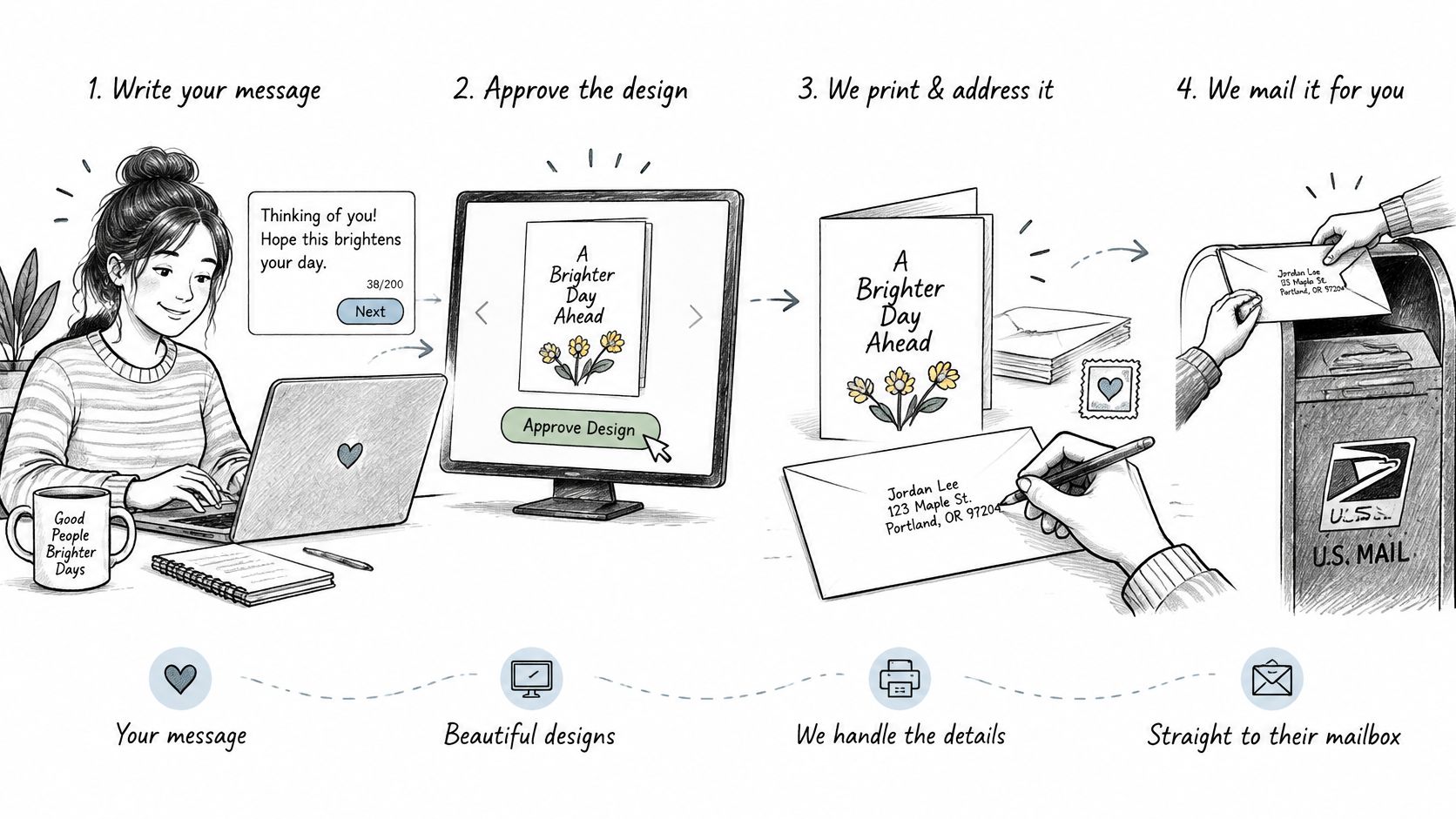
Three things separate this from the card you'd pick up yourself. Production and posting are handled for you, so there's no stamp to find, no envelope to hunt down, and no errand. Nothing prints until you approve the exact preview, which means the card that arrives is the card you signed off on rather than a close approximation. And the recipient receives actual mail: paper in an envelope in a mailbox, which lands differently than a notification.
Physical cards remain a mainstream habit, not a niche hobby. USPS reports that Americans buy approximately 6.5 billion greeting cards each year, and Christmas cards alone account for roughly 1.6 billion of them.
The people who use a service like this tend to fall into a few groups. Some want the card without the errand. Some have the sentiment and not the phrasing, so they draft with an AI assistant and then rewrite it in their own voice. Some are sending sympathy notes, thank-yous or birthday cards and care that the recipient can hold the thing in their hands. And some remembered late.
Everything that follows answers one question. What happens between clicking approve and the card reaching a mailbox?
How a Card by Mail Moves From Chat to Mailbox
The handoff is where first-time senders lose the thread. An order isn't one event. It's a short chain of events, and each link in that chain has a different owner.
Here's the whole loop in one picture, from the first conversation to the delivered card.
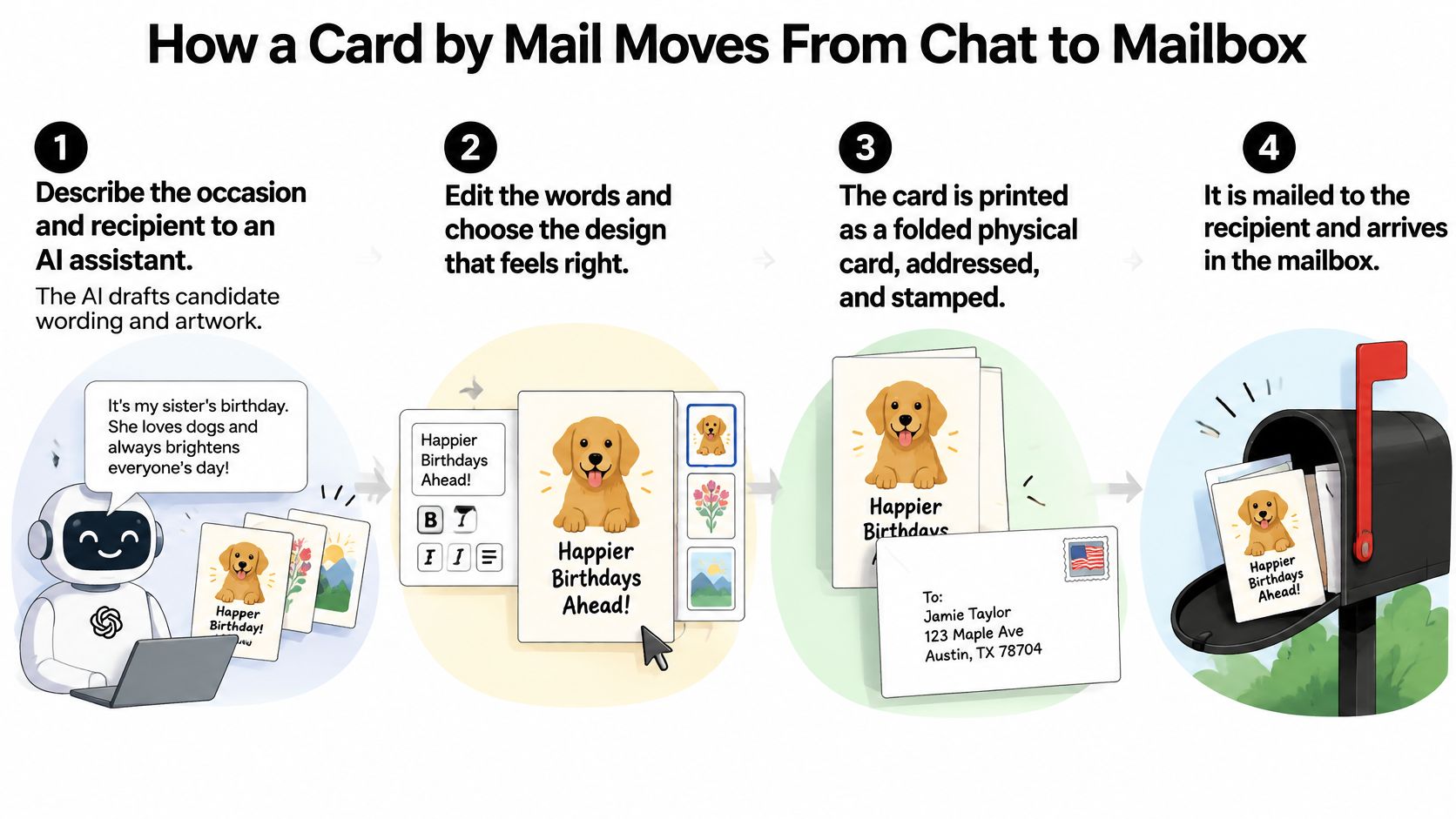
The sequence below is the one a Mail This order follows, and it's the same shape at any service worth using.
Describe the occasion and the recipient. You tell an AI assistant who the card is for, what the relationship is, and roughly what you want to say. The assistant drafts candidate wording and artwork. The reason this step exists is the blank page: people can freeze at "write something meaningful," and a draft to react to is easier than a draft to invent.
Edit the words and choose the design. The assistant's output is raw material. You keep the sentence that sounds like you and cut the rest. The message inside the card is written and edited by you, so nothing leaves in a voice that isn't yours. You can pick a catalog design or supply your own image, and uploads accept JPEG, PNG and WebP files.
Review the full preview. Design, recipient address, and the total including tax appear together on one screen. This is the cheapest moment in the entire process to catch a misspelled name or a wrong apartment number.
Approve the exact card and address. Approval is explicit and it binds the production side. Custom artwork has to be approved before a card can be sent, and the address you approve is the one printed on the envelope.
Pay securely. The approved card goes to the printer only once payment is confirmed. That's why an abandoned order never accidentally ships to someone.
Production and handoff. The printing partner produces the card, folds it, envelopes it, addresses it, and hands it to the postal service. This runs on a separate clock from the postal one, and it's the clock people forget to count.
Delivery. The postal service carries the card to the recipient. USPS First-Class Mail generally arrives in 1 to 5 business days, excluding Sundays and postal holidays, and USPS does not offer delivery by a specific date or time.
The three timestamps worth tracking
Every order carries three distinct moments. Approval time is stamped when you click approve. Production handoff is stamped when the sealed envelope enters the mail stream. Estimated arrival is the postal window applied to that handoff date.
The first two belong to the service. The third belongs to the postal network. Status tracking can report the first two and offer a range for the third. A service that promises a specific date is promising something USPS itself declines to promise.
Practical rule: count arrival from the mailing date, not from the day you placed the order, and never plan a card to land on the exact birthday unless you've left room for both production and transit.
One note for anyone who'd rather skip the conversation: cards can be created and ordered directly on the Mail This website without the assistant. From the design choice onward, the steps are identical.
What Cards by Mail Costs and What Is Included
Sticker price is the wrong number to compare. Actual cost of a mailed card is a stack of small costs, and the two ways of getting one stack them differently.
| Cost item | Buying and mailing yourself | Cards by mail (Mail This) |
|---|---|---|
| Card and printing | About $2 to $4 per retail card | Included in the per-card price |
| Envelope | Usually bundled with the retail card | Included in the per-card price |
| Postage | First-Class stamp at the current USPS rate | Domestic postage included |
| Sales tax | Depends on the card and your state | Shown before purchase, calculated at the destination |
| Travel and time | Trip to a store and a post office | None |
| Custom artwork | Your own design or a paid designer | Optional artwork packs, not required to send |
Read the left column top to bottom and it looks cheaper. A few dollars for the card, a stamp, and you're done. Then add the second errand, the parking, the twenty minutes in a store you didn't plan for, and the fact that you're doing this on a Tuesday night when both the shop and the post office are closed.
One price, several parts. One personalized folded card costs $9.99, including the envelope and domestic postage, plus any applicable tax shown before purchase. The tax isn't hidden in the base price and revealed at checkout; it's calculated once the destination is known, and it appears on the preview screen before you pay.
That structure matters for planning. With a stamp-and-store approach, you discover the cost in three separate transactions. With a bundled price, the number on the preview is the number you pay.
How to read any card price
- Is postage included? A low card price with postage added afterward isn't comparable to an all-in figure. Ask what a single domestic card costs end to end.
- Is the envelope in the price? It usually is, but confirm it rather than assume it.
- Is tax shown before you pay? A total that changes at checkout means the quoted price wasn't the price.
- Is extra artwork required? It shouldn't be. Optional design packs are an add-on, not an entry fee, and you can send a card without buying one.
- Does the full total appear on the approval screen? If design, address and total aren't visible together before payment, you're approving blind.
For a closer look at how stamps, cards and postage stack up when you mail one yourself, this breakdown of what it actually costs to mail a greeting card walks through the line items.
The point isn't that a $2 card is overpriced. It's that a higher card price can still be the cheaper option once travel, time, and a second errand are taken into account accurately.
How Long Cards by Mail Take and How to Plan Ahead
Approving a card and holding it in your hand are separated by three handoffs, and only two of them are visible to you. The first is your approval, which you control, along with payment. The second is the production handoff, when the approved card goes to the printer and into the mail stream. The third is postal arrival, which belongs to USPS and moves at whatever speed the network is running that week.
The delivery window most services quote, one to five business days for First-Class Mail, is a planning range, not a commitment. Business days exclude Sundays and postal holidays, which is why a card approved Friday afternoon doesn't arrive in "three days" on Monday.
One thing first-time senders miss: if a date matters, the question isn't only how long mail takes, it's when your approved card leaves for the printer. A card approved Friday night may not enter production until Monday, and that weekend doesn't appear anywhere in a one-to-five-day estimate. Ask about the production handoff, not just the postal leg.
| Occasion | Send at least | Why this buffer |
|---|---|---|
| Birthday | 7–10 days before | Covers production plus 1–5 business days of mail time |
| Thank-you note | 5–7 days after the gift | Short window, low pressure on arrival |
| Sympathy | 7–10 days before the service or event | Time matters, so allow margin for delays |
| Anniversary or wedding | 2–3 weeks before | Covers peak periods and address checks |
| Holiday season | 2–3 weeks before the holiday | Peak volume slows delivery in December |
| New baby or new home | 7–10 days before the visit | Covers mail time plus travel to the event |
Those buffers are planning recommendations, not service promises. They exist because postal performance varies, and the variation is measurable.
What the reliability numbers mean for your buffer
In fiscal year 2025, single-piece First-Class Mail reached 83.19% on-time performance for two-day mail, which was 3.81 percentage points below its target, and three-to-five-day mail missed its target by 7.24 points, according to USPS's FY2025 annual report. A separate inspector-general review cited in that same reporting found USPS missed five of six peak-season service targets, with delays continuing after the peak season.
That sounds worse than everyday experience, and there is a reason. Those figures describe single-piece mail as a whole across thousands of routes, not the one card you sent to Ohio. Most First-Class and Priority Mail still arrives close to its stated service standard, even in a year when overall on-time performance was weakened by network changes. A meaningful minority of cards don't.
The practical translation: add a few days for an ordinary occasion, and add a full week for December, a holiday weekend, or any card where the date genuinely matters. Normal variability and genuine risk are different problems, and only the second one needs a bigger buffer.
Late mail is usually a timing problem, not a lost card. Build the buffer into the send date and you stop having to explain anything.
Where a card can actually be sent
Cards go to all 50 U.S. states and Washington, DC. U.S. territories and military addresses such as APO and FPO boxes fall outside that footprint, so check the destination before you pick a send date. A beautiful card that can't be delivered solves nothing.
The habit that prevents most disappointment is simple. Count business days from the mailing date, skip Sundays and postal holidays, then add margin for whatever the calendar is doing that month. Then work backward one more step, to the day the card has to be approved and paid for, because that's the part of the timeline you control.
Cards by Mail Versus Digital and Store-Bought Cards
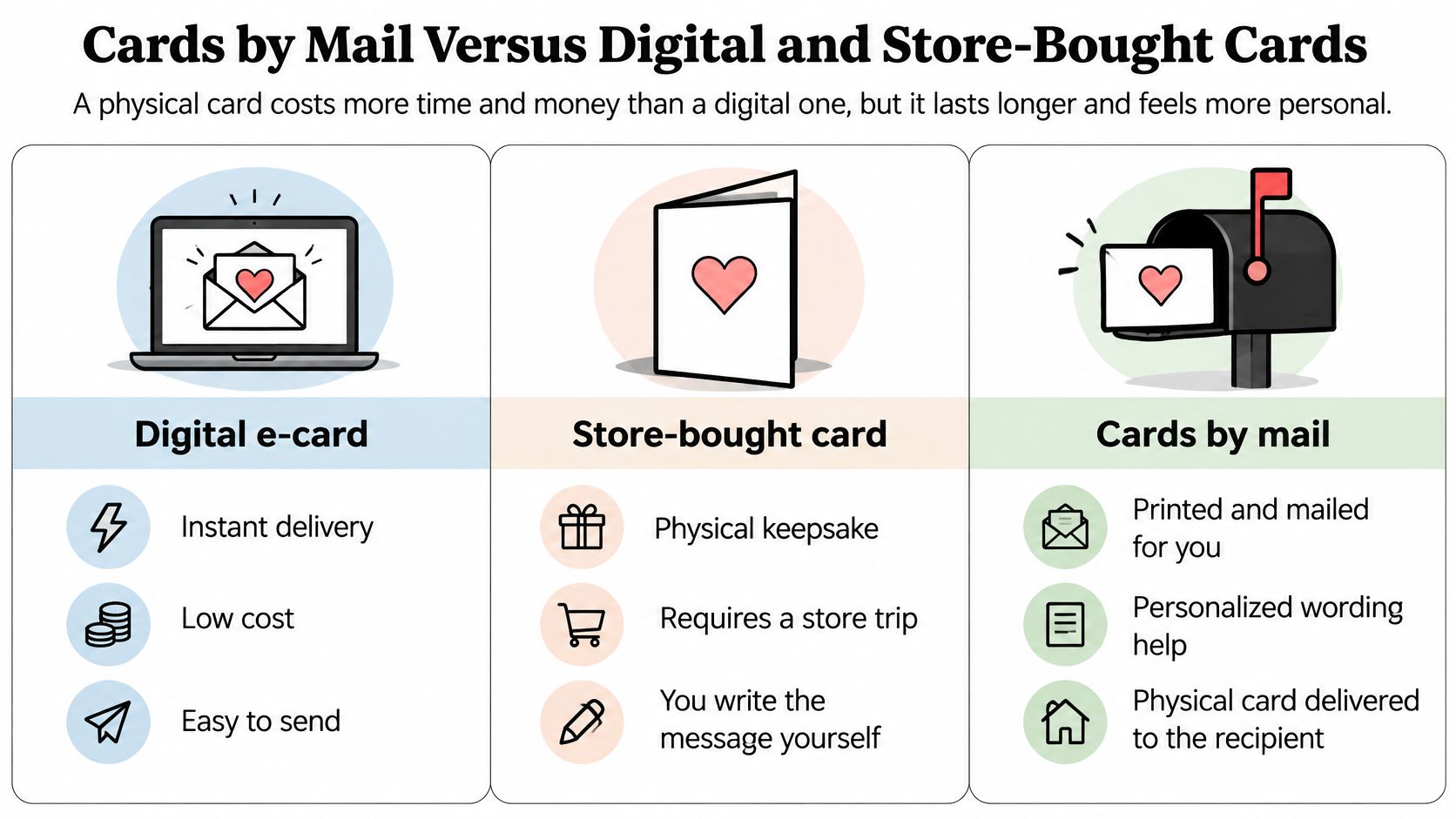
A physical card costs more time and money than a digital one, but it lasts longer and feels more personal. That's the whole trade-off in one sentence, and everything else is detail.
Here's how the three options line up.
| Criteria | Digital e-card | Store-bought card | Cards by mail |
|---|---|---|---|
| Effort | Very low | High: travel, writing, addressing | Low: approve a preview, then it's handled |
| Physical keepsake | None | Yes | Yes |
| Delivery proof | Usually a read receipt or open notice | None unless you pay for tracking | Status updates, but not proof of personal receipt |
| Cost per card | Free or low | Card price plus stamp | Single all-in price shown before checkout |
| Privacy | Depends on the platform | Only you see the address | Address and message go to the fulfillment partner |
The middle column is the one people underestimate. A store-bought card isn't expensive, but it costs an afternoon, and the afternoon is why the card often never gets sent.
What delivery proof can and cannot tell you
Expectations can drift. USPS reported that delivery-information services achieved 98.2% on-time performance in the fourth quarter of fiscal year 2025, according to its special services performance data. That figure measures how promptly the information service itself performed. It is not proof that a specific untracked greeting card reached a specific person.
Tracking improves operational visibility. It tells you a piece moved through the network. It doesn't tell you the recipient opened the envelope, that a roommate didn't set it aside, that a forwarding order redirected it, or that it wasn't taken from a porch. Ordinary letter mail is usually sufficient for a birthday card. Signature confirmation and address correction earn their cost when the card carries something irreplaceable or goes to an address you aren't sure about.
The honest version: tracking can tell you where a card has been. It can't tell you how it landed.
Privacy questions worth asking before you order
A third-party service sees things a stamp never did: the recipient's address, your message, and any photo you upload.
- How long are recipient addresses stored? Ask whether addresses are kept after the order ships and whether you can delete them.
- Are uploaded images retained? A photo of a grandchild shouldn't live indefinitely on someone else's server.
- Who sees the message? Typesetting and quality review may involve a human reading your note.
- Is there a deletion route? Know how to request removal of a card's content and address.
If the digital-versus-paper question is really about reducing waste while still sending something tangible, this comparison of paperless post alternatives covers where the two approaches overlap. In the end, the value of a card depends on the recipient knowing it came from you, not on what a status page says.
Common Problems With Mailed Cards and How to Fix Them
Start with the problem that has a clear, written remedy. If a card arrives damaged, misprinted, or materially different from the approved preview, contact MailThisNow within 14 days of delivery with the order number and a clear photo of the issue. From there you choose a free reprint or a full refund. A replacement card includes printing and standard postage at no cost to you.
Photograph the envelope and the card together before you discard anything. A photo of a bent corner still inside its envelope tells a support agent more in one image than a paragraph of description.
Lateness is the second frequent complaint, and it usually traces back to a misread calendar rather than a lost card. Work the business-day rule first: count from the mailing date on your receipt, skip Sundays and postal holidays, and see whether the delivery window has closed. If an expected First-Class card is still missing well past its estimated window, that is the point to contact USPS and start a missing-mail search. Chasing it the morning after a birthday rarely turns up anything, because the card may still be moving.
Here is where first-time senders get confused. A missing card could be in one of three places: still in production, in the postal network, or already delivered and sitting on a counter. Your order page tells you about the first. USPS can tell you about the second. Nobody can tell you about the third except the recipient, which is why a short, low-pressure message asking whether anything arrived is often faster than any support ticket.
Address errors behave differently from damage and delay, because they take effect the moment you approve. The approved address is the one used, so a mistake caught after approval may not be correctable. If you are unsure whether you have formatted a street, apartment number or ZIP correctly, this guide to how to address a greeting card covers the details that trip people up.
Check the preview the way you'd check a boarding pass: name spelling, street number, apartment, ZIP, then one more read of the message.
Keep this evidence on hand
- Order number. It is the first thing any support agent will ask for.
- A screenshot of the approved preview. It shows exactly what you signed off on.
- The mailing date. Every timing calculation starts from it.
- A photo of the card as it arrived. This is what turns a complaint into a resolution.
Notice where these problems start. Almost all of them begin at the approval step, which means a slow, careful look at the preview prevents more fixes than any support ticket resolves.
Confirm Your First Card Before You Send It
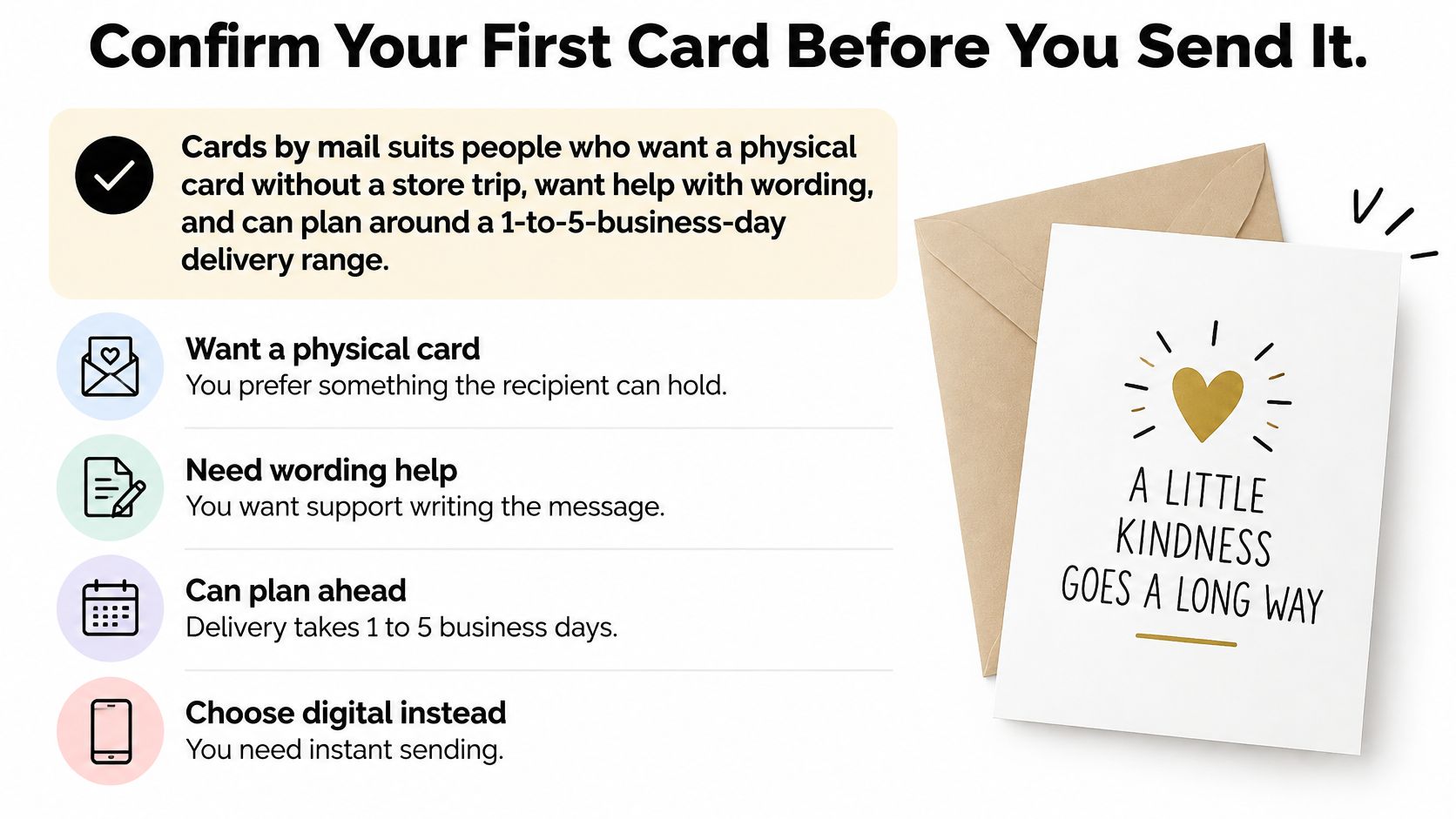
Cards by mail suit people who want a physical card without a store trip, want help with the wording, and can plan around a delivery range of one to five business days. A digital card suits a message that has to land in the next ten minutes. A store-bought card suits someone who enjoys browsing the aisle and writing by hand. None of these is the wrong answer; they just solve different problems.
Before your first order goes out, run these five checks in order.
- Recipient address. Confirm the street, apartment number and ZIP, and confirm the state is one the service reaches.
- Spelling in the preview. Read the message aloud once. Read the recipient's name letter by letter.
- Image quality. A small, blurry photo prints blurry. Upload the largest version you have.
- The total with tax. It should appear before payment, not after.
- The calendar. Count back from the event date, then add margin for a holiday week.
Two smaller notes. You don't need the chat assistant at all; cards can be created and ordered directly on the Mail This website, and custom artwork still has to be approved before anything is sent. And the message is yours to write and edit, so don't accept a draft you wouldn't say out loud.
If something doesn't fit the checklist, ask before you pay. Questions about an account, a card or a privacy request go to support@mailthisnow.com, and if you already have an order, you can open a request straight from its order page.
Mail This turns a short, thoughtful idea into a folded card that shows up in a real mailbox, with the message written and edited by you and the printing, addressing and domestic postage handled on your behalf at one flat price that includes the envelope. It fits neatly into the part of the process this guide kept returning to: you approve the design, the address and the total on one screen, and everything after that handoff runs without another errand. To send your first one, visit Mail This and start with the occasion.