You're sitting with a graduation announcement on the counter, a small amount of cash you want to send, and no clear sentence to put with it. A blank greeting feels cold, a long speech feels forced, and a store card that says the same thing as ten others won't explain why you can't be there. A good graduation card solves that narrower job. It names the finish, gives the money a purpose without controlling it, and arrives as a physical note the graduate can keep after the ceremony noise fades.
Table of Contents
- Graduation Card Lines by Relationship and Tone
- Money Distance and Inclusive Wording
- Size Price and Where a Card Can Ship
- Photos AI Art and Readable Layout
- Draft Preview and Approve the Card
Graduation Card Lines by Relationship and Tone
You have ten minutes, and the graduate already has a stack of cards that say some version of dreams and journeys. Start with a line you can use tonight: You did the hard part. We are proud of you. That works because it's short, it's specific to effort, and it doesn't pretend you know exactly what happens next.
Keep short lines under about 15 words. They're best when you'll see the graduate in person, when you're adding cash or a gift card, or when your relationship is warm but not intimate. A short line still needs a verb and a person. "Congratulations" alone is a label. "You finished. I knew you would" is a message.
How Tone Changes the Same Milestone
Sentimental lines name one true detail. Mention the night shift, the first-generation finish, the retaken class, or the program completed while working full time. One detail beats three adjectives because it proves you paid attention. If you can't name a detail, don't invent one. Use the short version instead.
Funny lines get one light jab and a sincere close. The joke can tease the couch, the email habits, or the family ranking, but it can't roast the graduate's grades, job prospects, debt, or body. End with a real wish so the card still works when they reread it later. If you'd hesitate to say the joke in front of their grandmother at the party, cut it.
| Relationship | Short | Sentimental | Funny |
|---|---|---|---|
| Parent or guardian | You did it. We are proud of you. | I watched the late nights. This diploma is yours. | The couch is now officially a guest spot. Go make the next chapter. |
| Grandparent | Congratulations, graduate. Love you. | Your hard work made this day. I am so glad I saw it. | I still have your crayon report cards. This one is fancier. |
| Sibling or friend | You finished. I knew you would. | I saw the setbacks up close. Today is earned. | Fine, you are the smart one. Dinner is on me once. |
| Teacher or mentor | Congratulations on finishing the program. | Your questions made the work better. I am proud to have taught you. | Class is dismissed. Try not to email me at midnight. |
| Coworker | Congratulations on the milestone. | You balanced the job and the coursework. That discipline will travel. | HR can update the signature. The rest of us already knew. |
| Announcement only, from a distance | Congratulations. Wishing you a strong start. | I cannot be in the seats, but I am celebrating the finish with you. | Consider this the slow-mail version of a loud cheer. |
Build the Inside Note Around the Line
Pick one row, then swap in the graduate's name and next step. College, a first job, a trade certificate, and a GED all deserve the same respect, but they don't need the same sentence. "Good luck at State this fall" lands differently from "Good luck with the apprenticeship," and that difference is the point.
Keep the full inside note near 60 to 80 words. That's enough for a greeting, one true detail, a wish for the next step, and a sign-off without crowding the panel. If you're unsure how warm the closing should be, check the guidance on signing a card with love and match the closing to the relationship, not to a template.
This is a crowded category, which is why generic wording disappears so fast. The USPS summary of Greeting Card Association figures reported approximately 67 million graduation cards purchased in 2019, and a later 2020 industry fact sheet estimated 59 million graduation cards. Millions of people buy the card. Only you can write the line that sounds like it came from their actual life.
Money Distance and Inclusive Wording
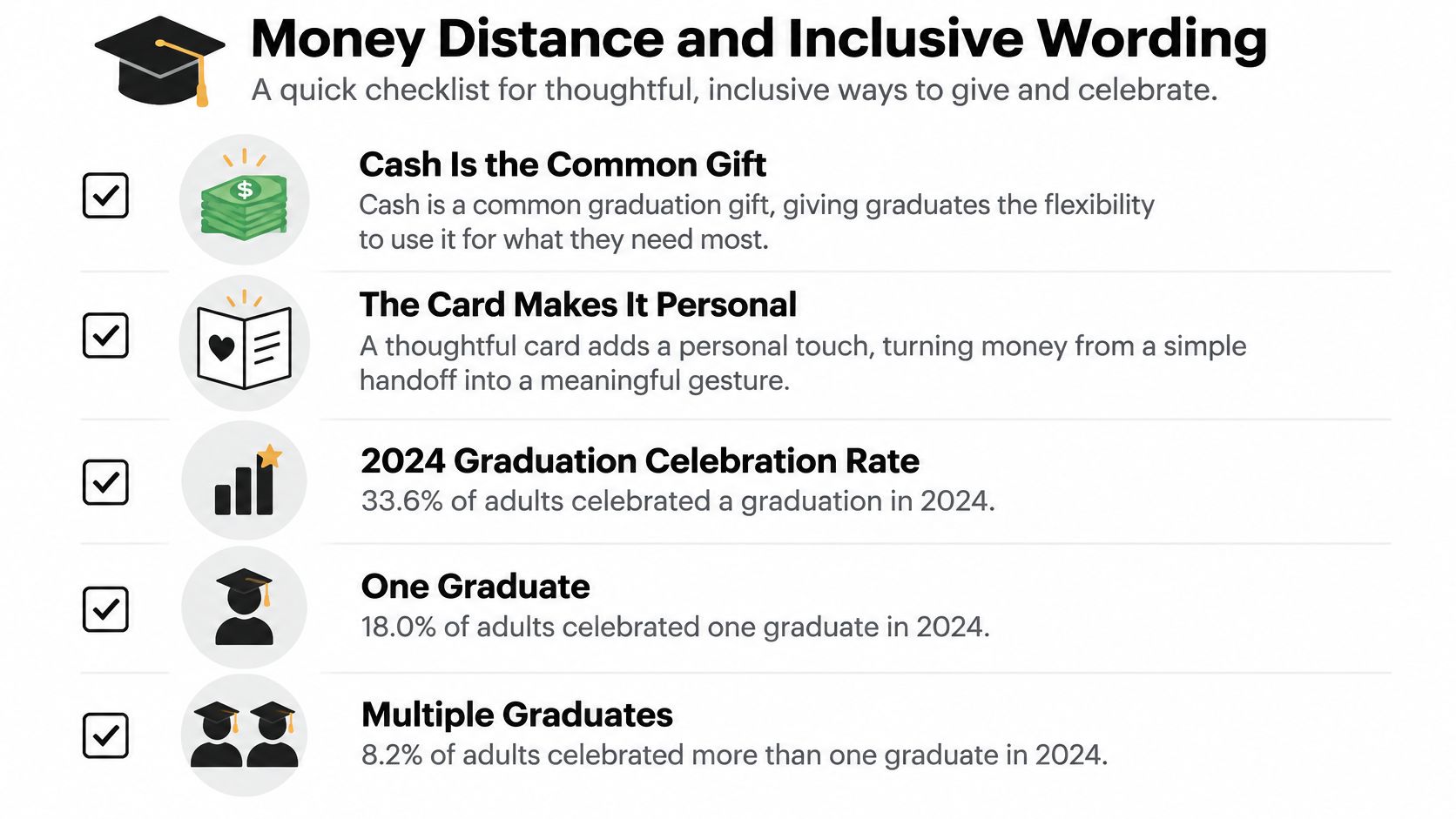
Cash doesn't need an apology. It needs a sentence that tells the graduate why you sent it and that you're not auditing how they spend it. Without that sentence, money in an envelope can feel like a handoff. With it, the same bills become help with books, rent, tools, gas, or a first week that costs more than expected.
The Northwestern University Medill Spiegel Research Center graduation spending report found that 33.6% of adults celebrated a graduation in 2024, with 18.0% celebrating one graduate, 8.2% celebrating two, and 7.4% celebrating three or more. Among people participating in graduation celebrations, 51.7% planned to give cash, 37.6% planned to give a greeting card, and 34.6% planned to give a gift card, with planned average graduation spending of $116.97 per person.
Match the Wording to How You Are Involved
If you'll attend, keep the card short because you'll hand it over and can say the rest out loud. Write the pride, name the next step, and stop. A long note in a card you deliver at a noisy party often gets skimmed and set aside.
If you only received an announcement, say how you heard and wish them a specific next step. "Your announcement made my week. Good luck starting the nursing program" tells them why a card arrived from someone who wasn't invited. You don't owe a gift just because an announcement arrived, and you don't need to explain that decision in the card.
If you're far away, let the card carry the whole gesture and don't apologize for the mail. "I can't be in the seats, but I'm celebrating the finish with you" is complete. Three sentences about plane fares and work schedules shift the focus from the graduate to your absence.
Give Money a Purpose Without Giving Orders
Name a possible use, then release it. Try "For books, tools, or whatever the first month throws at you" or "Use this however the next step is easiest." You're showing that you thought about their transition to college, employment, relocation, or vocational training. You're not requiring receipts.
If the amount is smaller than you wish, state the pride and skip the fake apology. "It's not much, but" makes the graduate comfort you. A clean sentence is kinder: "Proud of you. Wishing you a strong start in the new apartment." The card is the emotional part of the gift, and it doesn't get weaker because the amount is modest.
Practical rule: Suggest one use for the money, then add "or whatever helps most" so the help never sounds like instructions.
Stay Inclusive When You Do Not Know the Custom
Don't guess ethnicity, religion, or family custom from a name, a photo, or a school. Ask the graduate or a trusted relative if you want to use a specific tradition. Even amounts, the number eight, multiples of 18, or a lei can be thoughtful when you already know that family uses them. Borrowed blindly, they can feel like a stereotype.
Neutral congratulations fit secular recipients, LGBTQ+ graduates, first-generation graduates, and people finishing certificates, apprenticeships, or career changes. Use the name and pronouns the graduate uses, and name the credential they earned. A personal detail you know for certain will always beat a borrowed symbol you're guessing at.
Size Price and Where a Card Can Ship
Check the physical limits before you write a long note or choose a photo. A destination that can't be served or a file that can't be uploaded will block the order no matter how good the wording is.
| Item | What applies |
|---|---|
| Folded size | 125 by 175 mm, about 4.9 by 6.9 inches |
| Orientation | Portrait or landscape |
| Price | $9.99 per card, envelope and domestic U.S. postage included, tax shown before payment |
| AI artwork | One generation free after sign-in; additional packs of five cost $1.49 after the card is prepaid |
| Image files | JPEG, PNG, and WebP |
| Ships to | U.S. states and Washington, DC |
| Does not ship | New York State, U.S. territories, military addresses |
| Arrival | Estimated window and order status; no guaranteed date |
| Who mails it | Cardly prints, packs, addresses, and hands off to the postal service |
Rows That Stop an Order
Validate the destination before you polish the message. A New York State address, a U.S. territory, or an APO or FPO box won't complete on this path, so don't promise the graduate a mailed card from this service. Choose a supported address where the graduate will receive mail, or deliver the card another way.
File type is the other quiet blocker. A screenshot saved in an unsupported format or a photo still sitting in a messaging app can stall you at upload. Save or export the image as JPEG, PNG, or WebP before you start, while you're not under time pressure.
Rows That Shape Your Timing and Budget
The flat price makes the math simple, but tax still appears before payment, so read the total rather than assuming the base price is the final charge. If you're comparing options, the breakdown of how much it costs to mail a greeting card helps you separate the card, envelope, and postage parts. Don't build a plan that requires extra paid artwork generations unless you've already prepaid the card.
Order with enough lead time before the graduation date because you get an estimated arrival window and order status, not a guaranteed date. If the ceremony is this weekend and the card must be in your hand at the party, a mailed card is the wrong tool. If it's going to a home address and can arrive during graduation week, the estimate is workable.
Orientation is listed here as a spec, but the crop decision belongs with your photo choice. Don't lock portrait or horizontal until you see whether your best image is a tall close-up or a wide group shot.
Photos AI Art and Readable Layout
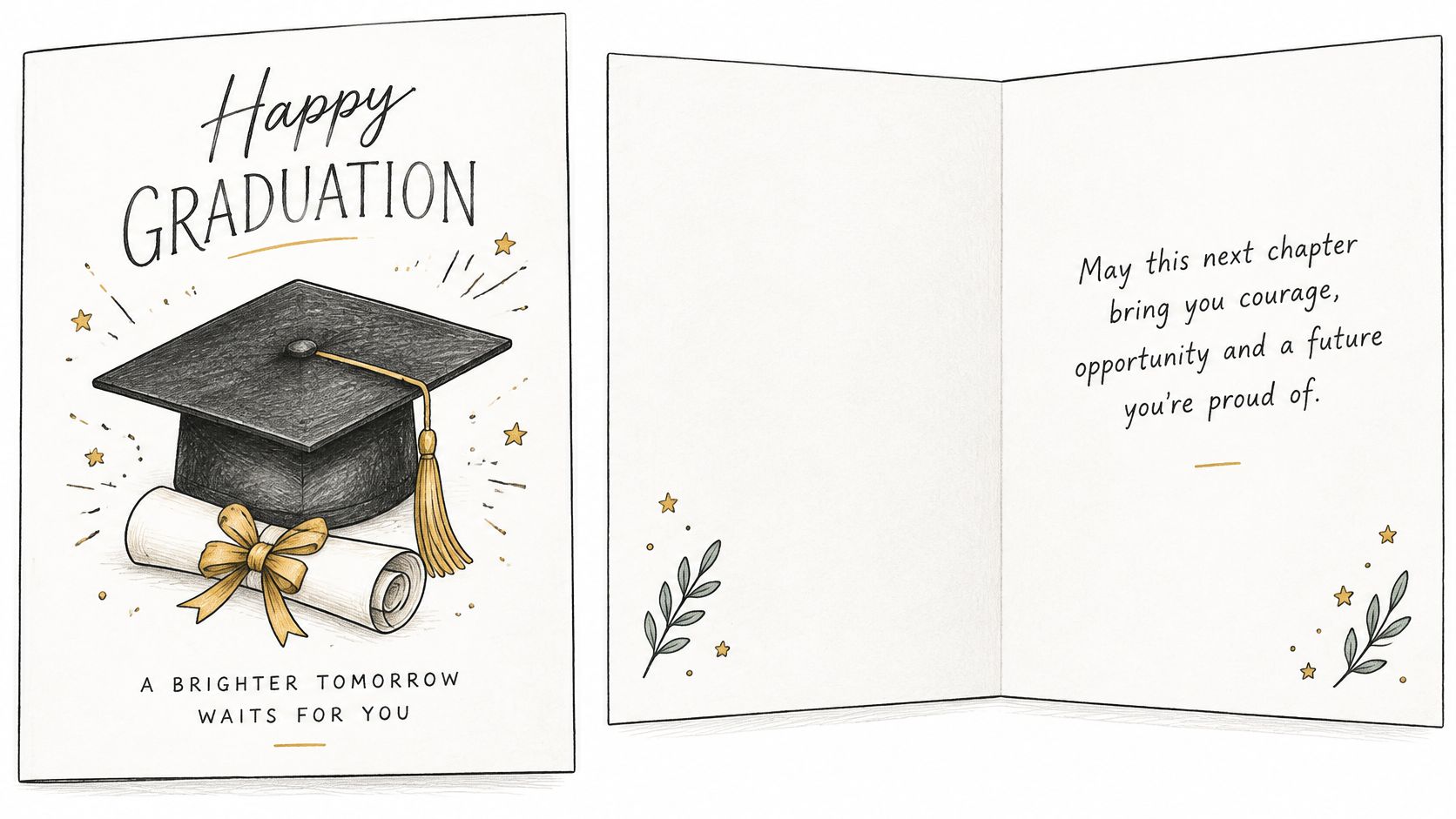
A strong front cover shows one clear thing. The inside does the talking. When senders reverse that, stuffing the front with a collage and leaving the inside nearly blank, the graduate gets decoration without a message they can reread.
This example shows the simple front treatment to aim for, with one milestone image and room for the eye to rest.
Crop for the Person Who Finished
Use one sharp face or one simple object tied to the milestone, not a twelve-photo collage. Choose portrait for a gown close-up and horizontal for a group photo or a wide campus scene, then crop to that orientation before you judge the layout. A group shot squeezed into a tall frame will cut people at the edges or shrink the graduate until they're hard to find.
Leave quiet space around the subject. Type should never sit on hair, a dark gown, a patterned dress, or a busy background of chairs and strangers. If the only good photo is busy, crop tighter on the graduate or move all words to the inside panel where the background is clean.
Watch for the joke-photo trap. A sibling making a face or a pet in a tiny cap can steal the card from the person who finished. Keep the graduate as the hero of the front, even when the inside line is funny.
Ask AI Art for a Scene Not Lettering
Ask for a scene the graduate would recognize, such as a cap near a campus arch, a toolbox after a trade program, or a stethoscope only if they finished a clinical program. Specific objects tied to the next step look intentional. Generic confetti and gold balloons look like every other card in the pile.
Don't put tiny words inside the picture. AI image tools often garble lettering, misspell names, or invent extra characters, and you can't fix baked-in text with a quick edit. Any caption belongs in the independently typeset message, where the exact sentence you approved stays exact. Upload your own photo as JPEG, PNG, or WebP if a real face matters more than a generated scene.
The same layout discipline helps with other milestone cards, including a personalized Father's Day card, because the reader's problem is identical. They need a clear image, readable type, and no important words trapped inside artwork.
If you can't read the line at arm's length in the preview, it's too small or too close to the fold.
This short video is useful for checking how a finished card front reads at a glance before you commit to your own crop.
Set the Inside Panel for Reading
Use dark type on a light panel. Start with one congratulations or the graduate's name, then add two or three short sentences and a sign-off. Short paragraphs give the eye a place to land, and they keep a sentimental detail from turning into a block of text.
Read the preview at the size the graduate will hold, not zoomed in on your screen. If a name looks cramped near the fold or a sentence runs into the edge, shorten the sentence instead of shrinking the type. A card that's easy to read once is a card that's easy to keep.
Draft Preview and Approve the Card
Approval is where a nice idea becomes a mailable card. You'll check three things in order: the words say what you meant, the address can be read by sorting equipment, and the total matches what you expected. Don't rush the last screen because the first draft looked cute.
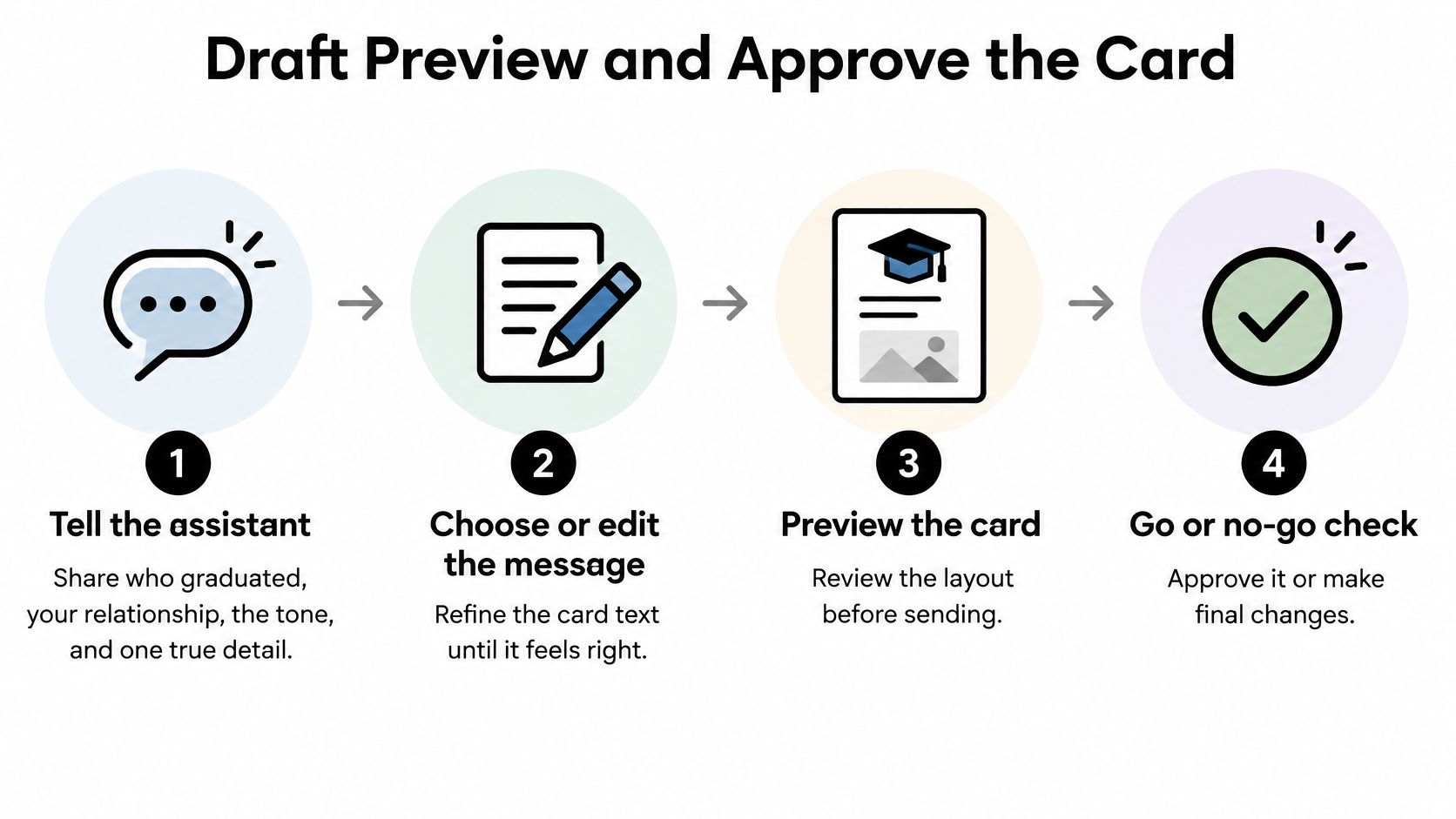
Steps 1 to 4 Build the Draft
1. Tell the assistant the facts. Say who graduated, your relationship, the tone you want, and one true detail. "My niece Maya finished her welding certificate while working nights, proud but not mushy" gives the assistant something real to work with. "Write a graduation card" gives it nothing but clichés.
2. Choose or edit the message. Ask for short, sentimental, or funny variants, then edit like a person, not a committee. Keep the sentence you'd say, cut any detail you can't verify, and make sure the next step named in the card is the graduate's real next step. If they haven't announced a job or a school, wish them a strong start without inventing one.
3. Add a photo or request AI art. Upload your image or use the free generation after sign-in to test a scene. Judge the result by recognition, not novelty. The graduate should look at the front and immediately connect it to their program, campus, trade, or finish.
4. Confirm the message is typeset separately. Your approved wording should sit as real type, not as lettering baked into the image. Read every word in the picture area anyway. If the artwork contains a misspelled name, a fake diploma line, or unreadable script, regenerate or crop it out rather than hoping nobody notices.
Step 5 Gets the Address Right
5. Enter the recipient address in separate machine-readable lines. Put the recipient's name on one line, the street address or PO Box on the next, and the city, state, and ZIP+4 on the last line. Don't add decorative symbols, extra nicknames, or a second person's name unless that name is part of how mail is delivered there.
The USPS addressing guidance places the complete delivery address inside the Optical Character Reader area, roughly 0.5 inches from the left and right edges and between 0.625 and 2.75 inches from the bottom. It also calls for keeping artwork, decorative borders, and dark backgrounds away from the address block and reserving the lower-right barcode area, with a 0.75-inch right margin recommended to reduce risk from lead-edge foldover.
Check the clear zones like a production preflight, even though you're the sender. The barcode clear zone extends across the lower-right 4.75 inches of the piece and up 0.625 inches from the bottom edge, so no art, border, or stray text should intrude there. Render or view the final envelope at full scale when you can, measure the margins, and validate the ZIP+4 format before you approve.
Address check: If any artwork touches the address block or the lower-right barcode clear zone, it's a no-go until that area is empty.
Confusing addresses cause most avoidable trouble. A dorm may need a building name or box number, a new apartment may need a unit number, and a graduate moving right after the ceremony may receive mail more reliably at a family home. Ask for the exact mailing address instead of copying a street address from a social post.
Steps 6 to 8 Confirm Before Anything Mails
6. Open the full preview. Review the design, the recipient, and the total together, including the base price plus tax shown before payment. Read the inside note out loud once. You'll hear a repeated word, a missing name, or a joke that sounds harsher than it looked.
7. Approve only when all three match your intent. Nothing should be sent before that confirmation. This is the point of an approval-first flow such as Mail This, where the assistant turns your intent into candidate art and wording, a hosted preview appears before payment, and Cardly prints, addresses, and posts the card after you confirm.
8. Track status and treat timing as an estimate. Save the order status view and check it if graduation week gets busy. An estimated arrival window helps you plan a follow-up text, but it isn't a promise you should pass on to the graduate as a delivery date.
Run the Go or No-Go Check
Before paying, confirm these three things in plain language:
- Words are right: The graduate's name is spelled correctly, the next step is accurate, the tone fits your relationship, and the sign-off is yours.
- Destination is supported: The address is a supported U.S. destination, not New York State, a territory, or a military box, and every address line is complete.
- Total is expected: The design, recipient, and final total on the preview match what you meant to order, with no extra generation pack you didn't intend to buy.
If the destination is unsupported, stop and deliver the card another way. Don't enter a nearby state, a friend's address without permission, or an incomplete ZIP code to force the order through. A card sent to the wrong place helps nobody.
If the wording is wrong, go back to the draft rather than fixing it in your head. The printed card will carry the approved sentence, not the sentence you meant to approve. That exactness is the advantage of typeset text, and it's also your responsibility at the preview screen.
Say your graduate is moving for a first job and you want to include cash help for the deposit. Your draft might read, "You finished the program while working weekends. I'm proud of that discipline. Use the enclosed help for the new place, or whatever the first month needs most." That note is specific, it doesn't apologize for distance, and it gives the money a purpose without attaching conditions. If the preview shows that exact text, the right name, a supported address, and the total you expected, approve it. If any one of those fails, it's a no-go until you fix it.
Turn the line you've picked, one true detail, and a photo or AI scene into a printed graduation card you preview and approve before anything mails. Visit Mail This to draft the message, check the recipient and total on the full preview, and send a card that explains the gift and your pride in your own words.