You're standing beside the graduation-party gift table, looking at a stack of cards with nearly identical caps, diplomas, and gold lettering. You've bought something perfectly respectable, but the inside still feels like it could belong to anyone. Congratulations, good luck, all the best. Nothing wrong with those words. Nothing especially personal, either.
The card a graduate keeps might be the one that remembers the statistics course they nearly abandoned, the camping trip where everything went wrong, or the friend who survived library closing time alongside them. Specificity matters more than elaborate decoration. A plain card with a recognizable voice can feel more thoughtful than a crowded design filled with borrowed inspiration.
Graduation is a familiar card-giving occasion: Americans purchase approximately 59 million graduation cards annually, according to the Greeting Card Association's greeting-card facts. Your job isn't to find a sentiment nobody has ever written. It's to make the card unmistakably theirs.
Choose a format that gives your personal detail room to stand out, rather than adding detail to a template that doesn't suit it.
These graduation card ideas cover letters, photographs, advice, humor, timelines, encouragement, typography, and custom illustration. Each works for a different kind of relationship, with practical decisions about wording, layout, and what to check before you approve the finished card.
Table of Contents
- 1. Heartfelt Personal Letter Card
- 2. Shared Memory Lookback Card
- 3. One Piece of Advice Card
- 4. Witty Inside-Joke Card
- 5. Milestone Timeline Photo Card
- 6. Forward-Looking Encouragement Card
- 7. Minimalist Typography Card
- 8. Custom AI-Generated Illustration Card
- Comparing the 8 Graduation Card Ideas at a Glance
- From Idea to Mailbox Without the Errand
1. Heartfelt Personal Letter Card
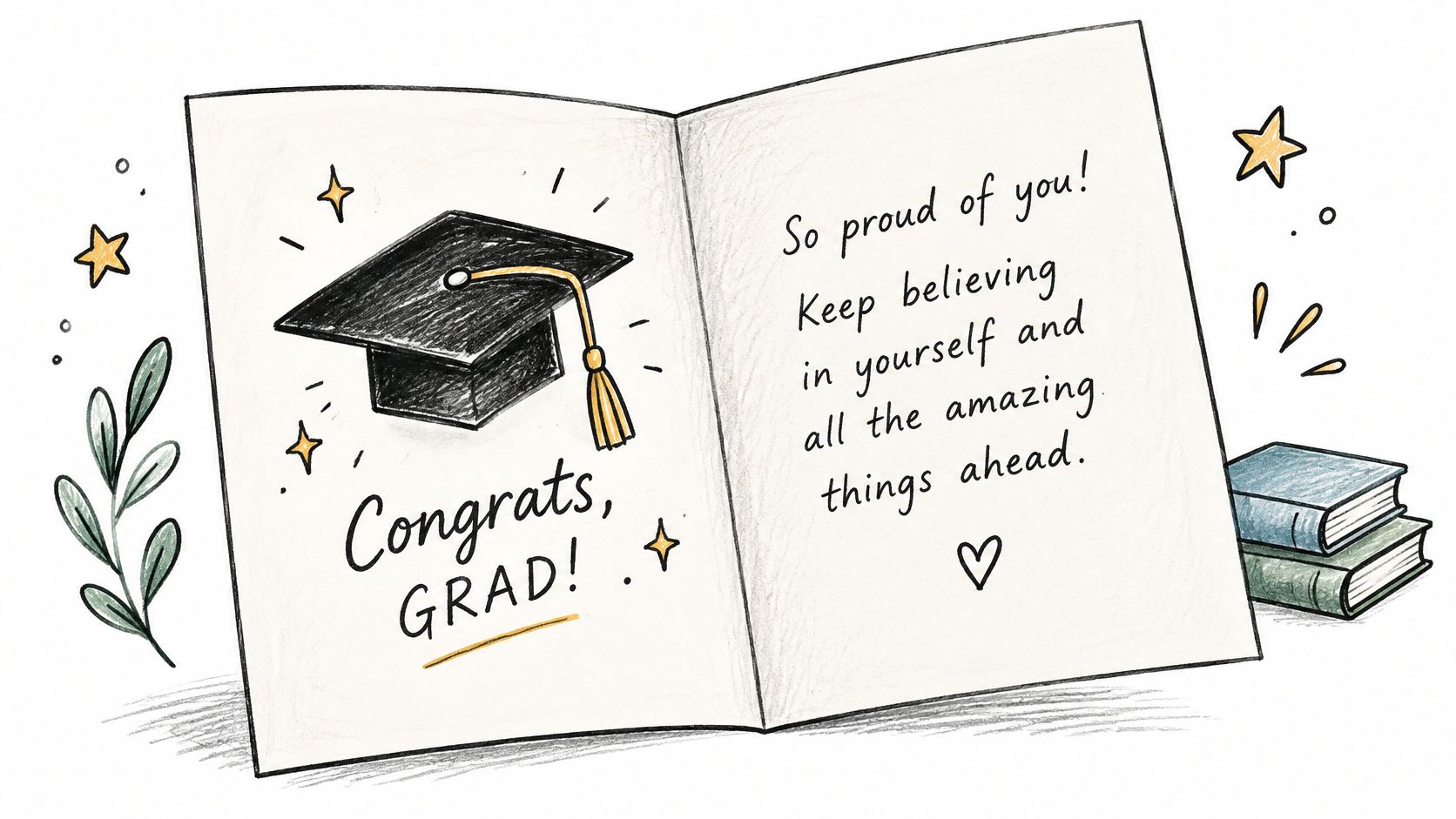
A personal letter card suits a niece, grandchild, close friend, or former student when you have something meaningful to say beyond congratulations. Start with a quality you can describe, then connect it to a moment the graduate will recognize. Persistence becomes personal when you name the evening they reopened their statistics notes instead of giving up.
Keep the design quiet enough for the message to remain the main event. An uncluttered inside panel, dark text, and a small graduation motif feel more intentional than decorative script surrounding every sentence.
Write in your own speaking voice
For a niece who struggled through a demanding course, try:
I'm proud of you for finishing, but I'm even prouder of how you kept going when statistics felt impossible. You asked for help, changed your approach, and stayed with it. I hope you give yourself credit for that persistence, not just the result. I'm so happy to celebrate you.
The trade-off is space. A long letter can be lovely, but shrinking it into tiny print makes the card harder to enjoy. Cut repeated praise before reducing the type size, and use handwriting-style lettering only if it remains comfortable to read.
- Read it aloud. Replace anything you'd never naturally say to this person.
- Check the ending. Match your sign-off to the relationship; these suggestions for signing a card with love can help you choose something affectionate without sounding forced.
- Inspect the preview. Check paragraph breaks, the graduate's name, and whether the final line feels cramped near the fold.
2. Shared Memory Lookback Card
Start with the photograph you'd send the graduate just to make them smile. A muddy hiking picture, a family beach trip, or an exhausted post-project selfie can be a better choice than a formal portrait because it gives you something personal to write about.
Choose recognition over polish. A slightly imperfect photograph can work beautifully if the graduate loves the memory. An embarrassing image doesn't become thoughtful just because it's nostalgic.

Let the picture carry the setting
Say you're using a photograph from a family beach trip when your cousin insisted on exploring beyond the familiar path. Your message could read:
You were always the person asking what was around the next corner. That beach trip still makes me smile, especially the detour you convinced us to take. Congratulations on this achievement. I hope you keep making room for the curiosity that's always been yours.
Keep the reference brief. You don't need to explain the whole trip to someone who was there, and a lengthy caption can compete with the image.
For the layout, place the photo on the front and the message inside, or give the image a generous border with a short caption beneath it. Avoid text over a busy background, particularly across faces or clothing.
- Use the original file. A screenshot of a social-media post may look noticeably softer than the photograph itself.
- Choose a suitable format. JPEG, PNG, or WebP are useful options when your card builder accepts them.
- Approve the crop. Check faces, hands, horizon lines, and orientation. A tightly cropped preview can remove the very detail that makes the memory recognizable.
3. One Piece of Advice Card
Advice belongs in a graduation card only when the relationship earns it. A trusted mentor can offer a useful thought; a distant acquaintance delivering a financial lecture is more likely to sound intrusive. Start by celebrating the achievement, then offer an invitation rather than a command.
A focused card works well for a graduate who has already talked with you about starting work, moving away, or learning to manage independently. Don't assume those plans because graduation has arrived.
Practical rule: If removing the advice leaves no congratulations behind, the message needs more celebration.
Offer something small enough to use
For a graduate starting a job, you might write:
Congratulations on everything you've put into reaching this point. As you settle into your new role, I hope you'll feel comfortable asking questions before you think you should know everything. You don't have to arrive fully formed to belong there. I'm cheering you on.
That's more supportive than instructions to impress the boss, work harder than everyone else, or have a career plan ready. It gives permission without setting another performance target.
Use a restrained front design, perhaps an open doorway or a small compass illustration. Keep the advice inside rather than turning the cover into a motivational poster. If you're using an AI drafting assistant, ask for a warm version and a more understated version, then edit the result into your own voice.
Before approval, check every assumption. Does the message presume employment, disposable income, relocation, or further study? Avoid mentioning debt, grades, or a difficult job search unless the graduate has invited that conversation. A card should acknowledge their achievement, not assign homework for what comes next.
4. Witty Inside-Joke Card
For the friend whose coffee order became a group project, a solemn inspirational card may feel completely wrong. A playful front with a sincere inside can sound much more like your friendship. The best material is a joke you already share, not a generic graduation pun you're hoping they'll appreciate.
Try a simple coffee-cup illustration on the cover with this original line:
Officially qualified. Still impossible to order coffee for.
Inside, bring it back to the accomplishment: I loved surviving late study nights with you. Beneath all the caffeine jokes, I'm seriously proud of what you've achieved. Congratulations, and the next coffee's on me.
Keep the graduate in on the joke
The Greeting Card Association's purchasing guidance identifies message and tone, visual appeal, relationship relevance, subject matter, and perceived value as purchase considerations. For a humorous card, relationship relevance and tone deserve particular attention. Clever wording isn't useful if it makes the recipient uncomfortable.
A nickname can work if the graduate still likes it. Teasing about poor grades, delayed completion, drinking, relationships, or money is much harder to justify, especially when someone else might read the card aloud.
- Make the reference recognizable. Include the familiar object, phrase, or setting without explaining the joke into exhaustion.
- Keep the front readable. A short setup and a clear illustration usually beat a paragraph of comic backstory.
- Finish sincerely. Give the graduate an unambiguous sentence of pride or affection.
At the preview stage, read the card as though a relative has just picked it up from the table. If the joke exposes something private, move it into a separate personal message or choose different material. Funny should feel affectionate, not risky.
5. Milestone Timeline Photo Card
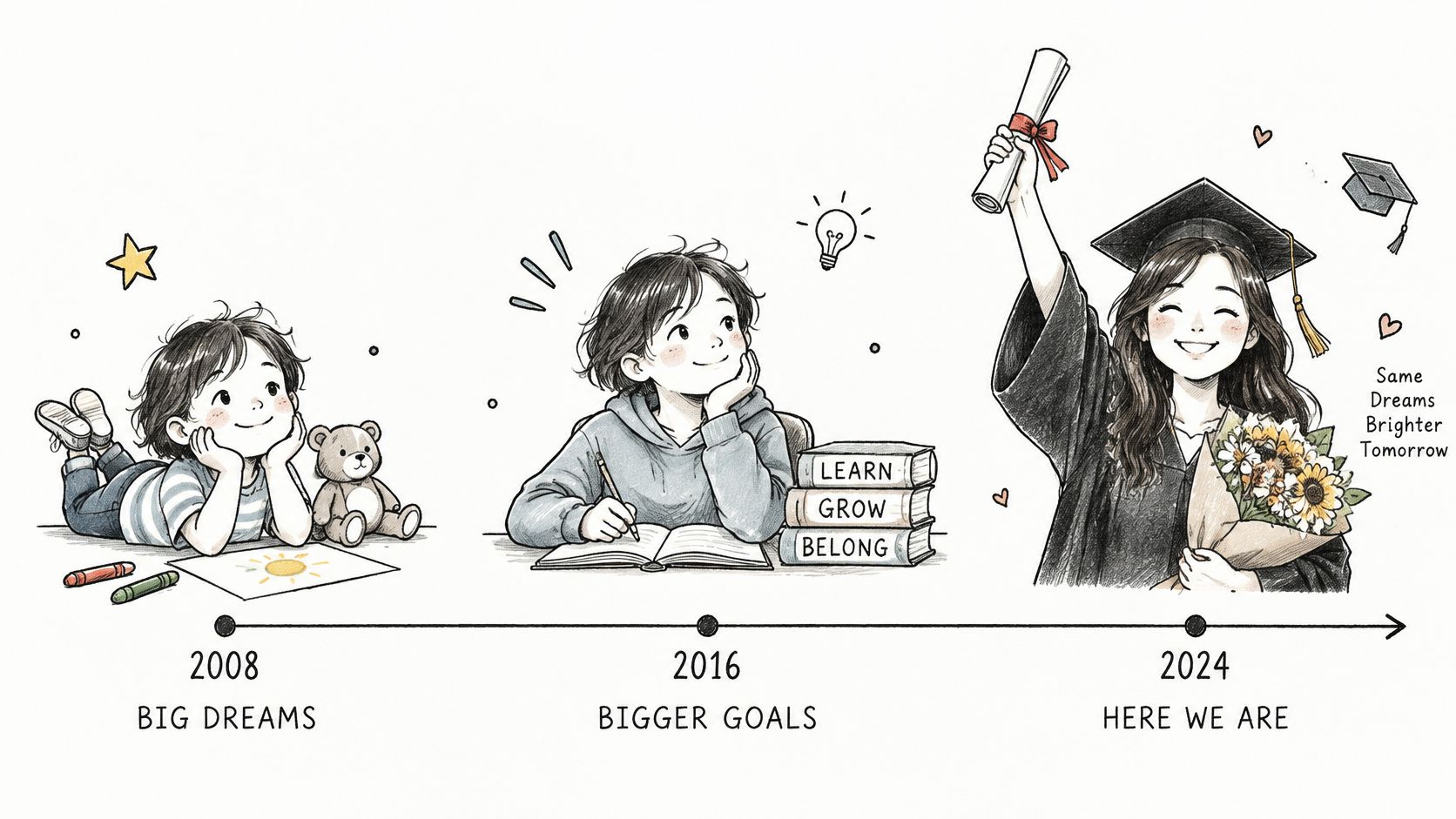
A timeline card is a good choice when you want to acknowledge the journey rather than spotlight a single memory. A parent might pair a first-day-of-school photograph with a school performance, a favorite activity, and the graduation portrait. For an adult learner, work, family life, and study can tell a more accurate story than childhood school pictures.
Don't force every graduate into the same childhood-to-campus narrative. Choose moments the recipient would recognize as part of their achievement, and leave out experiences they'd rather keep private.
Edit the collection before arranging it
Use a small selection of distinct photographs rather than filling every available space. Consistent crops and simple captions help the card feel coherent, even when the originals come from different cameras. The practical guidance on personalized greeting cards with photos can help you plan the balance between images and message.
For a grandparent's card, an inside note might read:
From the child who wanted to know how everything worked to the graduate celebrating today, your curiosity has been a joy to watch. These pictures remind me of how much you've tried, learned, and grown. I'm proud of the person you are, not just the qualification you've earned.
The trade-off is image size. Adding another photograph means the existing pictures become smaller, and expressive faces can turn into indistinct details.
- Compare orientations. A horizontal layout can suit a horizontal journey; portrait can work better for stacked images.
- Verify captions. Confirm names, credentials, and any dates before adding them.
- Respect the story. Don't label a period as a setback, comeback, or struggle unless the graduate uses that language themselves.
Check that the final photograph isn't crowded against the trim edge or fold.
6. Forward-Looking Encouragement Card
Not every graduate wants advice, a nostalgic photograph, or a prediction of greatness. Sometimes the right message is confidence without pressure, especially when the next step remains uncertain.
That uncertainty isn't unusual enough to ignore. In October 2024, 62.8% of U.S. high-school graduates ages 16–24 were enrolled in college or university, according to the U.S. Bureau of Labor Statistics. Don't automatically write about campus life, dorm rooms, or a degree program unless you know those plans apply.
Celebrate what they've completed without requiring them to explain what comes next.
Name a goal only when it's theirs
For a friend moving for a confirmed job, try:
Congratulations on your graduation and the move ahead. I know you've been looking forward to building a life in a new city, and I'm excited for you. You don't have to have everything figured out when you arrive. I'd love to keep our Sunday catch-ups going if that would feel good to you.
For someone without settled plans, change the middle to: You've earned the chance to celebrate this achievement without having every answer ready. I'm proud of you, and I'm here while you work out what you want next.
Our suggestions for what to write to a high-school graduate offer more ways to match encouragement to your relationship.
Choose a design that supports possibility without prescribing a destination. An open view or abstract sunrise is more flexible than a campus illustration. At approval, remove any promises you can't keep, and replace vague support with something genuine, such as a call, a meal, or help packing. An offer matters most when you're prepared to follow through.
7. Minimalist Typography Card
A text-led card is the strongest option when the graduate dislikes photographs, sentimental decoration, or attention-heavy designs. It can also be the most respectful choice when you don't know their preferred imagery or they'd rather keep the celebration private.
Minimalism isn't just leaving things out. The wording, spacing, and contrast have to be deliberate, because there's little else to distract from a typo or awkward line break.

Make the language fit the achievement
A bold serif Congratulations with a muted green accent can feel warm without being ornate. A clean sans-serif You did this can suit a friend who prefers something direct. Keep the inside equally clear: Congratulations on completing your certificate. Your care and determination deserve celebrating. I'm so pleased for you.
Graduation imagery doesn't have to mean a conventional university portrait. The range of formats shown in Shutterfly's graduation announcements can provide visual starting points, but choose terminology that fits the actual recipient.
For a GED, apprenticeship, career-retraining program, or online qualification, verify the name of the achievement rather than borrowing a degree title from a template. If you don't know the credential, plain congratulations is better than an inaccurate label.
- Choose contrast. Dark lettering on a light background is a dependable starting point; pale text can disappear.
- Protect the margins. Give the headline breathing room and keep it clear of the fold.
- Proof every character. Check the preferred name, capitalization, punctuation, and any credential abbreviation.
Don't use tiny decorative text merely to fill space. Empty space is part of this design, and a short message can feel complete without a quotation or graduation year.
8. Custom AI-Generated Illustration Card
Custom illustration works when you know the graduate's interests but don't have the right photograph. A mountain trail, favorite garden, beloved pet, or meaningful skyline can provide the personal connection. Add a graduation motif only if it improves the image rather than making it busier.
Describe a scene, not a collection of unrelated symbols. A graduate who loves hiking doesn't need mountains, books, a diploma, a city skyline, and a coffee cup squeezed into the same picture.
Give the artwork a clear brief
An adaptable prompt might read:
Create a watercolor-style illustration of a winding mountain trail beneath a soft peach sky, with deep green pines and a small graduation cap resting on a foreground rock. Leave open space above the trail and include no lettering.
Pair it with a separately typeset message: Congratulations on reaching this milestone. I hope you find time to enjoy the view before choosing the next trail. I'm proud of you and excited to see what you choose.
The video below offers a visual companion to the custom-card workflow.
AI artwork gives you flexibility, but it also creates an inspection job. Check hands, faces, architecture, cap shapes, and anything that's meant to resemble a specific place. If the scene feels almost right, revise the problem directly instead of adding more instructions everywhere.
- Keep lettering separate. Typeset the approved message rather than relying on text drawn inside the image.
- Check representation. Remove invented school crests, inaccurate uniforms, or unwanted likenesses.
- Approve the complete card. Review the artwork, inside wording, crop, recipient, destination, and total together.
A pleasing illustration isn't enough if the graduate's name is wrong or the message no longer sounds like you.
Comparing the 8 Graduation Card Ideas at a Glance
| Card Idea | Best For | Tone | Preparation Needed |
|---|---|---|---|
| Heartfelt Personal Letter Card | Most relationships, including family and friends | Sincere and personal | Write a short note with a specific memory or quality |
| Shared Memory Lookback Card | Close family and longtime friends | Nostalgic and warm | Choose a recognizable memory and a high-quality photo |
| One Piece of Advice Card | Graduates starting work, school, or independent life | Supportive and practical | Choose one thoughtful, actionable piece of advice |
| Witty Inside-Joke Card | Friends, siblings, and coworkers who share the joke | Playful and humorous | Check that the joke will land and stay appropriate |
| Milestone Timeline Photo Card | Parents, grandparents, and close relatives | Proud and sentimental | Gather three or four photos and arrange them in a clear timeline |
| Forward-Looking Encouragement Card | Graduates beginning a new role, move, or program | Hopeful and encouraging | Mention a future goal or offer a concrete form of support |
| Minimalist Typography Card | Recipients who appreciate a clean, modern design | Elegant and understated | Choose a brief phrase and verify the exact wording |
| Custom AI-Generated Illustration Card | Graduates with a distinctive hobby, favorite place, or style | Creative and personal | Write an art prompt and review the illustration before approving |
From Idea to Mailbox Without the Errand
Choose the format that suits your relationship, not the one that looks most elaborate. A close relative may appreciate a personal letter; a friend may prefer an inside joke; a private graduate may welcome clean typography without a photograph. The best choice gives you a natural way to say something true.
Write the message before polishing the design. That prevents you from squeezing a thoughtful note into a layout chosen for decoration alone. If you're stuck, finish the sentence What I most want you to know is…, then remove that opening and use the thought that follows.
Treat approval as the final editing stage
Review the card as a physical object rather than a collection of separate ingredients. Read the cover and inside in sequence, inspect the crop, and make sure the sign-off hasn't ended up isolated or cramped. Confirm the graduate's preferred name and the mailing address instead of relying on an old contact entry.
With Mail This, a personalized folded card measures 125 × 175 mm, in portrait or horizontal orientation, and costs $9.99 including the envelope and domestic U.S. postage, with applicable tax shown before purchase. Our approval-first flow lets you review the full design, recipient, and total before payment; printing and mailing happen only after you approve and pay. If the card arrives damaged, misprinted, or materially different from the approved preview, you can choose a free reprint or a full refund.
Check destination coverage and the estimated arrival window before treating the card as part of a ceremony-day gift. Delivery dates aren't guaranteed, and service currently excludes New York State, U.S. territories, and military addresses. If timing is tight, send your congratulations directly as well, then let the physical card become the keepsake.
Your final send-off checklist
- Choose the format. Match the card to the graduate's personality and your relationship.
- Draft a short message. Aim for a few purposeful sentences rather than repeated congratulations.
- Add a personal detail. Include a real memory, a recognizable joke, or a photograph they'll appreciate.
- Review the preview carefully. Check wording, names, crop, layout, address, and the complete total.
- Approve and mail. Finish only when the card says what you mean and looks how you expect.
You don't need a perfect speech about the graduate's future. You need a message they can recognize as yours, with enough care in the finishing that nothing distracts from it.
Mail This turns your graduation message, personal photo, or custom artwork into a physical card that we print and mail after your approval. Visit Mail This to build your card, review the finished design and total, and send congratulations without the stationery-store errand.