Are you counting from checkout, or from the moment the finished envelope enters the mail? Your card is printed and packed first, with no published production duration, and the USPS clock starts only when it is accepted into the mailstream.
That gap is where timing guesses go wrong. Plan around the arrival estimate shown before you pay, then treat First-Class transit as a second stage that excludes Sundays and postal holidays.
Table of Contents
- The Full Timeline and Planning Your Send Date
- How an Order Moves Through Production
- Destination and Route Factors That Change Arrival
- How Reliable the Delivery Window Really Is
- What to Do When a Card Arrives Late or Wrong
- Frequently Asked Questions About Mail This Timing
The Full Timeline and Planning Your Send Date
Your total wait includes fulfillment plus postal transit. We show the arrival estimate before payment, and your card is printed and mailed only after you've approved it and completed payment.
The USPS First-Class Mail guide gives an estimated delivery range of 1-5 business days, excluding Sundays and postal holidays. That's the postal portion, not a checkout-to-mailbox promise.
Mail This Timeline Stages and Time Windows
| Stage | What Happens | Time Window |
|---|---|---|
| Preview approval and payment | Recipient, design and total confirmed before paying | Approval is complete once payment is confirmed |
| Printing, packing and addressing | Cardly prints, envelopes and addresses the card | No published duration; use the estimate shown before payment |
| USPS acceptance | Card enters the postal network and the USPS clock starts | After Cardly completes fulfillment and hands it to USPS |
| USPS First-Class Mail transit | Card travels to the recipient's address | USPS estimate of 1-5 business days, excluding Sundays and postal holidays |
| Total from payment | Production plus postal transit | Production time plus the USPS transit window |
The unknown production duration isn't a reason to guess. Use the arrival estimate presented for your actual order, rather than assuming that payment means the envelope is already on its way.
Your drafting time is separate, too. Choosing a photo, editing the message and reviewing the preview happen before production can begin. If you're preparing personalized greeting cards with a photo, have the image and recipient details ready before you settle on a sending date.
Work Backward From the Occasion
- Note the occasion date. Decide whether the card needs to arrive before the event or whether arrival around the occasion is acceptable.
- Subtract the full postal allowance. Use the longer end of the published USPS window rather than building your plan around the earliest possible delivery.
- Subtract the production allowance in your checkout estimate. Don't substitute an assumed printing time for the estimate shown for your order.
- Approve early on a weekday when practical. A morning approval leaves more working time for processing, but it doesn't establish a same-day production guarantee.
Say you're sending a card for a Saturday birthday. Approving early in the week is a better plan than waiting until Friday, provided the displayed arrival window still fits. A Friday payment doesn't mean Friday postal acceptance, and nonworking days can extend the calendar wait.
Practical rule: Choose your approval date using the latest estimated arrival, not the earliest.
For holiday weeks and occasions that can't move, allow extra margin. If the estimated window already extends beyond the birthday, choosing the birthday as your desired arrival date won't make the underlying process faster.
Start the card, review the exact preview, recipient and total, then compare the arrival window with your calendar. That gives you a usable sending decision before you commit to payment.
How an Order Moves Through Production
An approved design, a paid order and a mailed envelope are different checkpoints. Knowing which one your card has reached helps you distinguish a production question from a postal delay.
This diagram illustrates the order's progress from purchase toward delivery.
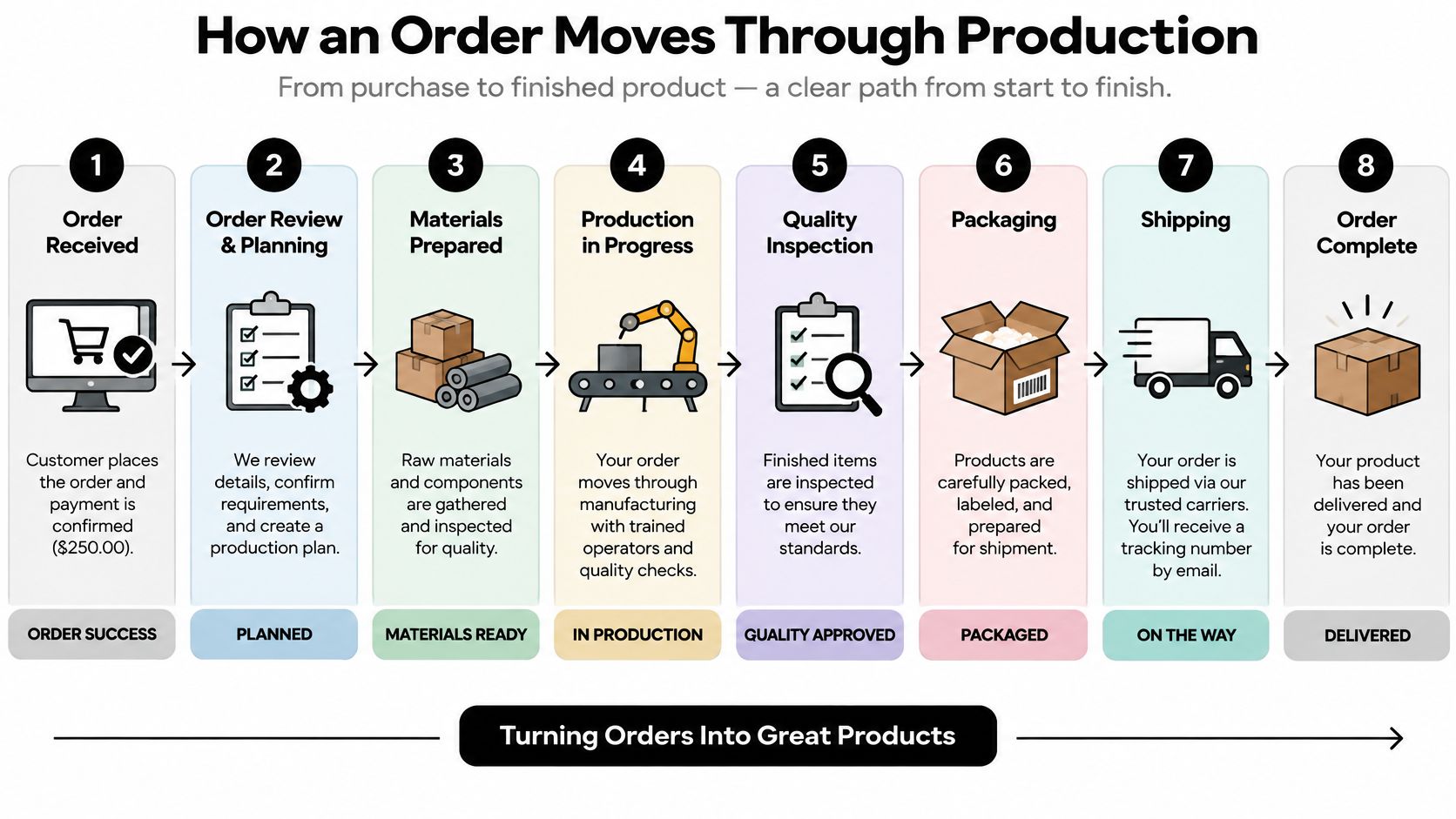
Approval Through Postal Handoff
Choose the design and approve the exact card. Check the wording, artwork and recipient address against what you intend to send. An unfinished draft isn't authorization to print.
Review any correction suggested by the address check. Accept the suggested address only after checking it, because an accepted correction becomes the delivery address used for the card.
Approve the delivery details, total and arrival estimate, then pay securely. Purchase approval applies to the exact draft version and recipient presented. This is your checkpoint for catching an incorrect destination or unsuitable arrival window.
We submit the approved card to Cardly only after payment is confirmed. Editing a preview and completing payment aren't interchangeable steps, so check payment confirmation before assuming production has started.
Cardly prints, packs and addresses the card, then hands it to USPS. Printing completion alone doesn't establish that USPS has received the envelope.
USPS accepts the piece, and postal transit begins. The USPS service-standard FAQs define the service standard around acceptance through delivery, not the customer's payment time.
Read Status as a Checkpoint
A useful way to interpret progress is processing before postal acceptance and mailed once USPS receives the card. The arrival estimate then concerns the route to the destination, rather than work still needed at the printer.
Our guide to sending cards by mail provides context for the physical mailing workflow. For an existing order, inspect the order page rather than using the date you first created the draft as your starting point.
If you need to stop the order, use the cancellation button on its order page before submission to the printer. After submission, cancellation depends on the provider and isn't guaranteed.
Check the preview before payment, confirmation after payment and mailing status before counting postal transit. Each check answers a different question, and none should substitute for the next.
Destination and Route Factors That Change Arrival
Distance, processing connections and the calendar shape the postal portion of your delivery. The relevant journey runs from the fulfillment origin to the recipient's ZIP code, not from one state name to another.
The USPS service-standard fact sheet explains how transportation distance and processing relationships affect delivery expectations, with longer routes potentially carrying two-, three-, four- or five-day standards. Local mail can receive a shorter standard. A familiar destination name still doesn't tell you which processing route your envelope will take, so a card addressed across town and a card addressed across the country can carry very different standards.
Why the ZIP Code Matters
An envelope may move between regional facilities and local processing centers before reaching the recipient's delivery route. A complete ZIP code gives a far better arrival estimate than a broad assumption like "nearby states should be quick." Two addresses in the same city can route through different facilities and land on different standards.
The calendar changes the arrival date without changing the physical destination. A holiday during the expected journey pushes receipt later on the calendar, even when the envelope follows its planned route.
Saturday and Sunday aren't interchangeable either. Follow the exclusions stated in the mailing estimate rather than assuming every weekend day counts, or that every weekend day is excluded. When the estimate shows a range, plan around the later end for anything date-sensitive.
A route-based window is more useful than a precise-looking date that doesn't account for postal acceptance and the calendar.
Check Eligibility Before Timing
A valid postal address and a supported service destination aren't the same thing. Mail This delivers cards to all 50 U.S. states and Washington, DC, but U.S. territories and military addresses aren't supported, so check the recipient's state and address type before you finalize the card.
Before payment:
- Confirm coverage. Check the recipient's state and address type before spending time finalizing the card.
- Enter the complete address. Include the ZIP code and any apartment or unit information the recipient uses.
- Review address suggestions. The recipient address is checked before you pay, but you still need to confirm that the result identifies the intended destination.
- Inspect the calendar. Look for holidays within the estimated journey and leave additional room when timing matters.
A supported address clears the eligibility check. The arrival window remains an estimate, so allow extra time for important occasions.
How Reliable the Delivery Window Really Is
A delivery range isn't a statement that every day within it is equally likely. Each postal route has an applicable standard, and USPS measures whether pieces meet that standard.
The chart provides a visual comparison of delivery reliability.
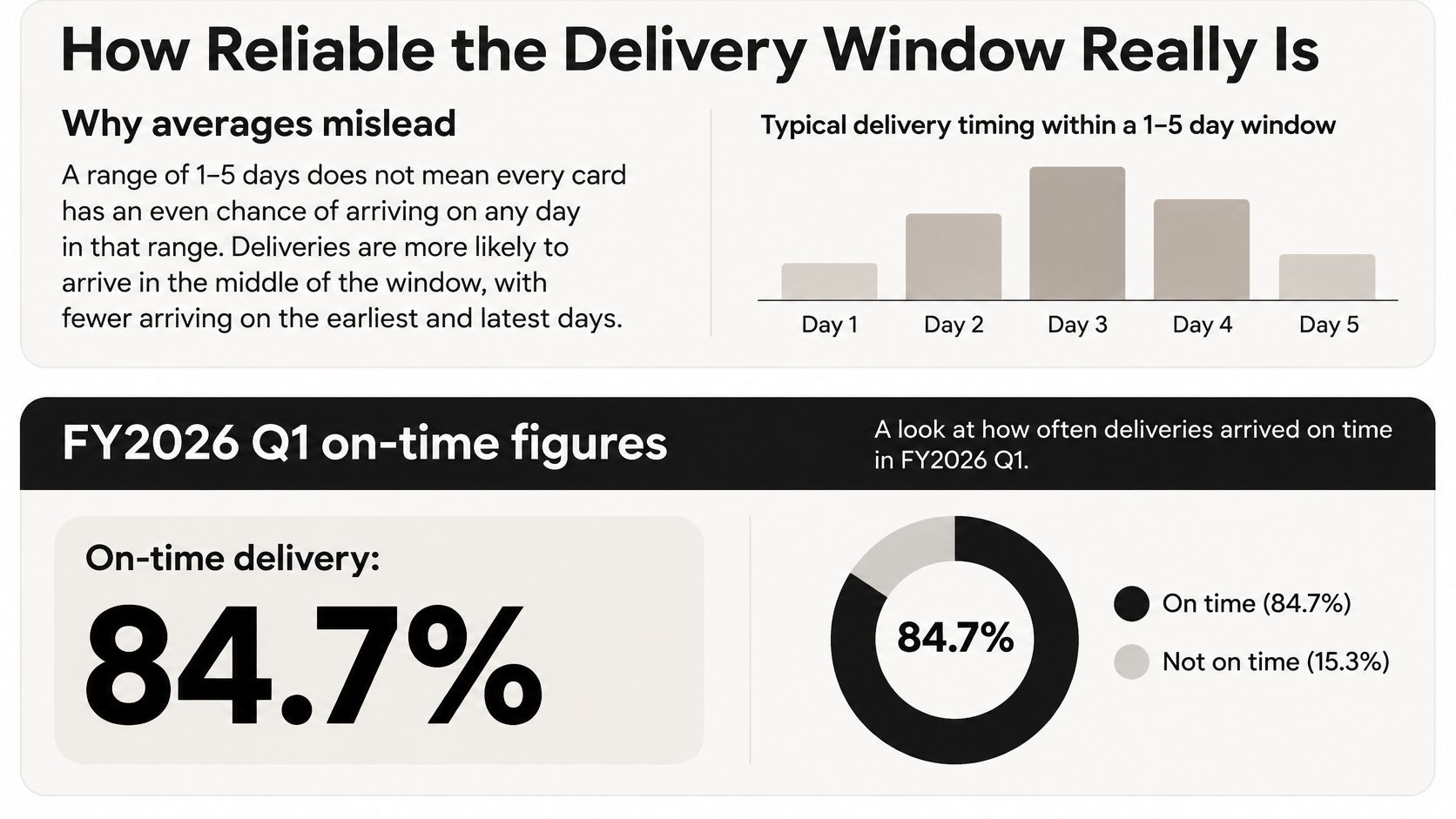
On-Time Performance by USPS Service Standard, FY2026 Q1
The USPS FY2026 Q1 single-piece First-Class Mail performance report reports the following on-time rates and shows that at least 96.8% arrived within the applicable standard plus three days.
| Service Standard | On-Time Rate | What It Means |
|---|---|---|
| Two-day First-Class Mail | 84.7% | Roughly 15% of pieces miss the standard |
| Three-day First-Class Mail | 78.4% | Roughly 1 in 5 pieces miss the standard |
| Four-day First-Class Mail | 74.7% | Roughly 1 in 4 pieces miss the standard |
| Five-day First-Class Mail | 87.4% | Roughly 1 in 8 pieces miss the standard |
| All standards, within standard plus three days | At least 96.8% | The large majority of pieces arrive by this extended threshold |
These are USPS service-segment results, not Mail This-specific delivery rates. They show why a published standard is useful for planning but insufficient as a promise for an individual card.
The extended-threshold result also needs careful reading. It describes all measured pieces reaching that threshold, not the percentage of already-late pieces that subsequently arrived.
Turn Reliability Into a Planning Decision
For an everyday note, accepting some uncertainty may be reasonable. For a milestone birthday, the cost of early arrival is usually less troublesome than the cost of late arrival, so I would approve earlier rather than rely on the shortest possible journey.
This video offers additional postal-delivery context.
A desired arrival date doesn't change the mailing service or guarantee arrival. Treat the displayed window as a target, and add a few days of your own planning margin when the occasion can't move.
That margin is a recommendation, not another delivery commitment. It reduces your dependence on perfect timing without implying that delays have a fixed maximum.
What to Do When a Card Arrives Late or Wrong
Start with order status, not the assumption that the order failed. An envelope awaiting postal acceptance needs a different response from a mailed card that hasn't reached its recipient.
Check Timing Before Escalating
Inspect the order page. Look for the available processing, printed, mailed or delivered information. A printing checkpoint doesn't by itself confirm postal acceptance.
Compare today's date with the full arrival estimate shown at checkout. Count according to the estimate's business-day rules, allowing for excluded days rather than treating elapsed calendar days as equivalent.
Contact us once the full estimated window has passed without arrival. Email support@mailthisnow.com or open a support request from the order page, and include your order number so we can identify the affected card.
An overdue card can reflect postal timing rather than a failed order. Waiting through the full window avoids escalating an envelope that's still within its estimate, but you don't need to keep guessing once that window has passed.
Before requesting another mailing, check the approved destination against the recipient's current address. Our guide to how to address a greeting card can help you review the envelope details, especially unit information and the delivery line.
Before resending: Establish whether the original address was correct, so a replacement doesn't repeat an avoidable addressing problem.
Report a Physical Problem Promptly
If the card arrives damaged, misprinted or materially different from the approved preview, contact MailThisNow within 14 days of delivery. Include the order number and a clear photo showing the problem so we can assess the quality claim.
A replacement card includes printing and standard postage at no cost to you. Keep the original card and your issue photo available while the request is reviewed, and distinguish a production defect from wording that matched your approved preview.
For a quality issue, photograph the affected area clearly rather than sending only a distant view of the whole card. For a timing issue, describe the status and the missed estimated window instead.
Those details help support address the actual problem. A missing envelope, an incorrect destination and a damaged print shouldn't be reported as though they're the same failure.
Frequently Asked Questions About Mail This Timing
How long does it take to receive a card in total?
Split the wait into production before postal acceptance and USPS transit after handoff. Mail This shows the arrival estimate before payment, and there is no published production duration to add yourself.When does production start?
After you approve the exact draft, recipient, price and arrival window, then pay. The approved card is submitted to Cardly only once payment is confirmed.Is the arrival date guaranteed?
Delivery windows are estimates unless explicitly identified as guaranteed, so allow extra time for birthdays, holidays and other dated events.Which addresses are supported?
We deliver to all 50 U.S. states and Washington, DC. U.S. territories and military addresses aren't supported.Can I cancel an order?
Use the cancellation button on the order page before submission to the printer. After submission, cancellation depends on the provider and is not guaranteed.Does my desired arrival date change the service?
A preferred date does not upgrade mailing speed or guarantee arrival. Approve earlier when the displayed window is tighter than your deadline.
Mail This turns your message and chosen artwork into a personalized physical greeting card, with printing, addressing and domestic mailing handled for you. Visit Mail This to review the preview, total and arrival estimate before payment.