Your friend's birthday is coming up, you've got a blank card in front of you, and everything you write sounds like something printed on a supermarket shelf. You don't need a grand declaration. You need a detail they'll recognize, a design that suits them, and an address the postal service can read.
Table of Contents
- Why a Physical Birthday Card Is Worth the Effort
- Write a Message That Sounds Like You
- Handle Sensitive Milestones With Care
- Choose Artwork That Fits the Card Format
- Check the Address Before You Pay
- How to Preview, Approve and Pay for Your Card
- Delivery Timing and Damaged Cards
- Send Your First Card
Why a Physical Birthday Card Is Worth the Effort
A physical birthday greeting card gives your message somewhere to stay: on a mantel, beside a desk, or tucked into a book. That doesn't mean the wording needs to be profound. A small, recognizable memory can make an ordinary card feel distinctly yours.
Birthdays are the leading everyday card-sending occasion, and more than half of all greeting cards sold are birthday cards, according to the Greeting Card Association's industry facts. The familiar ritual is worth doing thoughtfully, without turning it into a complicated project.
Make your decisions in this order:
- The words: Decide what you want to say.
- The look: Choose a photograph, custom artwork, or an existing design that supports those words.
- The delivery: Check the preview, destination, and mailing details before committing.
Design can frame a personal message, but it can't rescue a generic one. Start with the relationship, then work toward a readable, correctly addressed card that you're comfortable sending.
Write a Message That Sounds Like You
Build your message around a shared detail, a familiar name, your natural voice, and an appropriate level of warmth. These give you something more useful than an empty instruction to make it heartfelt.
Start with a few rough notes rather than polished sentences.
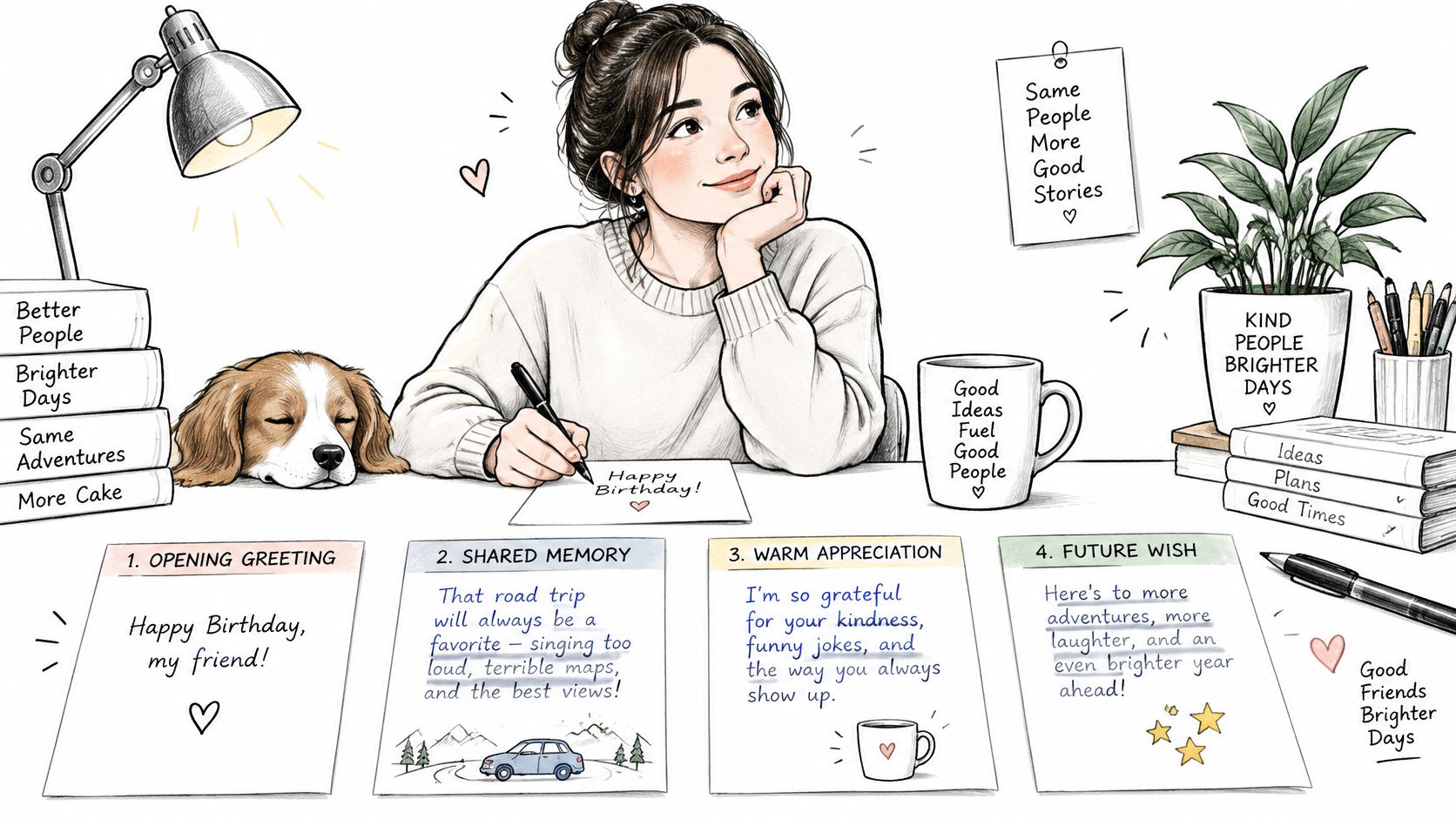
Start with something only you would mention
A shared memory gives the message its center. For a friend, that might be the road trip where you missed the exit but found a wonderful bakery; for a parent, it might be the calls they made while you were settling into a new home.
Use the name or relationship label you say aloud. If you call your sister Em, a formal greeting to Emily might feel oddly distant. Keep your usual sentence rhythm, too: short, straightforward sentences are better than elaborate language you'd never use.
Avoid stretching the relationship. A friendly coworker doesn't need a declaration of lifelong devotion, and a friend who dislikes teasing doesn't need a joke about getting older.
Personal detail and tone by relationship
| Relationship | Level of personal detail | Tone to aim for |
|---|---|---|
| Partner | High: a shared memory or private reference | Warm and a little playful |
| Parent | Medium: one specific thing they did for you | Sincere and grateful |
| Close friend | Medium to high: an inside joke or shared trip | Casual, humor allowed |
| Coworker | Low: one friendly, professional detail | Warm and brief |
| Distant relative | Low to medium: one memory or recent news | Polite and respectful |
Use drafting help without handing over the sentiment
An assistant can suggest openings or shorten an awkward sentence. Give it real ingredients, such as the bakery memory and your preference for understated humor, rather than asking it to invent closeness.
According to Grand View Research's U.S. greeting cards market report, 55% of surveyed consumers preferred unique, personalized messages over generic or AI-generated greetings. Treat suggestions as editable material, not a finished expression of your relationship.
For example, your final wording might read:
Happy birthday, Em! I'm still glad we missed that exit and found the bakery. Hope this year brings more good detours and another trip together.
For more starting points, browse these ideas for things to write in a birthday card, then replace general wishes with your own details. In our process, the customer writes and edits the inside message.
If you prefer watching a demonstration, use this video alongside your draft.
Keep the message compact enough to read comfortably inside the folded card. Before approving it, read it aloud and replace anything you wouldn't naturally say.
Handle Sensitive Milestones With Care
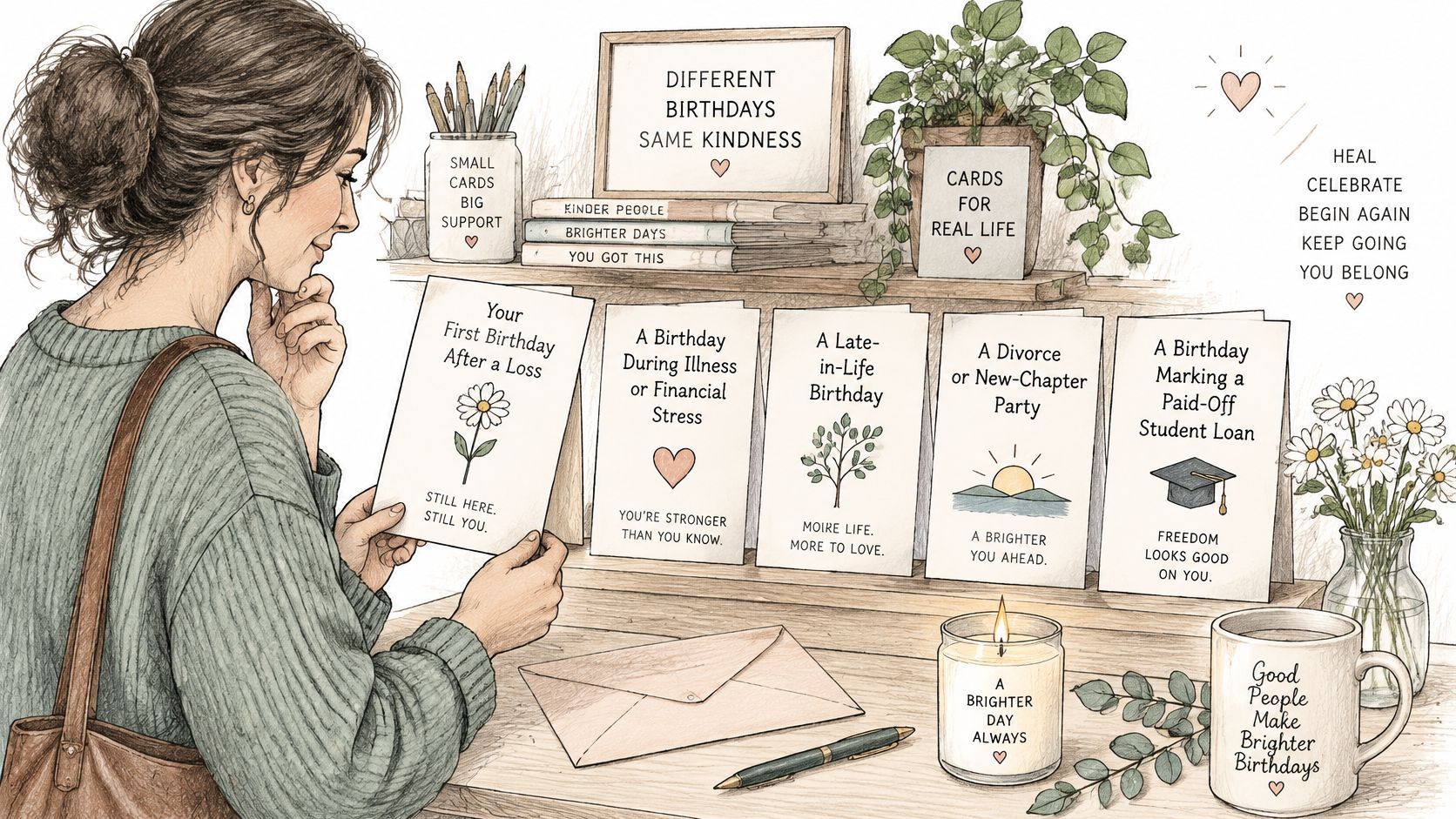
A birthday may arrive during bereavement, illness, financial strain, divorce, or a life change the recipient would rather not celebrate. It may also mark a recovery, a debt paid off, or a fresh start. Before choosing your words, consider what the person wants acknowledged. A birthday greeting does not have to turn their circumstances into a cheerful story.
Greeting cards can mark more than conventional celebrations. The wider range of occasions makes it even more important to choose a tone that respects the recipient, rather than relying on a standard birthday script. Start with the message, then choose artwork that supports its mood.
Acknowledge without prescribing a feeling
For a first birthday after a loss, a warm, low-pressure message might say:
I'm thinking of you today and of how you carried your family through this year.
Use wording like this only if it fits their experience. Praise for resilience can feel heavy to someone tired of being called strong. A simpler note may feel more supportive: “No fuss from me, I just wanted you to know I'm glad you're around.” During illness, a grounded wish for comfort or good company may suit better than a promise that everything will improve.
- Avoid forced positivity: Don't promise their best year yet when you can't know that.
- Skip appearance commentary: Weight, aging, and health aren't automatic birthday topics.
- Use humor with permission: Follow jokes the recipient already makes, not jokes you hope they'll tolerate.
- Separate worth from achievement: Marriage, parenthood, homeownership, and debt repayment aren't measures of a valuable life.
Customs and personal preferences differ. If you're unsure, keep the message short, specific, and kind. Ask yourself: Would this still feel kind on a hard day?
Choose Artwork That Fits the Card Format
Choose between a photo you supply, AI-generated artwork, and a catalog design according to what the message needs. A real photograph suits a shared memory. Custom artwork can celebrate someone's favorite hobby or pet, while a catalog design works when you want to spend your attention on the wording.
For a photograph, use a sharp, well-lit JPEG, PNG, or WebP file. Check the actual crop rather than assuming the whole image will fit. These tips for personalized greeting cards with photos can help you choose an image with room around the subject.
Artwork sources and what to check
| Artwork source | Best for | Check before approval |
|---|---|---|
| Photo you supply | Real memories, family and friends | Faces, edges and crop |
| AI-generated artwork | Recipients who love a theme, hobby or pet | Every detail and any stray text |
| Catalog design | Quick everyday birthdays | Message fit within the layout |
Fit the picture to the physical card
Our folded card measures 125 × 175 mm, approximately 4.9 × 6.9 inches, in portrait or horizontal orientation. Choose the orientation that preserves the subject: a wide photograph of a dog stretched across a sofa usually suits horizontal better than a tight portrait crop.
Keep the message in its own typeset layer, not generated inside the artwork. Review custom images for distorted paws, unexpected objects, or stray lettering before approval.
Postal space is a separate concern. For letter-size mailpieces, USPS barcode guidance defines a lower-right clear zone on the address side extending 4.75 inches leftward from the right edge and 0.625 inch upward from the bottom.
If your folded card travels inside an envelope, that postal constraint applies to the envelope's address side, not automatically to the decorative card front. A dog photograph can fill the card while the envelope remains plain and readable.
Before approving the artwork, confirm that the subject is visible, faces aren't cropped awkwardly, and the message is legible. Keep dense borders and graphics away from the mailing piece's postal clear area.
Check the Address Before You Pay
Build the recipient block separately from decorative artwork. Script lettering and textured backgrounds may look attractive on a card, but they introduce unnecessary ambiguity into an address.
The USPS guide to addressing mailpieces recommends a centered delivery address, left-justified lines, 10-, 12-, or 14-point type, all capitals, spaces between words, no punctuation, and adequate contrast.
Recipient block checks before mailing
| Element | Rule | Why it matters |
|---|---|---|
| Delivery address placement | Center of the envelope | Keeps the address where sorting equipment looks |
| Type size | 10, 12 or 14 point | Keeps characters readable |
| Capitalization and punctuation | All capitals, no punctuation, spaces between words | Simplifies machine reading |
| Contrast | Dark text on a light background | Avoids script lost in textured art |
| Return address | Include one | Lets undeliverable mail come back |
| ZIP code | Add ZIP+4 when available | Improves sorting accuracy |
Confirm the complete destination
For an apartment, verify the unit number against the recipient's actual mailing address. Don't guess a ZIP code or assume a recent move has been reflected in an old contact entry.
We deliver to all 50 U.S. states and Washington, DC. Confirm that the destination is supported before paying, especially for an address outside those areas.
Address check: A correctly spelled name doesn't compensate for a missing apartment number.
Use our guide to addressing a greeting card if you're unsure how to arrange the lines. Enter the destination into the ordering flow only after these checks pass.
How to Preview, Approve and Pay for Your Card
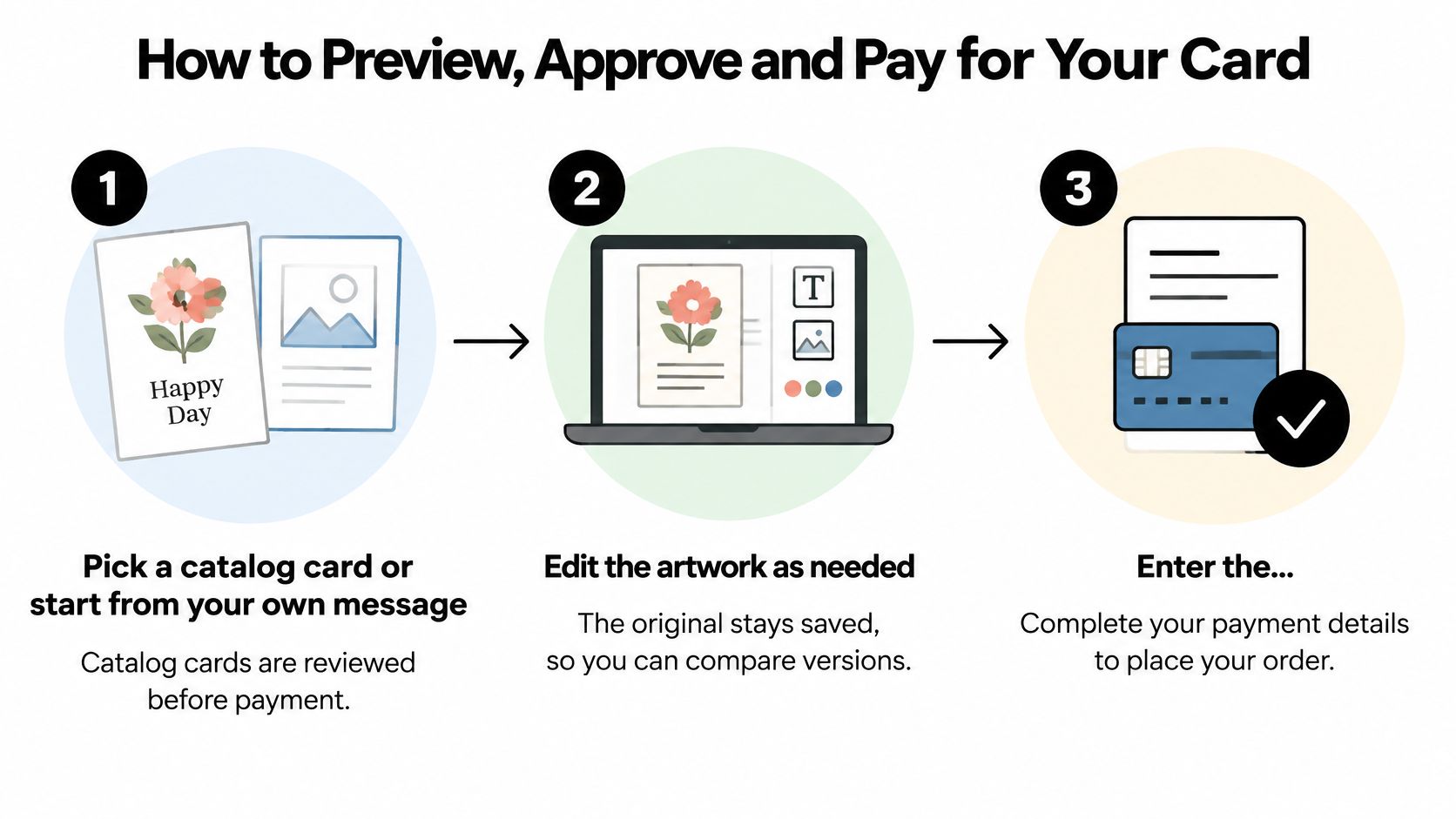
The preview is your production check, not just a picture of an idea. Inspect the exact version you intend to send, including the inside wording and recipient details.
Use the process visual as an overview, then complete the full approval sequence.
Complete the approval sequence
- Choose your starting point. Pick a catalog card or begin with your own message, knowing that catalog cards are reviewed before payment.
- Edit the artwork if needed. The original stays saved, so compare versions and choose the one that best suits your recipient rather than assuming the newest is better.
- Enter your final message. Confirm the name, relationship label, shared detail, and natural sentence rhythm, then remove anything inaccurate or overly intimate.
- Enter the checked recipient address. Confirm destination coverage and compare every line with your reliable address record, including any apartment or suite information.
- Open the full preview. Check the design, inside message, recipient, and total, including the applicable tax shown before purchase.
- Approve the exact card and address, then pay securely. You receive 20 free artwork generations without signing up or logging in, shared across your cards; after those are used, an optional pack of 20 more costs $1.00 plus applicable tax for the same card, paid at final checkout.
Buying artwork generations does not approve or send a card. Even after choosing an additional pack, you still need to inspect the full preview and complete approval and payment.
Make approval a deliberate pause
Custom artwork must receive your approval before a card can be sent. We print and mail only after you approve the card and complete payment, so treat approval as your last safe opportunity to correct a typo.
Check the preview at a comfortable viewing size. Look for a clipped signature, an unintended line break, a misspelled name, or an image detail you overlooked while concentrating on the message.
Approve what you can actually see, not what you remember asking for.
The selected artwork should match the version you intended to use, the recipient block should be complete, and the total should match your expectations. If any of those checks fails, return to editing rather than proceeding because you're nearly finished.
Delivery Timing and Damaged Cards
After payment and approval, Cardly handles printing and mailing. The fulfillment process includes packing, addressing, and handing the card to the postal service, so the approved preview is the reference for what should be produced.
Arrival windows are estimates, not guaranteed delivery dates. Work backward from the birthday using the estimated arrival window shown for your order, then leave extra margin for weekends and holidays. If the birthday is already close, don't mistake a quick checkout for guaranteed arrival.
Keep what you'll need for support
If the card arrives damaged, misprinted, or materially different from the approved preview, contact MailThisNow within 14 days of delivery with the order number and a clear photo of the issue. You can open a support request from the order page or email support@mailthisnow.com.
For example, if an address line is smudged, photograph the envelope clearly and include a picture of any damage to the card itself. Describe what differs from the approved version rather than just reporting that it looks wrong.
Keep the order number and approved preview saved so the issue can be checked against them.
Send Your First Card
Choose an upcoming birthday and someone you find easy to write to. A close friend with a shared memory is a gentler starting point than a complicated family relationship or sensitive milestone.
Write the message, select artwork that fits it, and inspect the finished preview before approving and paying. You can create and order directly on our website without using Muse.
Your first order gives you a practical way to evaluate the result: does the printed card match the approved preview, did it arrive when needed, and would you allow more mailing time next time?
- Message ready: The wording sounds like you and contains accurate details.
- Design ready: The crop, text, and selected artwork look right.
- Delivery ready: The complete address and supported destination are confirmed.
- Approval ready: You're satisfied with the exact preview and total.
Send only when every check passes. Preview and send a single card this week.
Mail This turns your wording and chosen design into a personalized physical card, with printing, an envelope, and domestic postage handled for you. Visit Mail This to create a birthday greeting card, review the exact preview, and approve it when you're ready to send.