A good Christmas greeting card isn't a broadcast. It's a folded paper note that tells one person they were chosen, remembered, and thought about by name. That simple job gets harder when the year was difficult, beliefs differ, or you aren't sure how close you're allowed to sound.
Start with the relationship, not the artwork. Choose your stance first, write one true sentence second, and only then lock the design, print file, and envelope. You'll avoid the two most common disappointments, a pretty card with empty words and a sincere message that's hard to read or late to arrive.
Table of Contents
- Why a Physical Christmas Card Still Matters
- Match the Greeting to the Person
- Wording When the Year Was Hard
- Inclusive Greetings That Stay Specific
- Design Rules for a Readable Printed Card
- Preview, Mail, and Confirm the Send
Why a Physical Christmas Card Still Matters
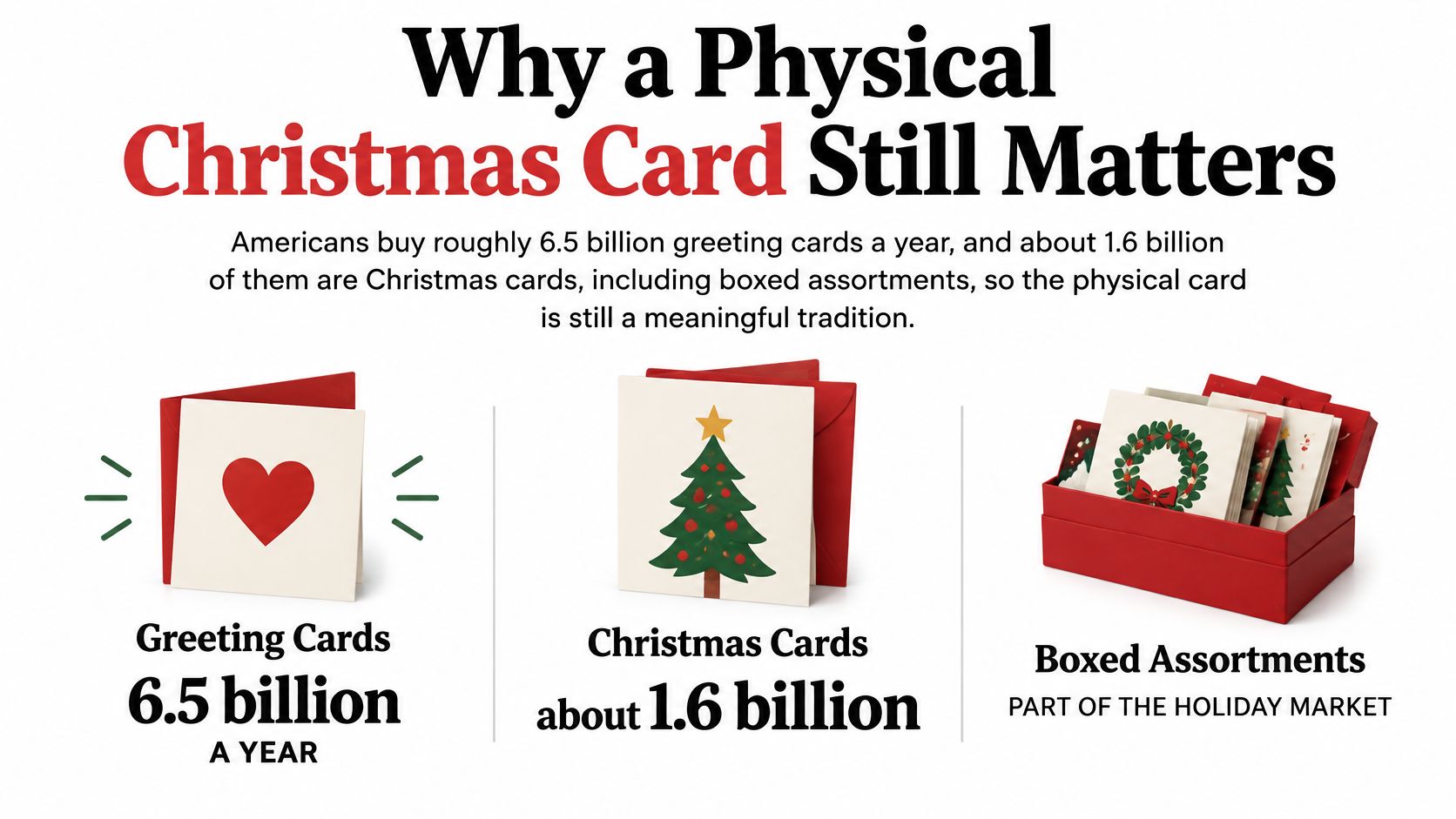
The Greeting Card Association fact sheet estimates Americans purchase approximately 6.5 billion greeting cards annually, including approximately 1.6 billion Christmas cards each year. That's not a fading niche. It's a mainstream habit that survives email, messaging, and social feeds because paper asks for a pause.
Most boxed cards work fine for routine greetings. Personalizing is worth your effort when a stock line would feel wrong, too cheerful, too religious, too distant, or too familiar. In those cases, the card's value comes from fit, not from elaborate art.
Four Decisions in Order
First, match the greeting to the person. Second, handle a hard year or mixed beliefs with care. Third, keep the words readable in print. Fourth, preview and mail the finished piece as a U.S. letter, working backward from the date you need it because delivery windows are estimates, not guarantees.
Match the Greeting to the Person
Choose your stance before you pick paper, photos, or fonts. The table gives you a starting level of closeness for each relationship, so you don't write a family letter to a client or a formal note to your sister.
| Recipient | Card approach | Greeting stance | How personal |
|---|---|---|---|
| Close family seen often | Folded photo or illustrated note | One shared memory plus Merry Christmas | High, one specific moment |
| Friends seen rarely | Short folded card | Two sentences of news and a warm close | Medium, no full year review |
| Coworkers, clients, and neighbors | Simple design | Kind and brief, no health or money news | Low |
| Grief, illness, or estrangement | Plain card | Thinking of you, no forced cheer, no ask for a reply | One careful sentence |
| Mixed belief or unknown tradition | Neutral seasonal art | Peaceful season or Happy Holidays plus one personal detail | Specific memory, no assumed custom |
| Children | Bright illustration | Their name and one concrete detail | Short and concrete |
Think of the card as a short doorway visit. The closer the tie, the more naturally you can step inside, mention a real memory, and use a direct greeting. A more formal or fragile tie calls for a briefer visit at the threshold, warm but not claiming closeness you don't have.
Reading Each Row
Close family seen often can carry one shared moment because you have plenty to choose from. Name the burnt pie, the driveway snowball fight, or the song everyone sang badly. One concrete memory plus Merry Christmas feels personal without turning into a newsletter.
Friends seen rarely need a small bridge across the gap. Two sentences of real news and a warm close are enough. A full year in review can read like a report, and it leaves the friend unsure what to answer first.
Coworkers, clients, and neighbors get kindness without private territory. Skip health, money, promotions, and family problems unless you already discuss them comfortably. A short, specific thanks or a sincere seasonal wish respects the boundary and still sounds human.
Grief, illness, or estrangement changes the greeting itself. Thinking of you is safer than a joke about a perfect holiday, and you shouldn't ask for a reply. The card offers presence, not a task.
A mixed-belief household or unknown tradition needs neutral seasonal language plus one personal detail. The neutral greeting avoids an assumption. The detail keeps the card from sounding like a slogan printed for everyone.
Children respond to what's concrete. Use the child's name and one thing you noticed this year, a lost tooth, a brave first recital, a drawing you kept. Short beats cute if the cute line could belong to any child.
If two rows fit, choose the more restrained one. Warmth doesn't require pretending a relationship is closer than it is.
Write the recipient's name and your chosen row on paper before you open any design tool. That one line becomes your filter for every later choice. If a draft sounds closer, louder, or more cheerful than the row allows, cut it back.
Wording When the Year Was Hard
A hard year doesn't make a Christmas greeting card inappropriate. It makes forced cheer inappropriate. The VistaPrint guide to physical Christmas card trends notes 42% of surveyed Britons said receiving a Christmas card signals that the sender made a personal effort, while 51% of senders included more than a generic “Merry Christmas.” Your extra sentence matters most when it tells the truth gently.
Four Lines You Can Adapt
For grief, try, "Thinking of you this Christmas. There's no need to write back." It names the season without demanding happiness, and it removes the pressure to perform gratitude. Readers who want deeper guidance can use this advice on what to say in a sympathy card before they finalize the wording.
For illness, try, "I'm sorry this year has been heavy. Wishing you comfort and rest." You're offering care without medical advice, predictions, or a request for updates. Don't promise recovery or praise someone for staying positive.
For little contact or estrangement, try, "I hope you're well. You crossed my mind, and I wanted you to know." It opens a door without reopening an argument. Don't use a holiday card to settle old scores or demand an explanation.
For money stress or a hard year, try, "Wishing you a gentle season. I'm glad to know you." You avoid asking how work or finances are going. You also avoid gifts, travel, and celebrations as measures of a good year.
Before You Print
Add a line about someone who died only if you already know it's welcome, such as, "We miss them too, and we're holding you close." If contact would cross a boundary the other person set, don't send the card. Silence can be kinder than a well written intrusion.
- Tone check: Does the line sound honest when you read it aloud?
- Privacy check: Could another person see the card and learn something private?
- Ask check: Does it request a reply, a visit, forgiveness, or reassurance?
An assistant can draft options, but you should reject any line that sounds warmer than you feel. Keep the sentence you'd still stand by in January.
Inclusive Greetings That Stay Specific
Swapping "Merry Christmas" for "Happy Holidays" is only the first move. Inclusion works when the greeting fits what you know and the personal sentence proves you wrote to that household, not to a mailing list.
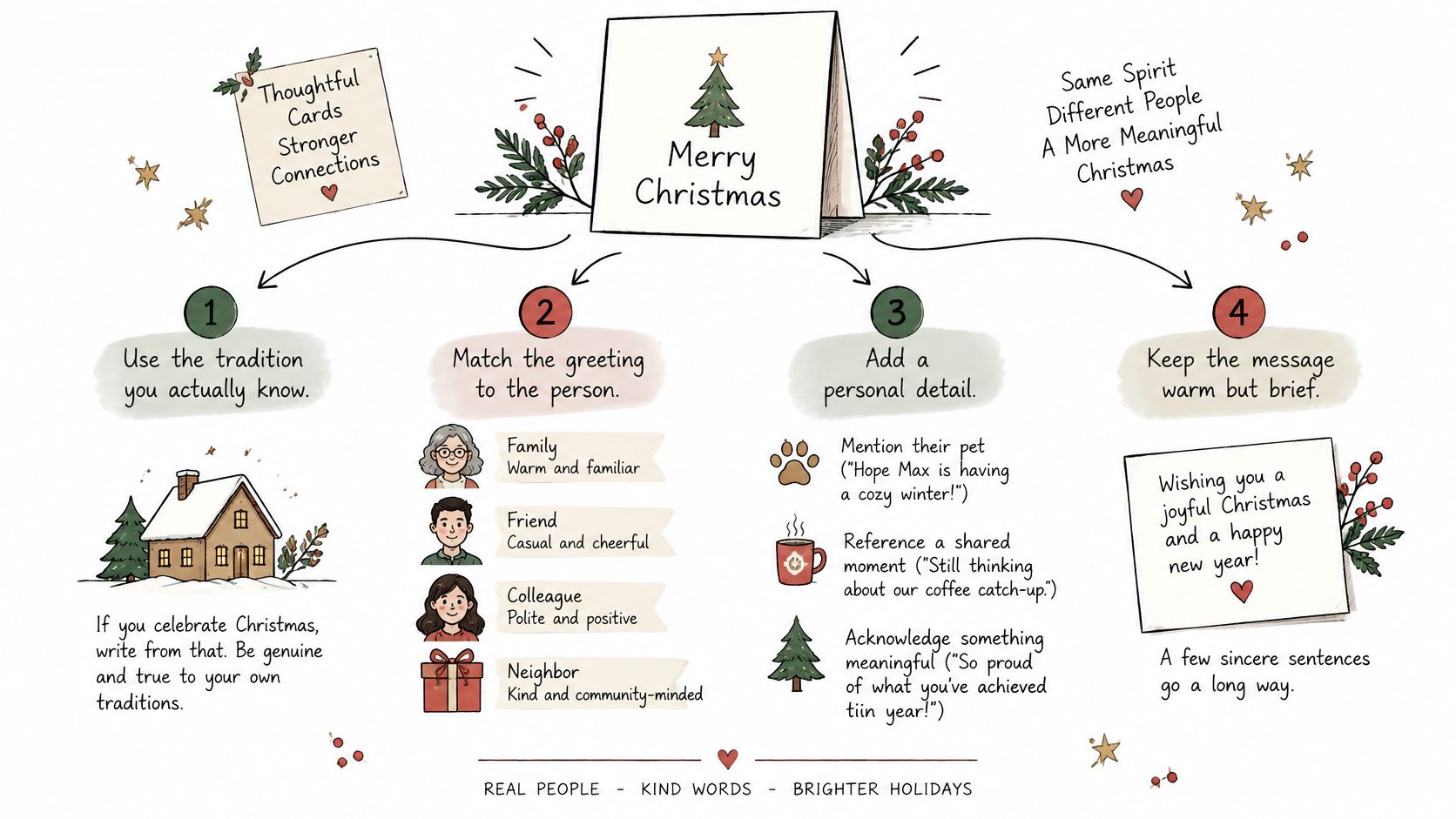
The holiday issue on greeting card trends reports 90% of U.S. households buy at least one greeting card annually, averaging 30 cards per year. Paper is still common. Your task is fit for the recipient, not abandonment of the tradition.
Four Practical Steps
Use the tradition you know. Say "Merry Christmas" to someone who celebrates Christmas. Use another holiday's name only when you know the person observes it, because a confident wrong guess feels worse than a careful neutral greeting.
Go neutral when you're unsure. "Wishing you a peaceful season" works across many households. Add one specific memory so the card doesn't shrink into a slogan, and check these holiday card sign off ideas if your closing feels stiff.
Don't assume the household. Avoid assuming a spouse, children, religion, gender, or shared customs. Address the people you know by name and leave unconfirmed family details out.
Check other languages with a fluent speaker. If you add Spanish, French, or another language, don't trust a word for word translation for idioms or forms of address. A short greeting checked by a speaker beats a longer one that sounds translated.
Watch how the personal half stays steady while the greeting changes.
For a known Christmas household, write, "Merry Christmas, Maya. I still laugh about the burnt cookies." For an interfaith or unknown household, write, "Wishing you a peaceful season, Maya. I still laugh about the burnt cookies." The memory does the personal work. One true detail beats a broader holiday slogan every time.
Design Rules for a Readable Printed Card
Treat the illustration and the greeting as two layers, the way a poster separates a photo from a caption. Generated images can warp letters, change spelling, merge characters, or lose contrast against a busy background. Your approved sentence shouldn't live inside that risk.
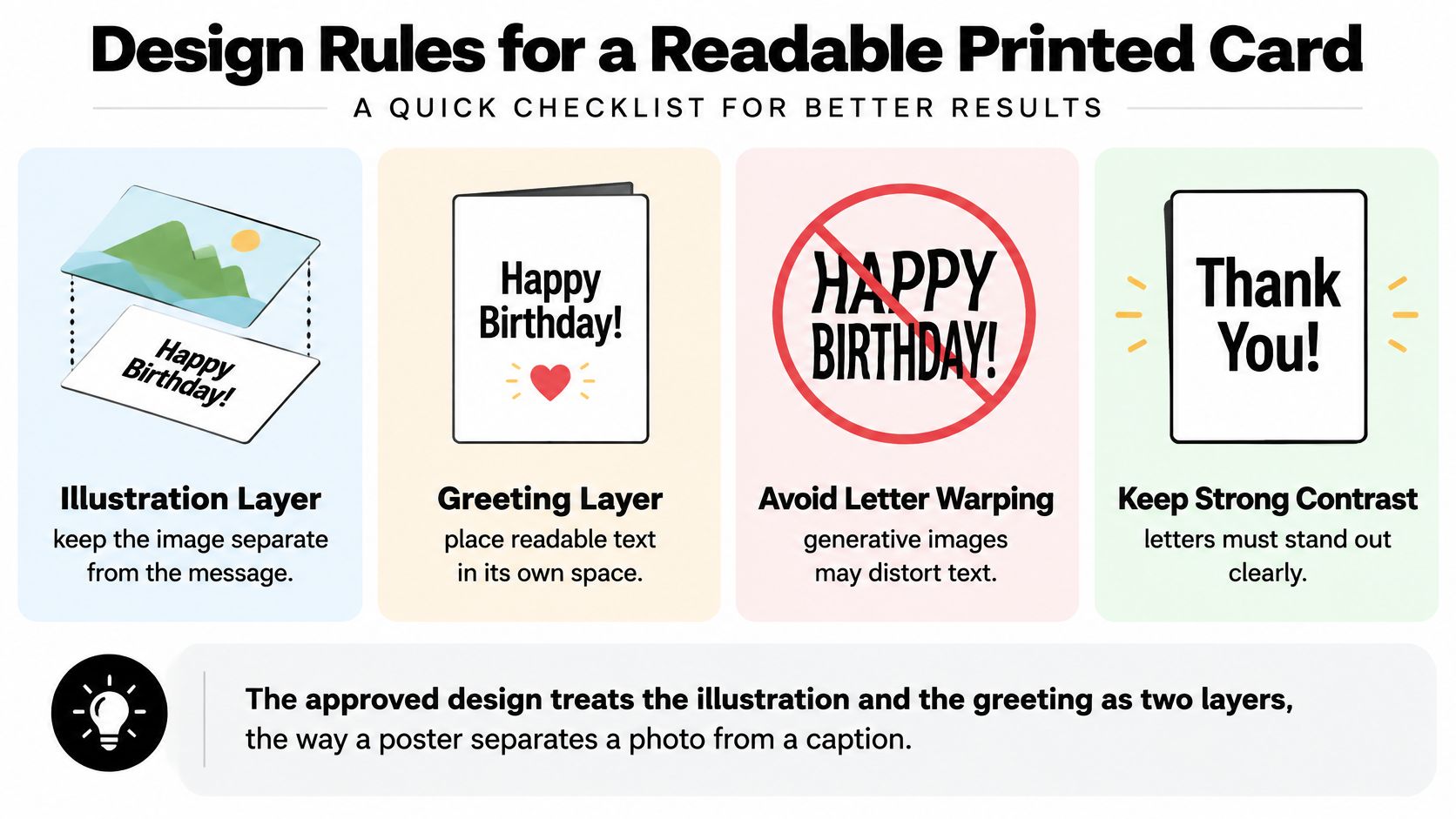
Keep the artwork as the image layer and typeset the message separately. That split keeps spelling, wording, and legibility under your control while the illustration can still vary. It also lets you compare the exact approved sentence with the final typeset text before payment.
Print Specs for a Folded Card
| Item | Target | Why it matters |
|---|---|---|
| Finished folded size | 125 × 175 mm, about 4.9 × 6.9 in | Portrait or landscape folded card |
| File resolution | About 300 ppi, roughly 1476 × 2067 px before bleed | Enough detail for print |
| Image file | JPEG, PNG, or WebP | Raster artwork only |
| Message | Separate typeset layer, editable until preflight | Stops warped or misspelled image text |
| Bleed | Extra margin set by the print vendor | Keeps edges from clipping |
Build a 125 × 175 mm Christmas greeting card at about 300 pixels per inch, roughly 1476 × 2067 pixels before bleed. Add the bleed your print vendor specifies. Use JPEG, PNG, or WebP for the artwork, and keep the message editable until final preflight so a corrected name doesn't require rebuilding the picture.
The Text Safe Area
Reserve a predictable band for words, with plain contrast behind the type. Keep font size, line spacing, margins, and color treatment consistent in portrait and horizontal layouts. Don't let branches, snow, faces, or patterned wrapping paper compete with the sentence.
Check the image layer for three faults before approval. Look for clipped edges, low resolution that turns soft at print size, and stray words hiding inside the art. Stray image text causes the worst confusion because the reader sees two messages and trusts neither.
Readable first: If you can't read the greeting at arm's length in the preview, the artwork is too busy or the type is too light.
Finish with three choices that help any recipient. Use one photo or one illustration, not both competing. Leave a margin wide enough for a thumb to hold the folded card. Skip hairline script that thins out or vanishes along the fold.
Preview, Mail, and Confirm the Send
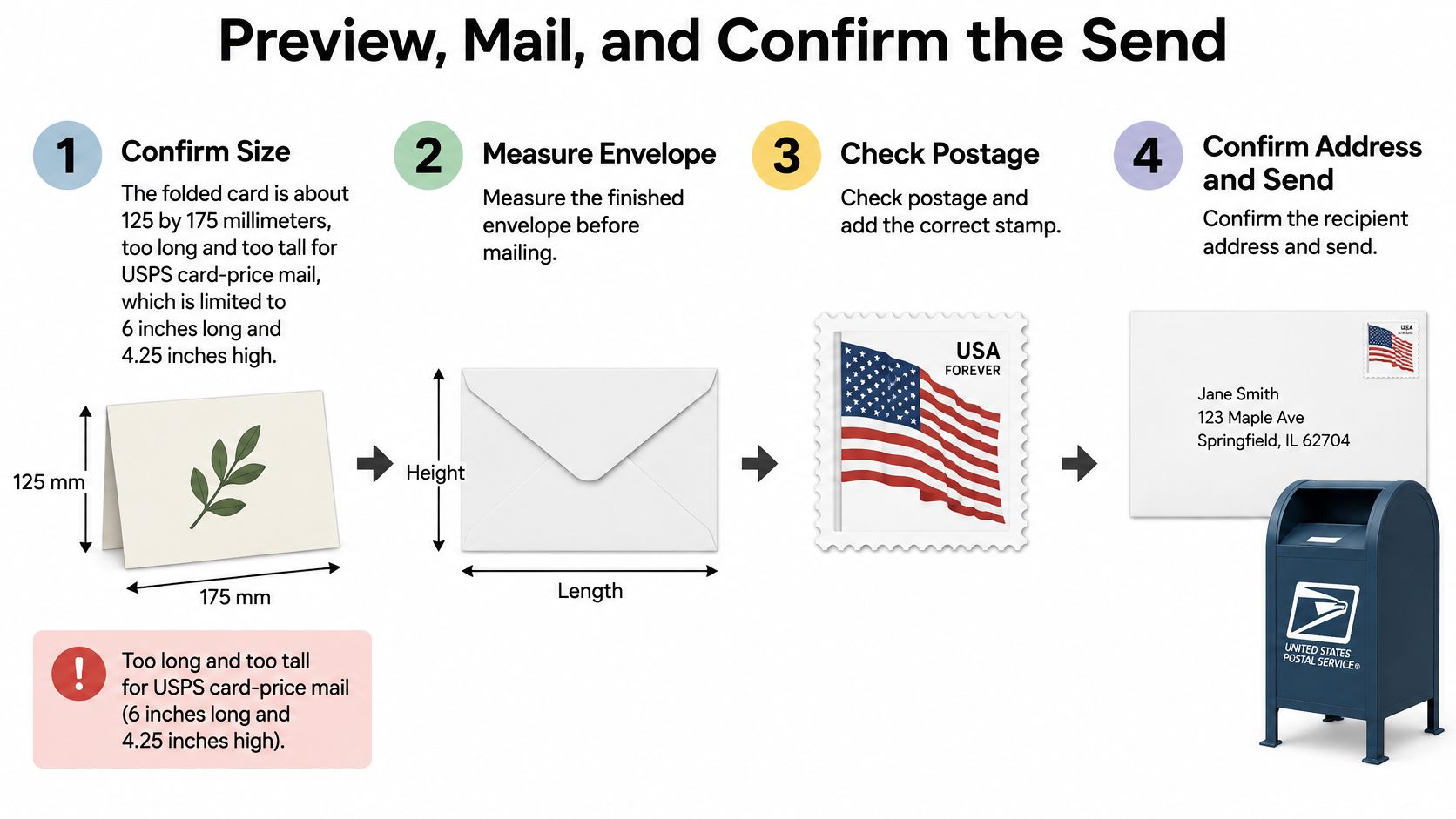
Measure the finished envelope, not your intention. The USPS guide to designing letter and card mail sets card price mail at no more than 6 inches long, 4.25 inches high, and 0.016 inch thick, so a 125 × 175 mm folded card belongs in an envelope mailed as a letter.
| Rule | Measurement | What to do |
|---|---|---|
| Card-price maximum | 6 in long, 4.25 in high, 0.016 in thick | Do not use card price; this card is larger |
| Letter maximum | 11.5 in long, 6.125 in high, 0.25 in thick | Keep the envelope inside these limits |
| Minimum thickness | 0.009 in when longer than 6 in or higher than 4.25 in | Check thickness after inserting the card |
| Maximum letter weight | 3.5 ounces | Stay under with card and envelope only |
| Shape | Rectangle, parallel sides, square corners | Avoid bulky closures and uneven decoration |
Five Steps Before Release
- Confirm the size: The folded card is about 125 × 175 mm, too long and too tall for card price mail.
- Use a rectangular envelope: Keep it within letter limits, at least 0.009 inch thick at this size and no more than 3.5 ounces.
- Protect even thickness: Leave out rigid inserts, lumpy gems, bulky closures, and thick coatings, then measure after inserting the card.
- Preview the piece: Check the art, exact typeset sentence, recipient address, and total with tax, using this guide to sending a card in the mail if any step feels unclear.
- Approve only on a match: Release the card for printing, packing, and postage only when all four preview items are right.
Work backward from the date you need the card because an arrival window is an estimate, not a guaranteed date. Confirm coverage before paying. Mail This reaches U.S. states and Washington, DC, but not New York State, U.S. territories, or military addresses, and it charges $9.99 per card with envelope and domestic postage included, tax shown before payment, and production handled by Cardly.
End with one choice, send, wait, or switch paths. If the person, place, sentence, and preview all match, send it. If the wording still feels false or the address is outside coverage, don't approve it yet.
Write your one true sentence, confirm the person and destination, and approve the exact preview before anything prints. Visit Mail This to turn that sentence into a personalized folded card that's printed, addressed, and mailed for you within the United States.