It's 4 p.m., your sister's birthday is tomorrow, and you're staring at your phone. You could send a digital card in two minutes and know she'll see it tonight. Or you could send something she can open, prop on her desk, and keep. That tension, speed versus something tangible, is exactly why searching for a Paperless Post alternative gets confusing. Most comparisons rank templates. The better question is what job your message needs to do.
Table of Contents
- Choosing Between Instant and Tangible Messages
- Why the Format Choice Matters
- Compare the Main Alternatives
- What Mail This Adds to Physical Cards
- Pricing, Delivery, and Coverage Trade-Offs
- How to Choose the Right Service
- Which Option Fits Each Occasion
Choosing Between Instant and Tangible Messages
Take a common week. On Monday you need to confirm dinner details for twelve people. On Wednesday you want to thank a colleague who covered for you during a family emergency. On Friday you remember a friend is struggling and you'd like to encourage her. Those three messages look similar in an app, but they don't need the same delivery promise.
The dinner needs immediate confirmation. People must see the time, reply, and flag allergies. A delayed card, however beautiful, fails that job. The thank-you is different. Nobody's waiting on logistics. What matters is that your colleague feels noticed, and a physical card she can keep in a drawer carries weight a notification rarely does.
The encouragement note sits in between. You want her to feel remembered today, not next week. That's where a hybrid approach earns its place, a quick digital message now and a mailed card that arrives as a lasting follow-up.

A Simple Framing Before You Compare Features
Judge every option on six things together, not templates alone.
- Delivery timing: Does it need to arrive now, or can it arrive meaningfully later?
- Recipient experience: Will they tap a link, or open an envelope?
- Permanence: Should this disappear into a feed, or stay on display?
- Personalization: Can you use your own photo, wording, and tone?
- Effort: Who handles printing, addressing, and postage?
- Reliability: What can fail, an inbox filter or a wrong address?
Practical rule: Choose digital when someone must act. Choose physical when someone should feel remembered. Use both when you need action now and meaning later.
If you're unsure which category your occasion falls into, browsing different types of greeting cards and when to send them helps sort birthdays and sympathy notes from event logistics. Don't treat a digital invitation and a mailed greeting card as interchangeable versions of the same product. They're different tools, and picking the wrong one is usually a format mistake, not a design mistake.
Why the Format Choice Matters
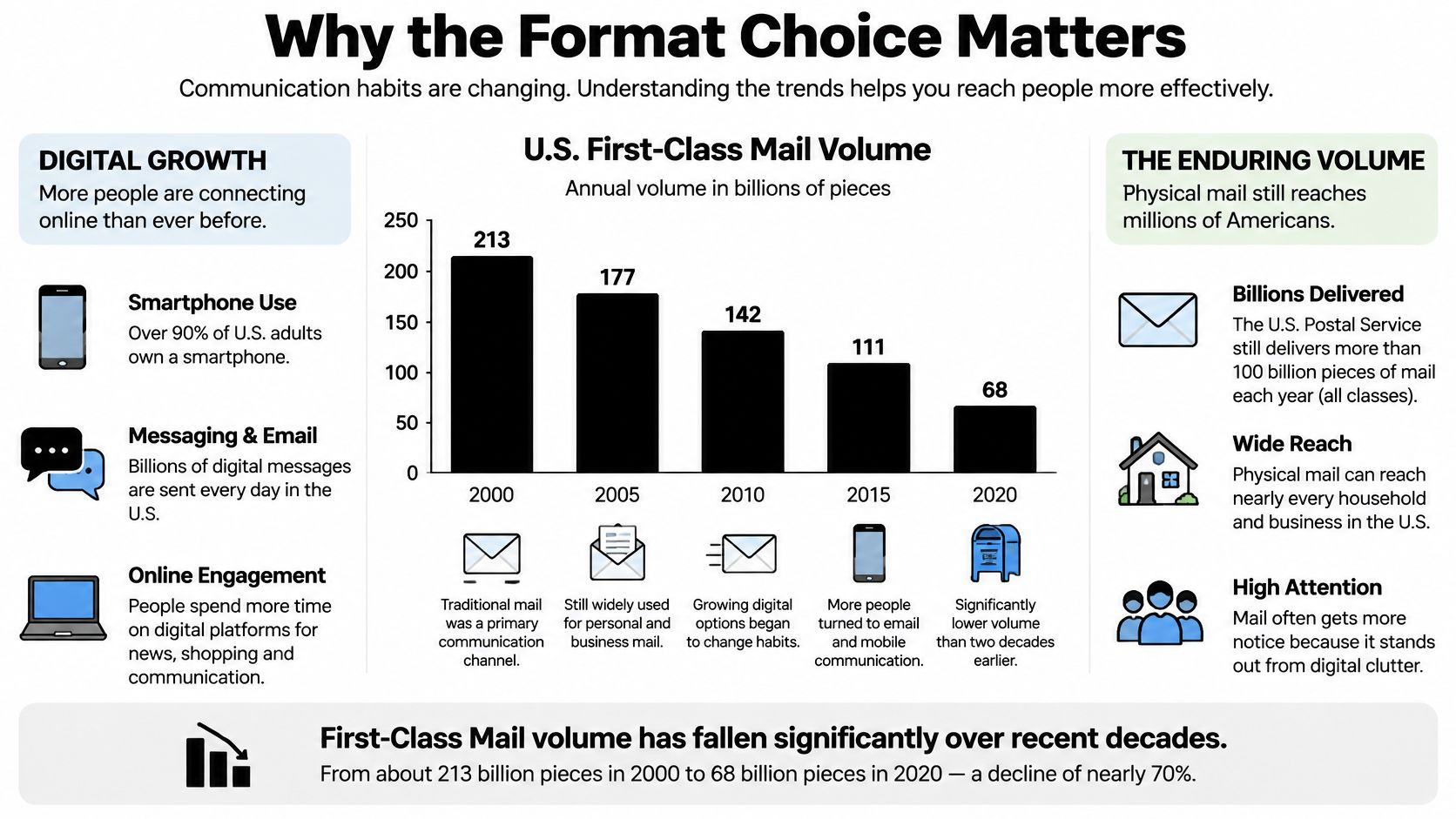
Digital communication isn't a fad layered on top of unchanged mail habits. It's grown during a long, structural decline in letter mail. First-Class Mail volume, covering letters, postcards, and large envelopes, fell 50% from 92 billion pieces in fiscal year 2008 to 46 billion in fiscal year 2023, according to the Postal Service Office of Inspector General. That report notes the steepest drop came in transactional mail like bills and statements as people adopted electronic billing.
That context matters because it explains why paperless options feel inevitable. For anything transactional, time-sensitive, or tied to a response, digital delivery won for good reasons. Nobody wants to mail an RSVP card when a tap works.
Physical Cards Did Not Disappear With Transactional Mail
Greeting cards tell a different story. Commercial production began around 1860, and industry estimates cited by Britannica put U.S. household purchases at approximately 7 billion cards annually during the 2010s, with retail sales exceeding $7.5 billion. Birthday cards led everyday sales, and Christmas cards dominated seasonal sales. That's not a dying category. That's a durable habit digital tools grew alongside.
Recipient preference explains part of that durability. In a 2023 U.S. survey of 2,000 adults, two-thirds preferred receiving a physical card, including 62% of Millennials and 59% of Gen Z. More than half still mailed cards rather than sending them digitally. Don't assume younger recipients automatically want a link.
The Real Distinction
Digital formats remove friction for the sender. Physical cards preserve something for the recipient, a keepsake that signals deliberate effort. When you search for a Paperless Post alternative, you're often trying to recover one of those qualities without losing the other. The right answer depends on whether your message is primarily logistics or primarily connection. Invitations with headcounts lean digital. Birthdays, thanks, sympathy, and encouragement often lean physical, because the object itself is part of the message.
Compare the Main Alternatives
Start with the delivery promise, not the template gallery. A digital invitation platform promises speed, tracking, and a response path. A physical card workflow like Mail This promises a printed, addressed, posted object. Comparing them only on design or price hides the trade-offs you will feel.
Digital and Physical Card Decision Criteria
| Criterion | Digital Invitation or Message | Physical Card Workflow |
|---|---|---|
| Delivery speed | Arrives almost immediately after sending | Requires production and postal transit |
| Recipient action | Built for RSVPs, links, and updates | Built for reading, keeping, and displaying |
| Keepsake value | Lives in an inbox or app | Physical object the recipient can revisit |
| Personalization | Templates, photos, and event details | Personal wording, photos, or custom artwork |
| Approval control | Preview of a screen-based design | Preview of the final printed card before payment |
| Failure mode | Spam filtering, missed notifications, poor mobile rendering | Wrong address, unsupported destination, postal delay |
| Cost structure | Often scales by guests, features, or subscription | Per-card price that can include envelope and postage |
| Follow-up visibility | Opens, clicks, and RSVP status | Order status and estimated arrival window |
That failure-mode row deserves your attention. Digital delivery doesn't guarantee attention just because sending is instant. Physical delivery doesn't guarantee arrival on a specific day just because you paid for postage. Each format moves risk to a different place, and a good sender manages the risk that matches their choice.
Where Each Format Clearly Wins
Pick digital first when you need immediate confirmation. Event changes, headcounts, directions, and last-minute reminders belong on a phone screen. You'll see who opened it, who replied, and who needs a nudge.
Pick physical first when permanence is the point. A sympathy card, a milestone birthday, or a thank-you after a major favor shouldn't compete with notifications. The recipient should be able to hold it, reread it, and keep it without logging in anywhere.
- Digital strength: Speed plus measurable response for logistics-heavy messages.
- Physical strength: Emotional weight plus a lasting object for personal messages.
- Shared requirement: Clear personalization and a preview you check before sending.
Don't declare a universal winner. A Paperless Post alternative should be judged against the occasion in front of you, and honest comparisons admit that mailing a card to manage a guest list is as wrong as texting a link to express condolences.
What Mail This Adds to Physical Cards
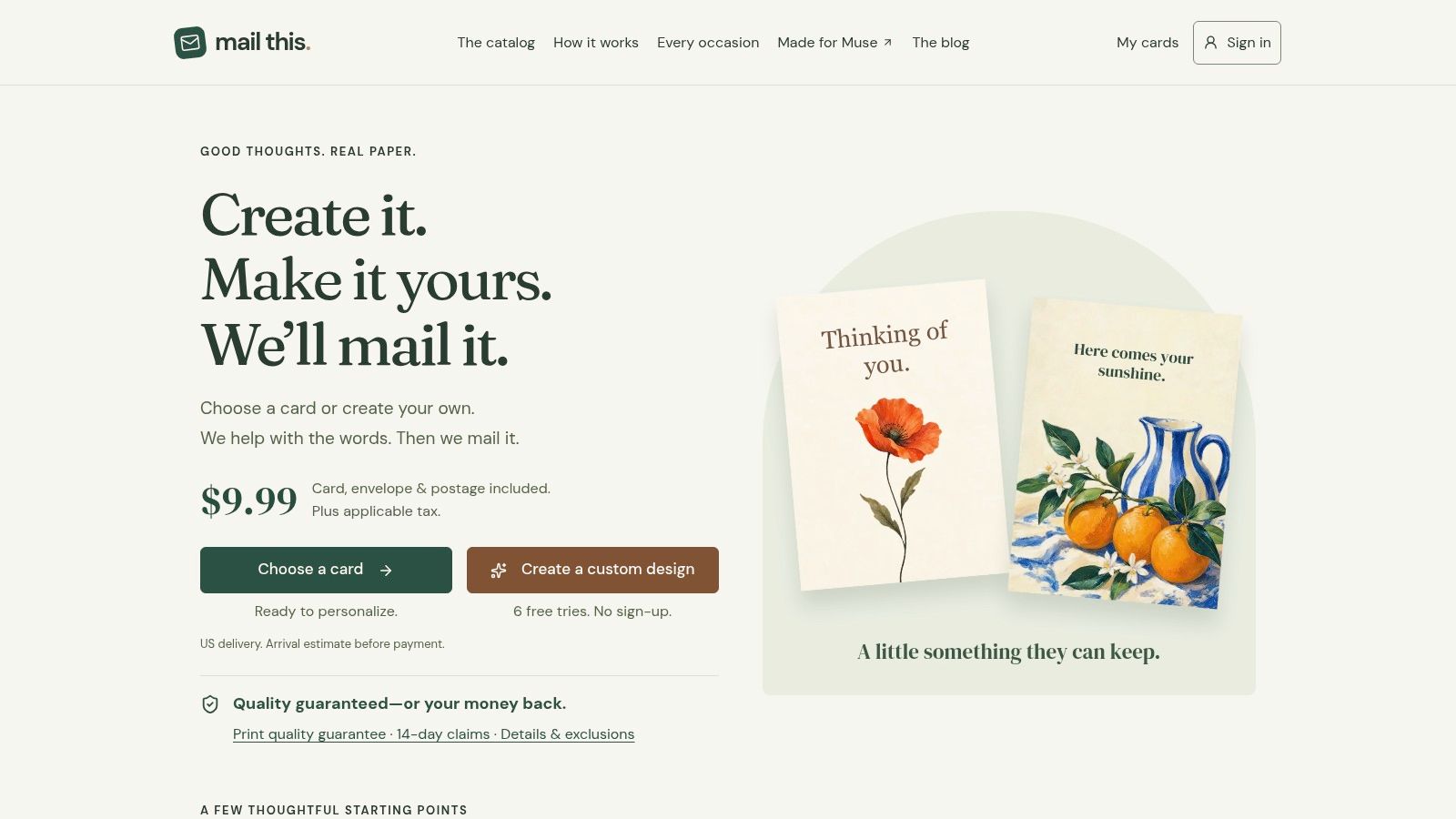
Mail This is a physical greeting card service that starts in conversation with an AI assistant and ends with a printed card in the U.S. mail. Invitation platforms with a print option work backward from a digital guest list; this one works forward from the card itself, and that difference shapes every step from drafting to approval.
From Short Intent to Approved Card
You begin with a concise intent, such as thanking a neighbor or cheering up a coworker. The assistant turns that into candidate wording and artwork, so you edit a draft instead of facing a blank card. Supply your own photo when a shared memory carries the message, or use AI-generated artwork when a fresh illustration fits better.
The feature I'd check first is separate typesetting. Your message is typeset independently from any text inside generated artwork, protecting the exact wording you approved and avoiding the garbled lettering image generators often produce.
Before payment, you see a full preview of the final card. JPEG, PNG, and WebP uploads are supported, and folded cards are planned at 125 × 175 mm in portrait or landscape. Nothing sends until you confirm the design, recipient, and total. That approval step carries real weight here, because a mailed card can't be recalled, corrected, or deleted the way a digital message can.
If you're deciding how much customization is worth the effort, this guide to building a custom greeting card from your own words and images shows where personal photos outperform generic designs.
What Happens After You Approve
Cardly handles fulfillment: printing, packing, addressing, and handoff to the postal service. You never buy stamps, hunt for an envelope, or drive to a mailbox. That removes the production friction that usually stops people from mailing cards at all.
Set expectations correctly on maturity. The connector API and hosted preview flow are available for testing within the Muse ecosystem, and directory availability remains subject to platform review. Treat this as early access built around approval control rather than a finished mass-market app. The practical differentiator is simple: creative help up front, explicit sender approval in the middle, and handled fulfillment at the end.
Pricing, Delivery, and Coverage Trade-Offs
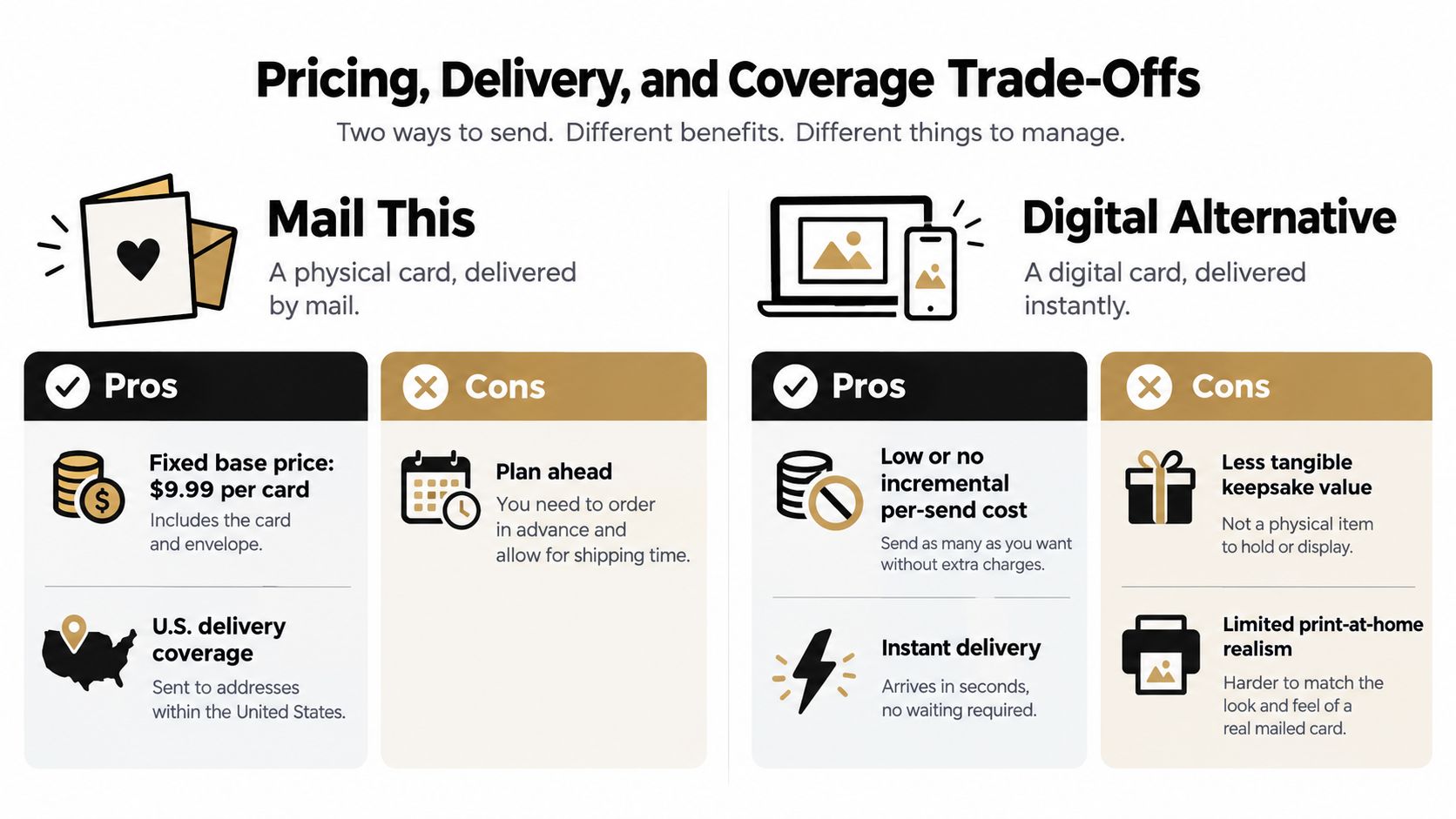
Physical and digital options ask you to manage completely different operational problems. With Mail This, the base price is $9.99 per card, including the envelope and domestic postage, with applicable tax shown upfront before you pay. Optional custom artwork generations are offered separately, with one free after sign-in and additional packs available after card prepayment, so keep the add-on distinct from the base card price when you compare totals.
Digital alternatives shift costs around instead. Pricing may vary by guest count, premium design, or subscription, and the core work becomes configuration. You're managing lists, reminders, and delivery settings rather than postage.
Inbox Risk Versus Postal Latency
Digital isn't frictionless. One industry summary citing Validity's 2025 benchmark reported that 83.5% of marketing emails reached the inbox globally, and 47% of recipients opened event emails on mobile devices. If you send digitally, keep the primary RSVP action prominent on small screens and track delivery separately from opens. An open isn't a completed response.
Physical mail avoids inbox placement and rendering problems, but it introduces production and postal latency. Mail This provides an estimated arrival window and order status visibility, and there's no guaranteed delivery date. Plan backward from the occasion. If the date can't move, digital confirmation should carry the deadline.
Coverage Boundaries You Must Check First
Coverage is a hard constraint, not a footnote. Delivery covers U.S. states and Washington, DC, but New York State is currently not supported, and U.S. territories and military addresses aren't supported either. Verify the destination before you spend time perfecting artwork. Senders who are new to mailing should also review the practical steps for sending a card in the mail correctly so address formatting doesn't become the weak link.
Treat postal delivery as a scheduled physical process, not a notification. Proof everything, confirm eligibility, and leave realistic time.
How to Choose the Right Service
Use four questions in order. Don't start with design, because design can't fix a wrong format decision. Answer fully and the choice between digital delivery, Mail This, or a hybrid workflow becomes obvious.
Question One Through Four
1. How soon must the recipient receive or respond? If someone needs details today, or you need a headcount this week, choose digital. Speed and response tracking aren't optional features there, they're the entire job. If the occasion is days away and no reply is required, physical mail stays in play.
2. Does the occasion call for a keepsake? Ask what you want the recipient to do after reading. Tap a button, or keep the card? A condolence note, a milestone birthday, and a heartfelt thank-you gain meaning from being held and reread. A parking update doesn't.
3. How much personalization and control do you want? Decide whether a template with your name inserted is enough, or whether you want your own photo, exact wording, and artwork made for one person. The more specific the message, the more approval control matters.
4. What constraints apply? Check destination eligibility, your budget per recipient, and how much delivery visibility you need. A physical card to an unsupported address isn't a thoughtful gesture. It's a failed order.
Final Checks Before You Send Anything
- Confirm the address: Ask the recipient or a mutual contact rather than trusting an old contacts entry.
- Read the exact message aloud: You'll catch tone problems and typos that silent proofing misses.
- Inspect artwork text: Make sure any words inside an image are legible and intentional, separate from your typeset message.
- Count backward from the date: Allow production and postal time for physical cards, and send a digital note if timing gets tight.
- Match follow-up to format: Track RSVPs digitally, and check order status for mailed cards instead of assuming arrival.
If your answers split, go hybrid. Send the digital message for certainty now, then mail the card for meaning. That's not indecision. It's using each channel for what it does best, which is the whole point of evaluating a Paperless Post alternative carefully.
Which Option Fits Each Occasion
Match the format to the delivery promise you need to make. Consumer research supports splitting the decision this way, since digital products are favored for instant delivery by 70% of respondents, while nine in ten Americans look forward to receiving personal letters and greeting cards. Urgency and emotional significance pull in opposite directions, so let the occasion decide which one wins.
Go Digital First for Logistics
Use digital delivery for time-sensitive event communication. That covers invitations needing RSVPs, venue changes, reminders, and anything guests will pull up on a phone while traveling. You get speed, update broadcasts, and visible responses. A printed card doing this job adds delay and gives you no reliable way to confirm who saw the change.
Digital also wins for same-day acknowledgments. Heard good news an hour ago? React now, and follow with something tangible later if the moment earns it.
Go Physical for Messages People Keep
Choose a physical workflow for birthdays, thank-you notes, sympathy, and everyday encouragement. These messages succeed when the recipient feels remembered, and a card on the kitchen counter keeps working for days. Mail This fits when you want that result without store trips or design skills, and when approving the exact final wording and artwork before printing matters to you. Confirm the destination is covered before you commit, since a thoughtful card to an unsupported address becomes a failed order.
- Birthdays: A personal photo and a specific memory beat a generic digital animation.
- Thank-you notes: Tangible effort reinforces genuine gratitude after a gift, favor, or interview.
- Encouragement and sympathy: A rereadable card respects that the recipient may process it slowly.
- Gift accompaniment: A mailed card arrives as its own thoughtful object when you can't be there.
Use a Hybrid When Both Needs Are Real
Weddings, milestone parties, and distant family occasions usually carry both needs at once. Run confirmations, directions, and RSVP tracking through the digital channel, then send the physical card as the meaningful follow-up that lands later and stays. The catch is postal latency. Order the mailed piece early enough that it arrives near the date, not weeks after it.
Paperless solves sender convenience. Tangible mail solves remembered thoughtfulness. Pick based on the job, not the trend.
If your message deserves to be kept rather than tapped past, Mail This helps you draft wording and artwork with an assistant, approve the exact final card before paying, and have it printed, addressed, and mailed for you within the United States. Start your next birthday, thank-you, or everyday card and send something your recipient can hold.