Birthday cards have been around since approximately 1850, according to the historical overview of the birthday card. Yet the last words can still be the hardest to write. Choosing between Love, Cheers, and Best wishes isn't really a vocabulary problem. It's a decision about what your relationship means, and what you want the recipient to hear.
Table of Contents
- Choose a Sign-Off That Matches the Relationship
- Test the Tone Before You Write
- Write One Personal Line Above the Sign-Off
- Name Formats That Leave No Doubt
- Handle Grief, Divorce and Estrangement Gently
- Make the Card Readable and Send It With Confidence
Choose a Sign-Off That Matches the Relationship
Birthday cards account for more than half of greeting cards sold in the United States, and about two-thirds of birthday cards are mailed, according to the Greeting Card Association's industry facts. On paper, your closing sits beside your name without your voice or facial expression to soften it. Choose wording that can stand on its own.
Sign-offs and tone by relationship
| Relationship | Sign-off | Signature | Tone |
|---|---|---|---|
| Close friend | Love, or a shared in-joke sign-off | Nickname or first name | Playful and warm |
| Partner or spouse | Love always | First name | Personal and affectionate |
| Parent or grandparent | With love and hugs | First name or Your grandchild | Warm and sentimental |
| Sibling or cousin | Love, or Miss you | First name or nickname | Teasing allowed |
| Coworker who is also a friend | Cheers, or Happy birthday | First name | Friendly, light humor |
| Boss or senior colleague | Best wishes | First name | Polite and brief |
| Acquaintance or neighbor | Warm wishes | First name | Short and neutral |
| New romantic interest | Enjoy your day | First name | Warm, no declarations |
| Former partner | Wishing you well | First name | Kind, brief, no pet names |
These are defaults, not obligations. A sibling you rarely speak to may need a less affectionate closing than a neighbor who has become a dear friend. A partner who dislikes sentimental language might prefer your usual affectionate nickname to Love always.
Practical rule: Match the closing to the closest relationship you both recognize, not the warmest feeling you happen to have while writing.
Adjust for the setting
Say your boss has been especially supportive. Best wishes, Dana acknowledges the professional relationship without making the card unexpectedly intimate. Put your appreciation in the sentence above it rather than changing the closing to Love.
A coworker who's also a close friend presents a different choice. Cheers, Dana fits a shared office card; Love, Dana may fit a personal card you give them privately. The audience matters as well as the recipient.
Move toward a warmer closing when affection is already mutual and expressed. Move toward a more neutral one when a friendship has become distant, the relationship is new, or you're unsure whether familiar language is welcome. You don't need to announce that adjustment.
If you're weighing whether affection will feel natural, this guide to signing a card with love can help you make that distinction. Find the recipient's row, choose the closing, then write a personal line above it.
Test the Tone Before You Write
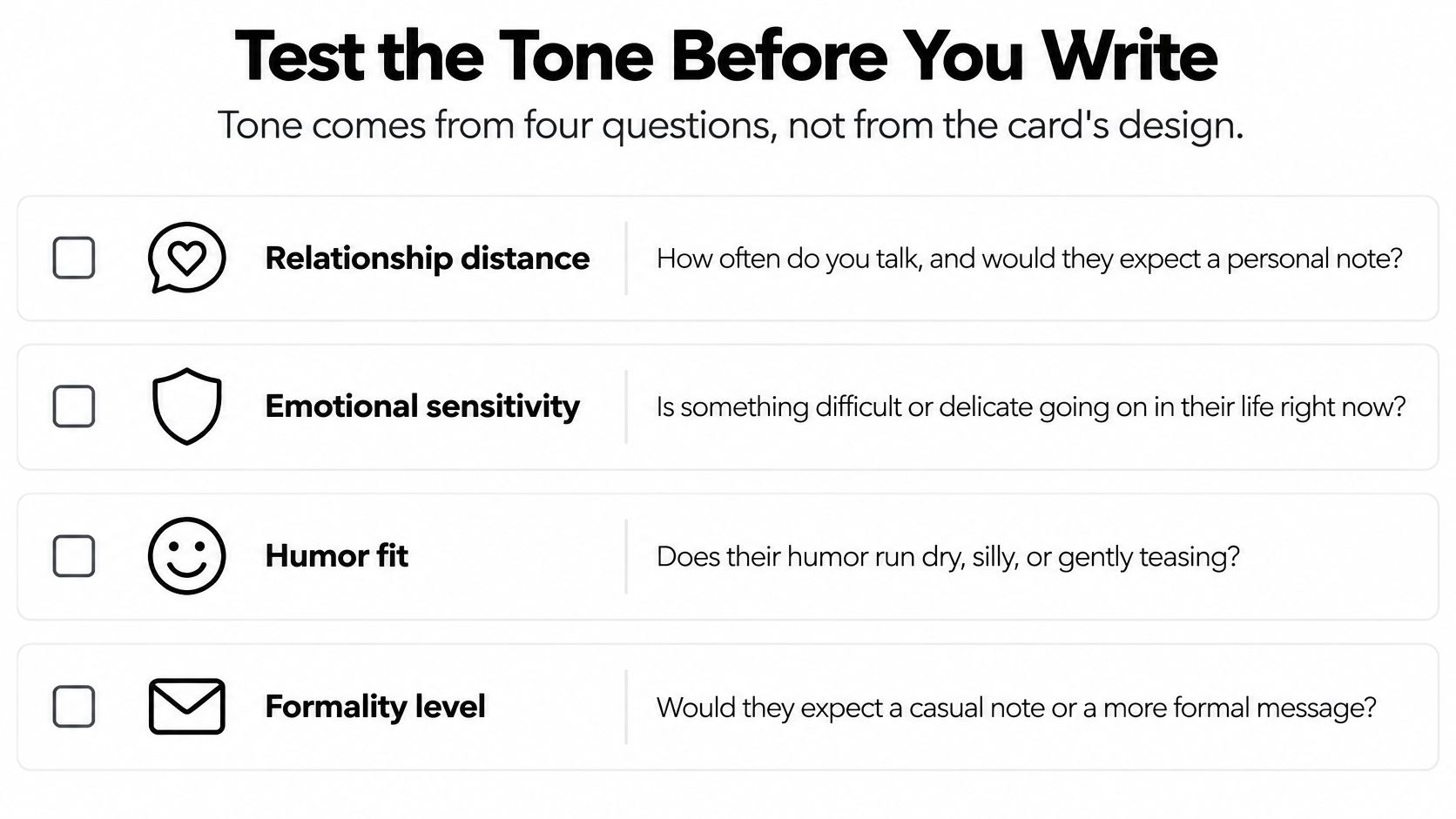
A glittery card doesn't require a bubbly message, and a joke on the front doesn't give you permission to tease. Tone comes from your knowledge of the recipient, not the design you picked.
Use these questions before committing anything to ink.
Ask what the message will imply
Relationship distance. How often do you talk, and would they expect a personal note? Apply this test: would the message sound natural if you said it during your next conversation? For someone you greet occasionally in the hallway, Warm wishes is easier to receive than a declaration of lasting friendship.
Emotional sensitivity. Is something painful or uncertain happening? Ask whether your wording requires them to feel cheerful. If a friend is having a difficult week, a gentle wish for a peaceful day leaves more room than an instruction to have the best birthday ever.
Humor tolerance. Do they enjoy this particular kind of joke, and do they joke back? A colleague who sends you silly memes might enjoy a playful reference to their fiercely guarded birthday cake. That doesn't establish permission for jokes about their body, age, or personal life.
Commitment. Are you saying that you care, or that you remembered? Read the closing without the rest of the card. If Forever yours would imply more than you intend, choose something lighter rather than hoping the recipient won't notice.
Use their habits rather than an age formula
Consider a hypothetical colleague turning thirty who regularly trades memes with you. A light joke and Cheers can fit that existing exchange. You don't need to become sentimental just because you're writing on paper.
Now consider an aunt turning seventy who sends long, thoughtful letters. A slogan and your name may feel abrupt; a sentence recalling your garden walks gives her something personal to enjoy. The useful clue isn't the birthday number alone, but how each person already communicates.
Before you sign, name the feeling you want to leave behind: appreciated, remembered, loved, amused, or gently supported.
If you can't choose that feeling, the sign-off isn't ready. Decide what you mean before polishing how it sounds.
Write One Personal Line Above the Sign-Off
Start with the feeling, then choose a concrete detail that supports it. A shared memory, hobby, nickname, or planned outing gives you more to work with than a string of flattering adjectives.
Keep the method simple enough that you'll use it.
Build the note around something real
- Identify the relationship and purpose. Are you expressing warmth, gratitude, affection, or respect?
- Choose your detail. Pick something the recipient will recognize immediately, without a lengthy explanation.
- Name the occasion. Happy birthday, Ravi is a perfectly good opening.
- Connect the detail to a wish. Hope your summer ferry trip brings you the quiet afternoon you've been looking forward to.
- Add the closing. Use wording that sounds like something you'd say, followed by your recognizable name.
The detail doesn't have to be profound. Remembering someone's enthusiasm for a trip can feel more personal than calling them an extraordinary human.
Replace praise with recognition
For a friend, you might write:
Happy birthday, Ravi. Hope your ferry trip includes calm water and a very generous snack bag.
Cheers,
Dana
For a manager, keep the appreciation specific without turning the card into a performance review:
Happy birthday, Lena. Thank you for keeping our launch meetings calm. I hope you get a restful day.
Best wishes,
Dana
For a partner, an ordinary shared ritual can do the work: Happy birthday. Breakfast at our favorite diner is still my favorite way to start a day with you. Love always, Dana.
Avoid stock wishes about unlimited joy or another adventure when you can name something real. For more starting points, use these birthday card notes, then replace the general wording with your own detail. A brief note is enough when it says something only you could say.
Name Formats That Leave No Doubt
Your signature should answer a basic question: Who sent this? A beautifully chosen closing won't help if the recipient has to examine the envelope to work out which Alex remembered their birthday.
Use the name they know you by, then add context only where it helps. Familiarity matters more than how impressive or elegant the signature looks.
Signature format by situation
| Situation | Signature format | Example | Watch for |
|---|---|---|---|
| Close friend | First name or nickname | Jo | Use only a nickname they already use |
| Coworker you rarely talk to | First and last name | Priya Shah | A full name may feel formal, but prevents confusion |
| Family with the same surname | First name only | Mark | Add a family line for group gifts |
| Team or group card | All signers' names | Ana, Ben and Lily | Order by closeness or alphabetically |
| Child signing their own card | First name and optional age | Lily (age seven) | A parent line is optional |
| Card sent for a child | Parent names plus child | Mom, Dad and Lily | Use parental names only if the recipient knows them that way |
| Recipient who may not know you | Full name plus connection | Sam Lee, your neighbor | Explain the connection briefly |
Initials alone are a gamble unless the recipient already associates them with you. A nickname works beautifully between close friends, but not if it requires the recipient to remember an old story before identifying the sender.
Make shared signatures genuinely shared
For a couple sending a card together, place both names on the same line or give them equal space. Don't squeeze the second name into a corner as an afterthought. Use a closing that represents both senders, especially if they have different levels of closeness to the recipient.
For a team, write a short collective line, such as Birthday wishes from the studio team, followed by the signers' names. Alphabetical order is useful when there's no obvious personal order; it avoids suggesting a hierarchy.
A child can make their own mark or write their first name, with a parent adding a clear identification underneath. If an adult writes the whole card on a child's behalf, make that clear rather than inventing an elaborate message in the child's voice.
Finish in this order:
- Write the message first so you know who the card speaks for.
- Add the chosen signature with enough room for every sender.
- Read it as the recipient would, without relying on the envelope.
- Clarify unfamiliar names with a surname, family line, or brief connection.
Handle Grief, Divorce and Estrangement Gently
The warmest closing isn't always the kindest. During a difficult birthday, affectionate language can accidentally create pressure to celebrate, reconcile, or reassure the sender.
Industry coverage from Convenience Store News Canada notes that younger consumers may prefer fewer words or no prewritten verse, while older consumers may welcome longer, more sentimental messages. Treat those as possible preferences, not rules. In a sensitive relationship, the recipient's circumstances and boundaries should carry more weight than a conventional birthday formula.
Choose language that doesn't demand a response
Grief. The risk is insisting on happiness when someone is missing a person they love. Thinking of you on your birthday leaves room for mixed feelings. Add your name or an established affectionate closing; for a fuller acknowledgment of loss, consult this guide to what to say in a sympathy card.
Estrangement. The risk is making a birthday greeting feel like a request for reconciliation. Wishing you a good day. Dana can acknowledge the occasion without asking for anything. If the person has requested no contact, respect that boundary rather than treating a birthday as an exception.
Divorce or separation. The risk is using a signature that no longer reflects the household. Sign only for the people sending the card, and leave out unsolicited news about an ex-partner.
Illness. The risk is making the birthday about symptoms, recovery expectations, or forced optimism. I hope today is kind to you offers care without predicting how they'll feel.
A changed name or gender transition. The risk is using an outdated name or disclosing information unintentionally. Use the recipient's current name and pronouns, and privately confirm what's safe on the envelope if others may see their mail.
Aging. The risk is assuming they share your amusement about getting older. Replace an age joke with a wish connected to something they enjoy, such as an afternoon in the garden.
Keep your own needs out of the closing
A useful boundary: A birthday card can offer care without asking the recipient to define the relationship.
Avoid slipping in a request to call, forgive, explain, or resume contact. Even a gentle closing can become loaded when followed by a sentence about how long you've been waiting.
Read the card's printed verse before signing it. If it contradicts the restraint you need, choose another card rather than trying to undo it with a handwritten qualification. Finally, ask whether your wording would still feel considerate if the situation changed next month.
Make the Card Readable and Send It With Confidence
Readability is part of personalization. A message doesn't succeed just because it looks attractive to the sender; the recipient needs to be able to read it, understand it, and identify who it's from.
The DataIntelo personalized cards market report identifies photo-based and customized formats as growth drivers. That makes a useful practical distinction: tailoring the artwork is only part of tailoring the card. The layout and wording also need to suit the person receiving it.
Make the words easy to use
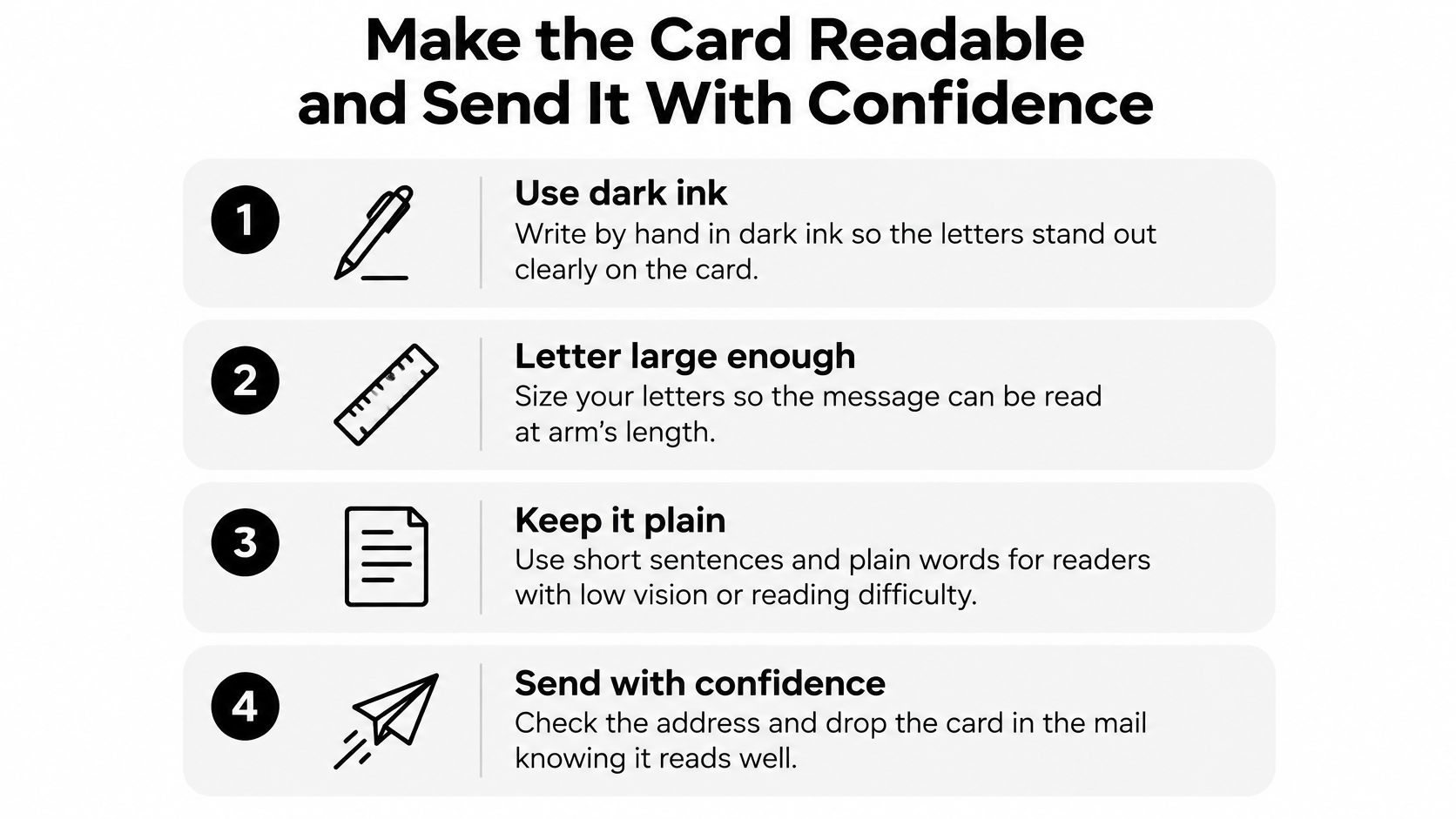
- Write in dark ink. Choose black or dark blue on a pale, uncluttered background. Metallic pens and pale ink may look decorative but can be difficult to distinguish from the paper.
- Give letters room. Write large enough to read comfortably at arm's length, then adjust for the recipient's known needs. Don't shrink the last lines just to fit an oversized message.
- Keep sentences plain. Use familiar words and direct wishes. If interpretation may be difficult, skip sarcasm and wording whose meaning depends on hearing your tone.
- Choose a clear typeface. Use an uncomplicated font for the message. Reserve decorative script for a short signature, and add a clearly printed or typed name if that signature is hard to decipher.
- Let photographs remain visible. Keep front-of-card wording brief instead of covering faces or meaningful details. For a recipient with low vision, add a short description inside, such as The photo shows us beside the lake after our picnic.
- Use the recipient's preferred language thoughtfully. A brief greeting in that language can be welcoming if you can verify the wording. Don't rely on an unchecked translation for an intimate or sensitive message.
An inside joke can be meaningful, but it shouldn't make the whole card impossible to understand without explanation. Keep the main birthday wish clear even when you add a playful reference.
If you're preparing a card digitally, inspect the preview at its intended print size rather than judging it only while zoomed in. Check that the message has space around it and that no letters disappear against the artwork.
Check the message and the destination separately
A touching note and a deliverable envelope require different checks. The USPS addressing guidance recommends clear, legible address printing and complete address details. Confirm the apartment or suite information, street direction, and ZIP code instead of assuming a familiar name will compensate for an incomplete destination.
Before sending:
- Read the message aloud at a normal pace. Notice any phrase you wouldn't naturally say.
- Cut or clarify ambiguous wording. Remove a joke or implication that needs an explanation.
- Confirm names and pronouns. Check every proper name against information you trust.
- Test independent readability. Ask whether this recipient could read and understand the finished card without help.
At Mail This, you write and edit the inside message, choose the design, and approve the exact card and delivery address before paying securely. We print and mail it after approval and payment, so review the final wording rather than relying on an earlier draft.
The best birthday sign-off is one the recipient can read, understand, and recognize as coming from you.
Turn your wording into a personalized physical birthday card with Mail This. Choose a design, edit your message and sign-off, and approve the finished card and delivery address before payment. We'll handle the printing and mailing.